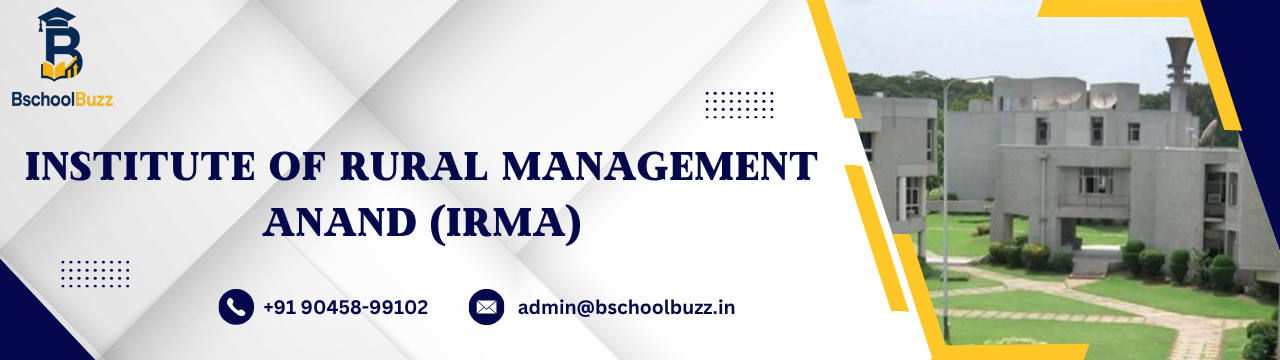
About Institute of Rural Management Anand (IRMA)
Know the institute, its legacy and what makes it stand out.
Legacy and Vision
Founded in 1979 by Dr. Verghese Kurien, the father of India’s White Revolution, the Institute of Rural Management Anand (IRMA) stands as one of India’s most prestigious public management institutions. Established under the aegis of the National Dairy Development Board (NDDB), IRMA was created to professionalize the management of rural institutions and cooperatives driving rural development.
The institute’s vision is “to promote equitable and sustainable socio-economic development of rural people through professional management.”
Over four decades, IRMA has produced leaders serving in the cooperative, development, and corporate sectors who focus on social impact along with profitability.
IRMA’s unique pedagogy emphasizes rural immersion, sustainability practices, and ethical governance—qualities that make its graduates pivotal agents in inclusive growth across India.
Academic Excellence
IRMA’s flagship Post Graduate Diploma in Management (Rural Management) focuses on applied management principles aligned with socio-economic, agrarian, and cooperative sectors. The curriculum integrates:
Core management disciplines (finance, marketing, operations, organizational behavior)
Rural policy frameworks and governance
Sustainable development and environment management
Business analytics and rural marketing experiments
Students spend over 8 weeks in Village Fieldwork Segment (VFS) for immersion in rural realities, followed by academic projects and internships in leading organizations.
Each program underlines the need for creating empathetic yet efficient managers committed to sustainable business practices across multiple sectors.
Faculty members include domain experts, researchers, and thought leaders crafting solutions to real-world issues like microfinance, climate adaptation, women empowerment, and rural digitalization.
Research, Consultancy, and Collaborations
IRMA actively collaborates with institutions such as the World Bank, NABARD, ILO, UNICEF, and ICSSR. Each year, students and faculty publish research contributing to national development agendas.
The institute is also affiliated with academic partners like Wageningen University (Netherlands)and University of Fribourg (Switzerland).
IRMA’s specialized centers include:
Centre for Sustainable Livelihoods
Centre for Social Entrepreneurship
Centre for Management of Agriculture and Rural Finance
Campus and Infrastructure
Spread over 60 acres, the campus of IRMA in Anand fosters an environment of learning and collaboration. Designed to embody sustainability, the campus offers:
Modern Classrooms: Digitally enabled, air-conditioned, equipped for hybrid learning.
Knowledge Centre: State-of-the-art library with 70,000+ titles, 6,000 e-journals, databases like EBSCO, JSTOR, and Emerald.
Residential Hostels: Fully furnished single-occupancy rooms; compulsory residential system ensuring immersive experience.
Computer Lab & Wi-Fi: 24x7 infrastructure powered by 500 Mbps connectivity and advanced analytics tools.
Cooperative Mess and Canteen: Operated by students to promote self-management.
The campus also houses sports grounds, amphitheatre, gymnasium, gymkhana, and recreational spaces.
Student Life and Extracurriculars
IRMA’s student ecosystem emphasizes corporate readiness and community building. Around 30+ committees and clubs operate, including:
RME (Rural Management Enthusiasts Club)
Kalpavriksha (Entrepreneurship Cell)
IRMA Volleyball League (ISL)
Students host events like Roshni – National Management Conclave and Jatra – Cultural Fest.
Community immersion activities allow IRMAns to directly engage with grassroots organizations and social enterprises.
College Highlights
Important Dates 2026
Key deadlines and upcoming events
| Event | Tentative Date |
|---|---|
| Application Window Opens | November 2025 |
| IRMA Registration Ends | January 10, 2026 |
| Shortlisting for WAT/PI | February 2026 |
| Written Ability Test + Personal Interview | February 17–22, 2026 |
| Final Result Announcement | March 2026 (4th week) |
| Fee Payment Deadline (First Installment) | Within 4 working days |
| Academic Session Commences | June 2026 |
See college life in action
Explore the campus, student life and placement stories.
Campus Tour
Life at Campus
Placements & Alumni
Student Experiences
Courses Offered 2026
Programs and specializations available
1. PGDM (Rural Management):
Flagship two-year full-time residential program combining business management learning with rural development applications.
Students learn topics like cooperative management, social entrepreneurship, and microfinance.
2. Fellow Programme in Management (Rural Management) – FPM:
Doctoral program aimed at training researchers and policymakers in sectors like rural governance, sustainable development, human resource systems, and economics.
3. Executive PGDM (Rural Management):
One-year program designed for working professionals in development or public sectors seeking managerial upskilling.
4. Short-term Certification Programs:
Continuing education courses offered in microfinance, social impact leadership, project appraisal, green finance, and agri-value chain management.
Admission Process 2026
Eligibility, selection process and how to apply
Step 1: Eligibility
Bachelor’s degree in any discipline with minimum 50% marks (45% for SC/ST/DAP).
Final-year undergraduate students are eligible to apply conditionally.
Step 2: Entrance Examinations
Accepted Exams: CAT 2025, XAT 2026, CMAT 2025 (for Indian Nationals); GMAT/GRE (for NRI & foreign applicants).
Step 3: IRMASAT Shortlisting
Candidates with valid entrance scores are shortlisted for the IRMASAT (IRMA Social Awareness Test) followed by Written Ability Test (WAT) and Personal Interview (PI).
Step 4: Evaluation Parameters
CAT/XAT/CMAT – 35% weightage
IRMASAT – 15% weightage
WAT & PI – 40% weightage
Academic Record, Work Experience, Diversity – 10% weightage
Step 5: Admission Confirmation
Selected candidates receive offer letters and secure their seats after fee and document submissions.
Fees Structure 2026
Program fee and other expenses
| Components | Year 1 (₹) | Year 2 (₹) | Total (₹) |
|---|---|---|---|
| Tuition Fee | 6,80,000 | 6,80,000 | 13,60,000 |
| Hostel, Mess, and Misc. | Included | Included | — |
| Deposit (Refundable) | 30,000 | — | — |
| Application Fee | 2,000 (Gen) / 1,000 (SC/ST) | — | — |
| Total Course Cost | — | — | ₹13.60 Lakhs |
Scholarships are provided for merit and need-based categories including SC/ST, minority, and BPL students.
Placements 2026
Recruiters, packages and placement highlights
Key Highlights (Batch 2023–25)
| Parameter | Data |
|---|---|
| Placement Rate | 100% |
| Highest Package | ₹53.00 LPA |
| Average Package | ₹14.17 LPA |
| Median Package | ₹15.00 LPA |
| Total Recruiters | 130+ |
| Offers Extended | 322 |
Top Recruiters
Deloitte, ITC, Amul, Adani Wilmar, ICICI Bank, HDFC Bank, KPMG, Flipkart, NDDB, Samunnati Financials, Mother Dairy, and Spandana Sphoorty Financial.
Sector Split
BFSI: 33%
FMCG/FMCD: 15%
Consulting: 12%
Development / NGO: 15%
Agri-business and Cooperative Sector: 25%
Internship Highlights
100% placement in summer internships, median stipend ₹45,000/month.
Highest stipend ₹1,70,000 (per internship period).
Internship recruiters included Amul, NABARD, Adani Group, PwC, and the Ministry of Rural Development.
Alumni and Industry Connect
IRMA’s alumni network exceeds 3,800 professionals holding key positions in organizations such as NDDB, NABARD, SEWA, ITC, Deloitte, and Azim Premji Foundation.
They actively mentor students via the IRMA Alumni Interaction Series, contributing to professional and personal growth.
Key Advantages of IRMA
Legacy of Impact: Founded by Dr. Verghese Kurien, architect of India’s Milk Revolution.
Exclusivity: Nation’s only management institute dedicated to sustainable rural development.
High ROI: Average ₹14.17 LPA for ₹13.6L total fee.
Government-Backed: Supported under MoEFCC & NDDB.
Social Responsibility: Curriculum integrates ethics, gender sensitivity, and environmental consciousness.
Innovation: Field-based learning and village immersion make it unique from urban-focused MBAs.
Global Recognition: Affiliated with top universities internationally.
Ratings & Reviews
Real experiences shared by students of Institute of Rural Management Anand (IRMA).
Your review can help future students make a better decision.
Studied here?
Tell students about your experience.