
Quick Summary
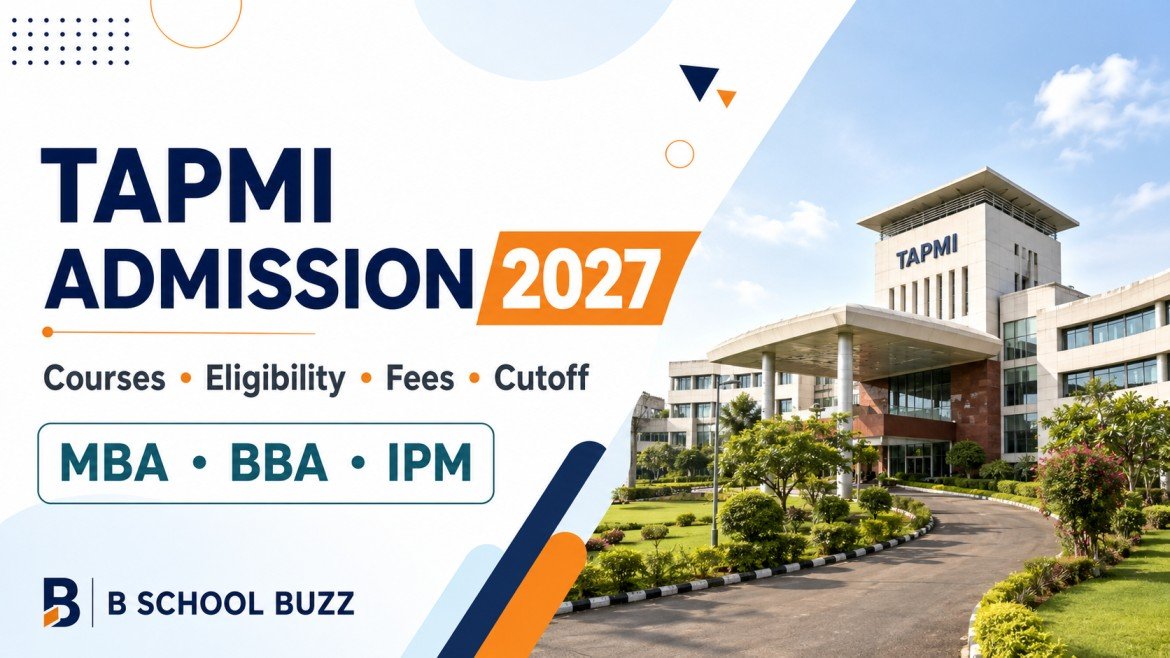
- TAPMI Admission 2027 is expected to consider CAT, XAT, GMAT or NMAT scores for MBA programs, while BBA and IPM applicants undergo entrance tests, interviews and micro-presentations before final selection.
TAPMI admission 2027 will cover entry to the institute’s MBA, BBA Honors, Integrated Program in Management and doctoral programs. MBA applicants are expected to use CAT 2026, XAT 2027, GMAT or, for eligible sectoral programs, NMAT scores. Undergraduate applicants are likely to be considered through IPMAT, JIPMAT, JEE Main, SAT, CLAT or the Manipal Entrance Test, subject to confirmation in the 2027 notification.
As of 18 August 2026, TAPMI has not published the complete admission notification for the 2027–29 MBA batch or the 2027 undergraduate intake. The official TAPMI admissions page continues to display the rules, fees and schedule for the 2026–28 MBA batch. Therefore, dates or fees described as “expected” in this article are planning estimates based on the latest official cycle, not confirmed TAPMI admission 2027 announcements.
Students should use this guide to understand the likely TAPMI admission process and prepare their documents, entrance examinations and interview profile. Every applicant must recheck the final TAPMI admission criteria after the institute releases its 2027 prospectus.
Table of Contents
- TAPMI admission 2027 overview
- About T. A. Pai Management Institute
- TAPMI courses and campuses
- TAPMI MBA programs
- BBA Honors and IPM programs
- Important admission dates
- MBA eligibility requirements
- BBA and IPM eligibility
- Entrance examinations accepted
- TAPMI cutoff 2027
- TAPMI application form 2027
- Application fees
- MBA selection process
- BBA and IPM selection process
- GD, WAT, PI and micro-presentation preparation
- TAPMI fees
- Scholarships and financial assistance
- Placements and return on investment
- Documents required
- NRI and international admissions
- Frequently asked questions
TAPMI Admission 2027 Overview
The TAPMI admission process differs according to the applicant’s study level. MBA candidates need a recognised undergraduate degree, an accepted management entrance-test score and a strong overall profile. BBA Honors and IPM candidates apply after Class 12 and are assessed through school academics, an entrance test, an interview and a micro-presentation.
| Particular | MBA admission | BBA Honors admission | IPM admission |
|---|---|---|---|
| Entry level | After graduation | After Class 12 | After Class 12 |
| Program duration | Two years | Four years, with an exit option after three years | Five years |
| Primary qualification | Recognised bachelor’s degree | Recognised 10+2 qualification | Recognised 10+2 qualification |
| Latest published minimum marks | 60% in graduation | 60% in Classes 10 and 12 | 60% in Classes 10 and 12 |
| Likely entrance route for 2027 | CAT 2026, XAT 2027, GMAT and NMAT for applicable programs | IPMAT, JIPMAT, JEE Main, SAT, CLAT or MET | IPMAT, JIPMAT, JEE Main, SAT, CLAT or MET |
| Additional assessment | GD, WAT and PI | Online PI and micro-presentation | Online PI and micro-presentation |
| Campus | Primarily Manipal; MBA Technology Management at Bengaluru | Bengaluru | Manipal |
| Official 2027 application dates | Not announced | Not announced | Not announced |
The minimum percentages shown above come from the latest official admission cycle. TAPMI may revise the eligibility, accepted examinations, score validity window, selection format, fees or program availability for TAPMI admissions 2027.
About T. A. Pai Management Institute
T. A. Pai Management Institute, commonly known as TAPMI, is a constituent unit of the Manipal Academy of Higher Education. The institute traces its present identity to 1980 and began its two-year postgraduate management program in 1981.
TAPMI offers management education at two locations:
- The Manipal campus houses the institute’s flagship MBA and most specialist MBA programs, along with the five-year IPM.
- The Bengaluru campus at Yelahanka offers BBA Honors and MBA in Technology Management.
TAPMI states that its MBA programs are approved by the All India Council for Technical Education. Its institutional profile also reports that TAPMI was first accredited by AACSB in 2012 and was re-accredited in 2022 for another five-year cycle. The institute is also listed in the AACSB accredited-school directory.
The latest available government ranking at the time of writing is NIRF 2025. TAPMI was ranked 39th in the Management category with a score of 57.13, according to the official NIRF 2025 Management ranking. A NIRF 2026 rank should not be assumed until the Ministry of Education publishes it.
Accreditation and rankings provide useful context, but applicants should also examine program fit, curriculum, fees, placement roles, campus location and the amount they may need to borrow.
TAPMI Courses Available for Admission
The current TAPMI program portfolio includes seven full-time MBA options, BBA Honors, a five-year IPM, doctoral study and executive education.
| Course | Duration | Campus | Intended student profile |
|---|---|---|---|
| MBA Core | Two years | Manipal | Candidates seeking broad, cross-functional management education |
| MBA-BKFS | Two years | Manipal | Candidates interested in banking, financial markets, risk and investment |
| MBA-HRM | Two years | Manipal | Candidates targeting human resources, people consulting and organisational roles |
| MBA-Marketing | Two years | Manipal | Candidates interested in brand, sales, digital marketing and consumer strategy |
| MBA-IB | Two years | Manipal | Candidates interested in cross-border business and international strategy |
| MBA-AI & Data Science | Two years | Manipal | Relevant engineering graduates seeking business and AI-oriented roles |
| MBA Technology Management | Two years | Bengaluru | Professionals or graduates interested in technology-led business management |
| BBA Honors | Four years | Bengaluru | Students seeking undergraduate business education after Class 12 |
| IPM | Five years | Manipal | Students seeking an integrated BBA and MBA route after Class 12 |
| PhD in Management | Varies | Manipal | Candidates seeking research and academic careers |
Program availability for the 2027 intake will be final only after TAPMI publishes its admission prospectus.
TAPMI MBA Core
The MBA Core is TAPMI’s flagship, cross-functional management program. It is suitable for students who want exposure to finance, marketing, operations, strategy, human resources, economics, analytics and information systems before choosing electives or career directions.
The MBA Core curriculum includes experiential components such as BrandScan, Student Managed Investment Course, SEVA, integrative simulations and leadership-development activities. The broader curriculum makes MBA Core appropriate for students who do not want to restrict themselves to one functional area at the application stage.
Possible career directions include:
- Consulting and business advisory
- Corporate finance
- Product and program management
- Operations and supply-chain management
- Sales and marketing
- Business analytics
- General management
- Banking and financial services
MBA Core also has the most clearly published work-experience-linked cutoff rules in the latest TAPMI admission criteria.
MBA in Banking and Financial Services
MBA-BKFS is intended for students targeting banking, financial analysis, capital markets, investment, risk, fintech and related financial-services roles.
According to the official MBA-BKFS page, the program includes a finance lab with Bloomberg and Refinitiv access, the Student Managed Investment Course and opportunities to participate in Samnidhy, a student-managed investment fund. TAPMI also states that a substantial part of the curriculum reflects the CFA Candidate Body of Knowledge.
The curriculum can suit candidates interested in:
- Investment research
- Corporate and commercial banking
- Wealth management
- Financial risk
- Credit analysis
- Treasury
- Financial consulting
- Fintech and financial products
Applicants should note that MBA-BKFS has an additional published training charge related to SBI and BSE exposure. This cost is separate from the standard tuition fee.
MBA in Human Resource Management
The MBA-HRM program combines management foundations with specialised study in talent acquisition, employee relations, compensation, performance management, HR analytics, labour law, organisational development and digital HR.
It is suitable for applicants who are genuinely interested in working with people, organisational systems and business strategy. It should not be selected merely because an applicant believes its entrance cutoff may be lower than MBA Core.
Possible career areas include:
- HR business partnering
- Talent acquisition
- Learning and development
- Compensation and benefits
- People analytics
- Employee relations
- HR consulting
- Organisational development
- Employer branding
During interviews, MBA-HRM applicants should be ready to explain why they want a specialist people-management program and how they understand the changing role of HR in data-driven organisations.
MBA in Marketing
TAPMI’s MBA-Marketing program is an intensive specialist course covering brand management, sales, distribution, consumer behaviour, digital marketing, marketing analytics, services marketing, pricing and retail.
The official program page states that more than 65% of its learning hours are devoted to marketing. BrandScan, live projects, sector exposure and a summer internship form part of its applied-learning structure.
The program can fit candidates interested in:
- Brand management
- Sales and distribution
- Digital and performance marketing
- Market research
- Consumer insights
- Product marketing
- Customer relationship management
- Retail and e-commerce
- B2B marketing
Applicants should not assume that marketing only means advertising. Many early-career management roles involve field sales, client acquisition, channel development, market analysis or revenue responsibilities.
MBA in International Business
The MBA-IB program is designed around international strategy, cross-cultural management and cross-border business decisions. Its latest published curriculum includes foreign-language learning, international business subjects, a capstone or thesis component and a possible short-term study-abroad opportunity.
Potential career directions include:
- International sales
- Export and import management
- Global supply chains
- Cross-border consulting
- International market development
- Trade operations
- Global account management
- Research and business analysis
An international-business degree does not automatically guarantee an overseas job. Applicants should judge the program through the actual roles offered, relevant language development, curriculum, internships and their willingness to begin in India-based global roles.
MBA in Artificial Intelligence and Data Science
The MBA in Artificial Intelligence and Data Science blends management education with artificial intelligence, machine learning and data-science applications.
The latest admission rules specify an additional academic requirement: applicants should have completed BE or BTech in a relevant area such as computer science, artificial intelligence, machine learning or data science. Freshers are permitted to apply.
The program may suit candidates targeting roles such as:
- Business analyst
- AI product manager
- Data-science program manager
- Analytics consultant
- AI transformation consultant
- Technology strategy analyst
- AI or ML solutions manager
This is a management degree rather than a substitute for a highly technical MSc or MTech. Candidates should evaluate whether they want to build models as technical specialists or manage analytics-driven products, teams and decisions.
MBA in Technology Management
The MBA in Technology Management is a two-year, six-trimester program delivered at TAPMI Bengaluru. Its curriculum combines business fundamentals, technology management and industry-focused learning in areas such as fintech, e-commerce, retail and healthcare.
TAPMI describes the course as particularly relevant to industry professionals with approximately two to seven years of experience. The latest admission page says that two years of work experience is preferred, although candidates with shorter experience may still fall under the published score-based shortlisting rule.
The program is relevant for students seeking roles in:
- Technology consulting
- Digital transformation
- Product management
- Technology sales
- Program management
- Business analysis
- Fintech
- E-commerce
- Technology implementation
Applicants must be prepared to demonstrate a credible interest in technology-oriented careers. General statements such as “technology is the future” are unlikely to establish strong program fit.
TAPMI BBA Honors
TAPMI’s BBA Honors is a four-year undergraduate program offered at the MAHE campus in Yelahanka, Bengaluru. Students have the flexibility to exit after three years with a BBA degree, subject to the applicable academic regulations.
The program includes business foundations and multidisciplinary subjects such as economics, psychology, anthropology, communication, technology, analytics and design thinking. The fourth-year Honors component provides tracks connected with research, entrepreneurship, study abroad or corporate careers.
BBA Honors is appropriate for a student who wants:
- A broad undergraduate management degree
- Flexibility to pursue an MBA later from TAPMI or another institution
- Access to Bengaluru’s business environment
- The option to work after graduation
- A multidisciplinary curriculum with business specialisations
BBA Honors does not reserve a direct seat in the TAPMI MBA. Students planning postgraduate management education later should expect to apply to business schools through the relevant entrance and selection processes.
TAPMI Integrated Program in Management
The TAPMI IPM is a five-year program at Manipal leading to BBA and MBA qualifications. The first three years provide multidisciplinary undergraduate education, while the final two years cover postgraduate management study.
The current program description includes psychology, sociology, management, analytics, technology, public policy, ethics, foreign-language learning, social exposure, internships and research-based work.
IPM may suit students who:
- Are reasonably certain about studying management for five years
- Want a structured transition from BBA to MBA
- Prefer the residential Manipal learning environment
- Are comfortable making a substantial five-year financial commitment
- Value multidisciplinary education rather than an exclusively commerce-based BBA
Students should read the 2027 regulations for progression, exit, academic-performance requirements and degree award conditions. These provisions should not be assumed from older brochures.
BBA Honors or IPM: Which Course Should You Choose?
BBA Honors offers greater postgraduate flexibility. After three or four years, a student can work, pursue another master’s program, study abroad or attempt CAT for a different business school.
IPM offers a more structured five-year management pathway. It reduces the uncertainty of applying for a separate MBA later, but it requires a larger and longer commitment at the Class 12 stage.
| Decision factor | BBA Honors | IPM |
|---|---|---|
| Duration | Four years; BBA exit after three years | Five years |
| Campus | Bengaluru | Manipal |
| Degree outcome | BBA or BBA Honors | BBA and MBA |
| Flexibility after undergraduate study | Higher | More structured |
| Best for | Students wanting options after BBA | Students already committed to a five-year management path |
| Latest published tuition benchmark | ₹4.04 lakh per year | ₹28.65 lakh total course fee over five years |
| Entrance and assessment | Accepted UG test, academics, PI and micro-presentation | Accepted UG test, academics, PI and micro-presentation |
The better option depends on the student’s career certainty, preferred campus, finances and willingness to commit to the same institution for five years.
TAPMI Admission 2027 Important Dates
The TAPMI application form 2027 dates have not yet been officially announced. MBA aspirants can, however, begin with the confirmed CAT and XAT schedules.
| Event | Confirmed or expected date | Status |
|---|---|---|
| CAT 2026 registration | 3 August to 15 September 2026 | Confirmed |
| CAT 2026 examination | 29 November 2026 | Confirmed |
| XAT 2027 registration | 15 July to 6 December 2026 | Confirmed |
| XAT 2027 admit card | From 20 December 2026 | Tentative official date |
| XAT 2027 examination | 3 January 2027, 2:00 p.m. to 5:00 p.m. | Confirmed |
| TAPMI MBA application opening | Likely October or November 2026 | Expected; not announced |
| TAPMI MBA application deadline | Likely January 2027 | Expected; not announced |
| MBA shortlist and GD/WAT/PI | Likely February–March 2027 | Expected; not announced |
| First MBA selection list | Likely around April 2027 | Expected; not announced |
| MBA term commencement | Likely June or July 2027 | Expected; not announced |
| BBA/IPM application phases | Not announced | Await official UG notification |
| BBA/IPM interviews | Not announced | Await official UG notification |
The official CAT website confirms registration from 3 August to 15 September 2026 and the test on 29 November 2026. The official XAT website confirms registration from 15 July to 6 December 2026 and the examination on 3 January 2027.
For context, TAPMI opened MBA applications for the 2026–28 batch on 15 October 2025, closed the application window on 27 January 2026 and conducted selection rounds during February and March 2026. Its first selection list was tentatively scheduled for 10 April 2026.
The previous timeline is useful for planning, but it is not the official TAPMI admissions 2027 calendar.
TAPMI MBA Eligibility 2027
The institute has not yet issued the final TAPMI eligibility rules for the 2027–29 batch. Under the latest published criteria, an MBA applicant must have a recognised graduate degree with at least 60% marks.
Final-year students may apply, but the latest rule states that admission can be cancelled if the candidate ultimately obtains less than 60% in graduation.
Applicants should plan around these requirements:
- A bachelor’s degree from a recognised university
- At least 60% marks under the current admission benchmark
- A valid score in an entrance examination accepted for the selected program
- Completion of the degree and submission of proof by the deadline specified in the offer
- Satisfaction of additional program-specific conditions
- Genuine and verifiable academic, work-experience and extracurricular information
Students should rely on TAPMI’s current 60% official requirement rather than secondary websites that continue to display an older 50% figure.
Are Final-Year Students Eligible?
Yes, final-year students are eligible under the latest TAPMI admission criteria. Their selection remains provisional until they complete the degree and provide the required results and documents.
A final-year applicant should keep track of:
- University examination dates
- Expected result declaration
- Provisional degree or completion certificate availability
- Pending backlogs
- Required aggregate percentage
- TAPMI’s final document-submission deadline
A provisional offer should never be interpreted as a waiver of the graduation requirement.
Is Work Experience Compulsory?
Work experience is not compulsory for all TAPMI MBA courses. Freshers can apply to the MBA Core and several specialist programs. TAPMI also expressly states that freshers are eligible for MBA-AI & Data Science if they meet its academic-domain requirement.
Work experience affects shortlisting for MBA Core and MBA Technology Management. The published cutoff changes according to the duration of experience, and profile-based shortlisting is used for more experienced candidates.
Only full-time, verifiable post-graduation work should be presented as formal experience unless the 2027 form explicitly states otherwise. Internships, academic projects, family-business exposure and freelance work can still enrich the profile, but they should be entered under the correct category.
MBA Core Eligibility
Under the latest published criteria:
- A recognised graduate degree with at least 60% is required.
- CAT, XAT and GMAT are accepted.
- Applicants with fewer than 11 months of work experience require a score above the published 90-percentile threshold.
- Applicants with 12–23 months of work experience require a score above the published 80-percentile threshold.
- Candidates with more than 24 months of experience are considered through profile-based shortlisting.
The exact definitions and measurement date for work experience must be checked in the 2027 form.
MBA Technology Management Eligibility
The latest criteria state that:
- CAT, XAT, NMAT or GMAT scores may be used.
- Applicants with less than 12 months of experience require a score above the published 85-percentile threshold.
- Applicants with 12 months or more experience undergo profile-based shortlisting.
- Two years of work experience is preferred.
- Applicants should demonstrate interest in a technology-oriented career.
The program’s location at the Bengaluru campus and its industry-facing format should also be considered before applying.
MBA-AI & Data Science Eligibility
Along with the common graduate-percentage requirement, applicants should have completed BE or BTech in a relevant field such as:
- Computer science
- Artificial intelligence
- Machine learning
- Data science
- A closely related computing or technology discipline accepted by TAPMI
Freshers are eligible. Students from other engineering branches should not assume eligibility unless the 2027 notification explicitly includes their degree.
Eligibility for MBA-BKFS, MBA-HRM, MBA-Marketing and MBA-IB
The latest common requirement is a recognised graduate degree with at least 60%. These sectoral programs can consider the accepted entrance-test score and the applicant’s overall suitability for the specialisation.
Program fit matters. An applicant to MBA-BKFS should demonstrate interest in finance; an MBA-HRM applicant should understand people and organisational issues; an MBA-Marketing applicant should understand customer, sales and market problems; and an MBA-IB applicant should be able to discuss international business developments.
TAPMI BBA Honors Eligibility 2027
The complete 2027 criteria are awaited. For the 2026 intake, TAPMI required:
- A recognised Higher Secondary Certificate, 10+2 qualification or equivalent
- At least 60% aggregate marks
- English as a compulsory subject in Class 12
- At least 60% in both Class 10 and Class 12 for shortlisting
- An accepted undergraduate entrance-test score
- Participation in the interview and micro-presentation if shortlisted
The current page lists candidates who passed Class 12 in 2023, 2024 or 2025 or were appearing in 2026. TAPMI will need to publish a revised passing-year window for the 2027 intake. Students should not assume that every earlier passing year will remain eligible.
TAPMI IPM Eligibility 2027
The latest IPM criteria are broadly similar to BBA Honors:
- Minimum 60% in a recognised Class 12 or equivalent examination
- English as a compulsory Class 12 subject
- Minimum 60% in both Classes 10 and 12 for shortlisting
- A valid accepted entrance-test score
- Participation in an online interview and micro-presentation
The 2027 passing-year window and any age conditions will be final only after the official notification.
Entrance Exams Accepted for TAPMI Admission 2027
Accepted examinations vary by program. The following matrix reflects the latest published structure and the likely corresponding exam year for the 2027 intake.
| Program | Likely examination route | 2027 confirmation status |
|---|---|---|
| MBA Core | CAT 2026, XAT 2027 or an eligible GMAT score | Await TAPMI notification |
| MBA-BKFS | CAT 2026, XAT 2027, GMAT or NMAT 2026 | Await program-wise matrix |
| MBA-HRM | CAT 2026, XAT 2027, GMAT or NMAT 2026 | Await program-wise matrix |
| MBA-Marketing | CAT 2026, XAT 2027, GMAT or NMAT 2026 | Await program-wise matrix |
| MBA-IB | CAT 2026, XAT 2027, GMAT or NMAT 2026 | Await program-wise matrix |
| MBA Technology Management | CAT 2026, XAT 2027, GMAT or NMAT 2026 | Likely based on latest criteria |
| MBA-AI & Data Science | Entrance route to be confirmed by TAPMI | Await official notification |
| BBA Honors | IPMAT, JIPMAT, JEE Main, SAT, CLAT or MET | Based on latest cycle |
| IPM | IPMAT, JIPMAT, JEE Main, SAT, CLAT or MET | Based on latest cycle |
Does TAPMI Accept NMAT for MBA Core?
Under the latest published rules, MBA Core accepts CAT, XAT and GMAT. TAPMI describes NMAT as an entrance route for sectoral programs. Therefore, students should not use an NMAT score for MBA Core unless the TAPMI admission 2027 notification specifically permits it.
Can Applicants Submit More Than One MBA Test Score?
The latest process allows an applicant to submit more than one valid score, with the best eligible score being considered. However, each score must fall within TAPMI’s stated validity window.
For the 2026–28 batch, TAPMI accepted CAT 2025, XAT 2026, NMAT 2025 and GMAT scores taken between 1 January 2021 and 31 January 2026. A new GMAT validity window will be needed for TAPMI admissions 2027.
Which Undergraduate Entrance Test Is Best?
TAPMI does not state that one accepted UG examination automatically receives priority over all others. Students should choose tests according to their broader college targets and preparation strengths.
- IPMAT is useful for students targeting integrated management programs.
- JIPMAT provides access to several IPM-related admission opportunities.
- JEE Main can suit students simultaneously considering technical education.
- CLAT can serve students also applying for law.
- SAT can support applications to institutions using international-standardised testing.
- MET provides a direct Manipal-system examination route.
Students must still submit a separate TAPMI or MAHE application. Registering for an entrance examination does not automatically constitute an application to TAPMI.
TAPMI Cutoff 2027
TAPMI cutoff 2027 has not been announced. The institute’s current admission page publishes clear score-related conditions for MBA Core and MBA Technology Management, but it does not publish a single universal cutoff for every specialist course.
Latest Official Cutoff Benchmark
| Program and profile | Latest published threshold | Nature of criterion |
|---|---|---|
| MBA Core with work experience below 11 months | Above 90 percentile | Official latest-cycle benchmark |
| MBA Core with 12–23 months of experience | Above 80 percentile | Official latest-cycle benchmark |
| MBA Core with more than 24 months of experience | Profile-based | No single public cutoff |
| MBA Technology Management with experience below 12 months | Above 85 percentile | Official latest-cycle benchmark |
| MBA Technology Management with 12 months or more experience | Profile-based | No single public cutoff |
| MBA-BKFS | Not separately disclosed | Overall profile and valid test score considered |
| MBA-HRM | Not separately disclosed | Overall profile and valid test score considered |
| MBA-Marketing | Not separately disclosed | Overall profile and valid test score considered |
| MBA-IB | Not separately disclosed | Overall profile and valid test score considered |
| MBA-AI & Data Science | Not separately disclosed | Program eligibility and profile considered |
| BBA Honors | No fixed entrance-test cutoff published | Academics, test, PI and micro-presentation |
| IPM | No fixed entrance-test cutoff published | Academics, test, PI and micro-presentation |
These are shortlisting benchmarks, not guaranteed conversion scores. A candidate who crosses a cutoff can still be rejected based on academics, interview performance, program fit or overall competition.
What Is a Safe CAT or XAT Percentile for TAPMI?
There is no guaranteed “safe” percentile. Applicants should aim comfortably above the applicable published threshold because:
- The applicant pool changes every year.
- TAPMI evaluates school and graduation academics.
- Work experience affects the shortlisting route.
- Different programs maintain separate shortlists and merit lists.
- GD, WAT and PI carry substantial weight in final selection.
- Program suitability is considered alongside the examination score.
For a fresher targeting MBA Core, treating the latest “above 90 percentile” rule as the minimum planning boundary is more reliable than depending on older secondary articles that mention 80–85 percentile.
Does TAPMI Have Sectional Cutoffs?
The latest public admission page explains overall entrance-score and profile-based shortlisting but does not provide a complete sectional-cutoff table. Applicants should wait for the TAPMI cutoff 2027 notice rather than assuming that no sectional expectations will apply.
Are Scholarship Scores Admission Cutoffs?
No. The score levels mentioned in scholarship policies for undergraduate programs are conditions for particular financial awards. They are not necessarily the minimum scores required for admission.
For example, a scholarship threshold such as a specified IPMAT or SAT score should not be reported as the TAPMI IPM admission cutoff.
TAPMI Application Form 2027
The TAPMI application form 2027 will be available online. TAPMI does not accept hard-copy applications under its current rules.
Applicants should use only the official TAPMI website or the authorised MAHE application portal. TAPMI has warned applicants against unauthorised websites claiming to represent the institute.
How to Apply for TAPMI MBA Admission
Once applications open, the process is expected to involve these actions:
- Visit the official TAPMI admission page and open the authorised application link.
- Register with an active email address and mobile number.
- Verify the contact information through the process shown on the portal.
- Enter personal, academic and communication details.
- Select the MBA program or programs for which you want to be considered.
- Add eligible CAT, XAT, GMAT or NMAT details according to the program.
- Enter work experience carefully, including employer, role, dates and duration.
- Add extracurricular, sports, social-impact, entrepreneurial and leadership achievements.
- Upload documents in the required format and file size.
- Review every field before final submission.
- Pay the non-refundable application fee.
- Download the receipt or submitted-form confirmation.
- Monitor the registered email address and applicant dashboard for shortlist communication.
Candidates should not select every course only to increase the number of possible calls. Each program maintains an independent shortlist, and the applicant must be able to justify every selected specialisation during the interview.
How to Apply for BBA Honors or IPM
The undergraduate application process is also conducted online:
- Register on the authorised application portal.
- Select BBA Honors, IPM or both, if permitted.
- Enter Class 10, Class 11 and available Class 12 information accurately.
- Choose or enter an accepted entrance-test route.
- Select TAPMI MET if you want to use that examination and pay the additional fee.
- Add extracurricular, academic, sports and leadership achievements.
- Upload the requested documents.
- Pay the application fee.
- Monitor the portal and email for the shortlist and online interview schedule.
Students awaiting Class 12 results should use the “appearing” option only where provided and update their marks within the specified deadline.
TAPMI Application Fees
The institute has not published the application fee for the 2027 cycle. The following amounts are the latest official benchmarks.
Latest MBA Application Fee Benchmark
| Number of MBA programs selected | Current published fee |
|---|---|
| One program | ₹2,000 |
| Two programs | ₹2,250 |
| Three programs | ₹2,500 |
| Four programs | ₹3,000 |
| Five programs | ₹3,750 |
| Six programs | ₹4,750 |
| Seven programs | ₹5,750 |
The fee is non-refundable. Payment-gateway charges may be additional.
Latest BBA Honors and IPM Application Fee Benchmark
The current undergraduate application fee is ₹800, inclusive of taxes. A student appearing for TAPMI MET pays an additional ₹1,200, apart from any payment-gateway charge.
Applicants must check whether one ₹800 payment covers both undergraduate courses or whether the 2027 portal calculates a separate amount according to program selection.
TAPMI MBA Selection Process
The latest TAPMI admission process has two broad phases: shortlisting and final assessment.
Entrance-Score and Profile Shortlisting
TAPMI first considers the applicant’s best valid entrance-examination score for the relevant program. The institute also evaluates:
- Class 10 marks
- Class 12 marks
- Graduation performance
- Nature and duration of work experience
- Extracurricular achievements
- Sports achievements
- Contribution to social activities
- Entrepreneurial initiative
- Leadership potential
- Diversity
- Integrity and values
- Suitability for the selected program
A high examination score strengthens the application but does not erase a weak or inconsistent profile. Similarly, a strong profile cannot be assumed to compensate for failing to meet an explicitly published cutoff.
GD, WAT and Personal Interview
Shortlisted candidates proceed to the selection round. The latest process includes:
- Group Discussion
- Written Ability Test
- Personal Interview
TAPMI may change the format each year. The precise components, delivery mode, centres and evaluation method for TAPMI admission 2027 will be communicated to shortlisted candidates.
Final Selection Weightage
The latest published selection formula is:
| Selection component | Weightage |
|---|---|
| CAT, XAT, GMAT or NMAT score | 35% |
| Academic performance in Classes 10, 12 and graduation | 15% |
| GD, WAT and Personal Interview | 45% |
| Gender diversity and extracurricular activities | 5% |
| Total | 100% |
The formula shows why admission cannot be predicted from the TAPMI cutoff alone. The GD/WAT/PI component carries 45%, which is greater than the 35% entrance-test component.
TAPMI notes that this formula is subject to the applicable AICTE admission-process framework. Candidates must check whether the same weightage continues for 2027–29.
Separate Merit Lists for Different MBA Programs
TAPMI prepares separate shortlists and merit lists for each MBA program. Receiving a call for MBA-HRM does not guarantee a call for MBA Core, and selection in MBA-Marketing does not automatically establish eligibility for MBA-BKFS.
Applicants applying to multiple programs should prepare an independent explanation for each selection:
- Why the program matches their education or experience
- Which roles they are targeting
- What they understand about the curriculum
- How their past achievements support the choice
- Why TAPMI is suitable for that goal
Fast-Track Admission
For the 2026–28 cycle, TAPMI described a limited fast-track route for candidates demonstrating outstanding academics, leadership potential and strong interview performance. Selected candidates could receive an offer within 48–72 hours of the interview.
Applicants should not assume that the same system or turnaround time will apply to TAPMI admissions 2027 until officially confirmed.
How to Prepare for TAPMI Group Discussion
A strong group-discussion participant does not need to speak continuously. The assessors are likely to value clarity, reasoning, listening and the ability to help a group move toward a useful discussion.
Effective preparation should include:
- Reading reliable national, international, business and economic news
- Practising issue analysis from multiple stakeholder perspectives
- Supporting opinions with relevant facts and examples
- Entering the discussion at a useful moment
- Listening instead of repeating a point already made
- Disagreeing without becoming personal
- Connecting another participant’s point with a new idea
- Summarising only when the discussion genuinely needs it
Candidates should practise topics related to business, technology, sustainability, employment, public policy, artificial intelligence, banking, workplace change and social issues.
Avoid shouting, cutting off every speaker, delivering memorised speeches or treating the exercise as a contest to speak for the longest time.
How to Prepare for TAPMI WAT
The Written Ability Test evaluates whether a candidate can build a coherent argument under time pressure.
A useful response normally contains:
- A direct opening that identifies the issue
- A clear central argument
- Two or three logically connected supporting points
- Relevant examples
- Consideration of an alternative view where appropriate
- A practical and balanced conclusion
Candidates should practise writing short analytical responses without depending on automated grammar or research tools. During the actual assessment, clarity is more valuable than excessive vocabulary.
Common weaknesses include an unrelated introduction, factual claims without context, repetitive paragraphs, poor paragraph structure and a conclusion that merely restates the topic.
How to Prepare for the Personal Interview
The TAPMI selection process places considerable emphasis on the combined GD, WAT and PI performance. Interview preparation should therefore begin before the shortlist is released.
Candidates should be able to answer:
- Why do you want an MBA now?
- Why have you selected TAPMI?
- Why did you choose this specific MBA program?
- What did you learn during graduation?
- How does your work experience support your career goal?
- What are your short-term and long-term goals?
- Which business or economic issue are you following?
- What did you contribute to your workplace, college or community?
- What is one failure that changed your approach?
- How will you contribute to a diverse classroom?
Questions for Freshers
Freshers may receive deeper questions on:
- Undergraduate subjects
- Academic projects
- Internships
- College societies
- Competitions
- Positions of responsibility
- Career clarity
- The reason for pursuing an MBA without full-time experience
A fresher should never invent work experience. A strong academic project, internship or student initiative can still demonstrate analytical ability and responsibility.
Questions for Working Professionals
Working professionals should prepare:
- Employer and industry overview
- Role and day-to-day responsibilities
- Measurable achievements
- Team size and stakeholder interaction
- Reasons for changing career direction
- Difficult decisions handled
- Business impact of their work
- Salary progression, if asked
- Explanation of any short tenure or employment gap
Every number mentioned in the form should be defensible. If a candidate claims a 20% improvement, the interview panel may ask how it was measured.
Program-Specific Interview Preparation
MBA-BKFS applicants should revise financial statements, banking developments, inflation, interest rates, financial markets and risk.
MBA-HRM applicants should understand labour issues, employee engagement, performance management, people analytics, organisational culture and workplace technology.
MBA-Marketing applicants should be able to analyse brands, customer behaviour, pricing, sales channels, digital acquisition and recent campaigns.
MBA-IB applicants should follow global trade, exchange rates, geopolitical developments, supply chains and cross-cultural management.
MBA-AI & Data Science applicants should understand the business use of AI, model limitations, data quality, privacy, bias and the difference between technical development and managerial deployment.
MBA Technology Management applicants should be able to discuss digital transformation, products, platform businesses, cybersecurity, analytics and technology adoption.
TAPMI BBA and IPM Selection Process
The undergraduate selection method differs from the MBA process. Under the latest rules, shortlisted students attend an online interview and micro-presentation lasting approximately 20–25 minutes overall.
Final selection considers:
- Class 10 and Class 12 academic profile
- English proficiency
- Accepted entrance-test performance
- Personal Interview
- Micro-presentation
- Extracurricular achievements
TAPMI has not published a fixed percentage weightage for each undergraduate component. Students should therefore prepare for every part instead of focusing only on the entrance score.
How to Prepare for the Micro-Presentation
The micro-presentation tests the student’s ability to organise thoughts quickly and speak clearly. TAPMI’s latest published topic list includes deliberately unusual and debatable statements, indicating that originality, structure and reasoning may matter more than memorising factual speeches.
A practical response structure is:
- Interpret the topic in one clear sentence.
- State your position or central idea.
- Present two supporting arguments.
- Give a brief example.
- Acknowledge another possible interpretation.
- End with a concise conclusion.
Students should practise speaking on education, technology, social media, environment, commerce, science, gender, culture, sports, ethics and everyday life.
The purpose is not to discover a single “correct” answer. A thoughtful, well-structured and authentic interpretation is more effective than an over-rehearsed speech filled with quotations.
TAPMI Fees
TAPMI fees for the 2027 intake have not been released. The amounts below are the latest figures published by the institute and should be used only as financial-planning benchmarks.
Latest MBA Fee Benchmark
| MBA program | Published tuition per year | Two-year tuition |
|---|---|---|
| MBA Core | ₹9.75 lakh | ₹19.50 lakh |
| MBA-BKFS | ₹9.75 lakh | ₹19.50 lakh |
| MBA-HRM | ₹9.75 lakh | ₹19.50 lakh |
| MBA-IB | ₹9.75 lakh | ₹19.50 lakh |
| MBA-Marketing | ₹9.75 lakh | ₹19.50 lakh |
| MBA Technology Management | ₹9.75 lakh | ₹19.50 lakh |
| MBA-AI & Data Science | ₹9.75 lakh | ₹19.50 lakh |
Additional latest-cycle charges include:
- Alumni lifetime membership fee: ₹20,000
- Refundable caution deposit: ₹40,000
- MBA-BKFS training cost at SBI and BSE: ₹70,000
- Hostel and mess charges: not included; the official page states that these will be updated
Thus, the currently published minimum academic outlay for a standard MBA is ₹19.70 lakh before the refundable caution deposit, hostel, mess and personal expenses. Including the refundable deposit, the initial published components total ₹20.10 lakh. MBA-BKFS carries the additional ₹70,000 training cost.
Students should avoid reporting ₹19.50 lakh as the complete cost of attendance because living and other charges are separate.
Latest BBA Honors Fee Benchmark
The current published regular-category fee is ₹4.04 lakh per year, with a refundable caution deposit of ₹10,000.
If the annual tuition remains unchanged across all four years, the indicative tuition calculation is:
This calculation does not include accommodation, food, travel, personal expenses or future fee revisions.
The current NRI fee benchmark is USD 6,300 per year, with a refundable caution deposit of USD 200.
Latest IPM Fee Benchmark
| Year | Course fee | Caution deposit | Published annual total |
|---|---|---|---|
| First year | ₹5.53 lakh | ₹40,000 | ₹5.93 lakh |
| Second year | ₹5.53 lakh | — | ₹5.53 lakh |
| Third year | ₹5.53 lakh | — | ₹5.53 lakh |
| Fourth year | ₹6.03 lakh | — | ₹6.03 lakh |
| Fifth year | ₹6.03 lakh | — | ₹6.03 lakh |
| Five-year total | ₹28.65 lakh | ₹40,000 | ₹29.05 lakh |
The ₹29.05 lakh total includes the refundable ₹40,000 caution deposit but does not necessarily represent the complete cost of living for five years.
For NRI or foreign-category students, the current page displays a total of USD 45,450, including a USD 600 caution deposit.
Budgeting Beyond Tuition
Students should create a full cost-of-attendance estimate covering:
- Tuition
- Refundable deposits
- Alumni or institutional charges
- Hostel and mess
- Laptop and study material
- Local and home travel
- Insurance and medical expenses
- Professional certifications
- Exchange or international immersion
- Personal expenses
- Interest on an education loan
The loan principal is not the final amount repaid. Interest accumulated during the study and repayment periods can materially change the effective cost.
TAPMI Scholarships
Scholarship rules for TAPMI admission 2027 are not yet available. The institute’s current MBA scholarship framework includes the following categories.
Scholarship for Excellence in Academics and Practice
This scholarship can provide up to a 100% tuition-fee waiver for selected students across MBA programs. The latest policy identifies high CAT, XAT or GMAT performance, quality work experience and professional qualifications such as CA, CFA, CS, FRM or CMA as relevant indicators.
The award is merit-based and should not be treated as automatic merely because a candidate crosses a particular examination score.
Scholarship for Achievers
The current policy provides a 20% tuition-fee waiver to 5% of the approved MBA intake, based on academic performance and merit within the program.
This means the award may depend on performance after joining, not only on the admission profile.
Future Innovators Scholarship
The latest policy provides a 10% tuition-fee waiver for eligible MBA Technology Management and MBA-AI & Data Science students.
Applicants should verify whether this waiver continues automatically for the 2027 batch and whether it applies throughout the program.
Undergraduate Scholarships
The current undergraduate framework includes:
- Dr Ramdas Pai UG Freeship Scholarship with a 100% course-fee waiver for selected top-ranked students
- Dr Ramdas Pai UG Scholar Scholarship with a 20% waiver for selected students
- Scholarship for Achievers based on performance after joining
BBA Honors currently has more scholarship positions than IPM, but the number of awards, entrance-score conditions and continuation rules may change.
Scholarship recipients generally need to maintain the prescribed CGPA and remain free from disciplinary action. Admission and scholarship selection are separate decisions.
TAPMI Placements and Return on Investment
No official placement report for the graduating class of 2026 was located on TAPMI’s current placement-report page at the time of writing. The latest detailed official report available is the 2025 report for the 2023–25 batch.
According to the TAPMI Placement Report 2025:
| Program | Students interested in placement | Students placed | Placement rate | Average CTC | Highest CTC |
|---|---|---|---|---|---|
| MBA General | 340 | 340 | 100% | ₹13.99 LPA | ₹32.77 LPA |
| MBA-Marketing | 46 | 46 | 100% | ₹13.72 LPA | ₹19.59 LPA |
| MBA-HRM | 38 | 38 | 100% | ₹12.86 LPA | ₹19.59 LPA |
| MBA-BKFS | 58 | 58 | 100% | ₹14.73 LPA | ₹26.25 LPA |
| MBA-IB | 23 | 23 | 100% | ₹11.74 LPA | ₹16 lakh |
TAPMI marked several average CTC figures as indicative because some recruiters had not disclosed their offer amounts at the time of publication.
For MBA General, the report also disclosed:
- Average CTC for the top 50 students: ₹18.19 LPA
- Average CTC for the top 100 students: ₹16.74 LPA
- Average CTC for the top 200 students: ₹15.04 LPA
- Average CTC for freshers: ₹14.05 LPA
- Average CTC for experienced students: ₹13.94 LPA
- Number of PPOs: 58
- Number of participating companies: 89
These are 2025 outcomes, not guaranteed salaries for students entering through TAPMI admission 2027 and graduating in 2029.
How Should Students Evaluate ROI?
A simple tuition-versus-average-CTC comparison is incomplete. CTC is not the same as monthly take-home salary, and the average does not represent every student.
Applicants should evaluate:
- Median salary, when available
- Role quality and function
- Fixed versus variable compensation
- Placement distribution
- Number of students opting out
- Total cost including living expenses
- Education-loan interest
- Previous salary and opportunity cost
- Career growth over three to five years
- Alignment between the program and target role
MBA-BKFS recorded the highest average CTC among the specialist programs in the 2025 report, but that alone does not make it the best course for every applicant. A student without finance interest may perform better in another program.
Documents Required for TAPMI Admission
The exact 2027 upload checklist will appear in the application portal. Applicants should prepare clear scanned copies of the following documents in advance:
- Recent passport-size photograph
- Signature
- Government-issued identity proof
- Class 10 marksheet and certificate
- Class 12 marksheet and certificate
- Semester-wise graduation marksheets
- Degree or provisional degree certificate
- Entrance-test registration details
- Entrance-test scorecard
- Work-experience letters
- Appointment and relieving letters
- Recent salary slips where requested
- Professional-qualification certificates
- Internship certificates
- Extracurricular and sports certificates
- Category or international-status documents where applicable
- Passport and visa-related documents for international applicants
Names, dates of birth and academic details should match across the form and official records. Any mismatch should be addressed before admission verification.
Building a Strong TAPMI Application Profile
The TAPMI admission process rewards more than examination performance. Candidates should present evidence rather than broad claims.
Academic Profile
Applicants with strong academics should show consistency. Candidates with weak semesters or a gap should prepare a short, truthful explanation focused on what changed afterward.
Do not blame teachers, the university or personal circumstances without explaining how the situation was managed.
Work Experience
Strong work-experience descriptions explain:
- The business problem
- The candidate’s responsibility
- The action taken
- The measurable result
- The skill learned
“Worked on multiple projects” is weaker than explaining the scale, stakeholders and outcome of one relevant project.
Extracurricular Activities
TAPMI gives 5% combined weight to gender diversity and extracurricular activities in the current MBA selection formula. Useful evidence may include:
- Competitive sports
- Cultural participation
- College societies
- Volunteering
- Social-impact work
- Entrepreneurship
- Published work
- Professional certifications
- Leadership positions
- National or state competitions
One sustained activity with verifiable impact can be more convincing than numerous short certificates.
Statement of Purpose and Career Goals
If the application asks for an SOP, it should connect:
- Past education and experience
- The problem or career area that interests the applicant
- The need for management education
- The selected TAPMI program
- The intended post-MBA role
- A realistic longer-term direction
Avoid copying a generic statement from the internet or repeating TAPMI’s website language.
Common TAPMI Application Mistakes
Applicants frequently weaken their chances through avoidable errors:
- Depending on an unofficial website for the application link
- Using an old 50% graduation requirement instead of checking the latest 60% rule
- Assuming NMAT is accepted for MBA Core
- Entering internship experience as full-time employment
- Selecting specialist programs without understanding their curriculum
- Waiting for CAT or XAT results before beginning the TAPMI form
- Uploading unreadable marksheets
- Entering inconsistent employment dates
- Exaggerating extracurricular achievements
- Missing emails because the registered inbox is not checked
- Treating the cutoff as a guaranteed interview or admission
- Ignoring tuition charges beyond the headline figure
- Assuming a scholarship will automatically cover the fee
- Preparing for the PI only after receiving a shortlist
- Quoting old placement data as the outcome for the current graduating batch
Candidates should save a PDF or screenshot of the final submitted form because interview questions may be based directly on it.
NRI, NRI-Sponsored and International Admission
The latest TAPMI admission rules allow NRI, NRI-sponsored, foreign-national, PIO and OCI applications for specified programs.
Under the current benchmark:
- A recognised graduate degree with at least 60% is required.
- NRI applicants may use CAT, XAT, GMAT, NMAT, ATMA, CMAT or MAT for eligible programs.
- PIO and foreign-national candidates require GMAT.
- An IELTS score of 5.0 may be required for relevant candidates.
- Shortlisting is profile-based.
- Applicants must participate in the designated selection round.
The current NRI MBA tuition benchmark is USD 18,300 per year for MBA Core, MBA-BKFS, MBA-HRM and MBA-Marketing. Additional charges include the alumni membership fee, a USD 600 refundable caution deposit and, for MBA-BKFS, a USD 900 training cost.
International applicants should contact the admissions office because eligible programs, document requirements and fee structures may change for 2027.
TAPMI Admission Contact Details
For admission-related clarification, candidates can use the current official contact details:
- Admissions email: admissions.tapmi@manipal.edu
- Mobile: 9482701000
- Landlines: 0820-2701010, 1070, 1080, 1090 or 1091
- Address: Office of Admissions, K.K. Pai Block, T. A. Pai Management Institute, Manipal – 576104, Karnataka
Applicants should verify contact details on the official website before sharing personal documents.
A Practical Preparation Timeline
August to September 2026
- Complete CAT 2026 registration before 15 September.
- Register for XAT 2027 if it is part of the exam plan.
- Shortlist TAPMI MBA programs according to career fit.
- Collect academic and employment documents.
- Begin reading business and economic news.
- Record major academic, professional and extracurricular achievements.
October to November 2026
- Watch the official website for the TAPMI application form 2027.
- Start the form early once released.
- Prepare a program-specific SOP.
- Continue CAT preparation.
- Practise short analytical writing.
- Review graduation subjects and work projects.
- Submit the form before the last-minute traffic period.
December 2026 to January 2027
- Take CAT and XAT according to their schedules.
- Update scores in the TAPMI portal if permitted.
- Check whether TAPMI has extended or revised its deadline.
- Prepare answers for MBA Core and every specialist program selected.
- Conduct mock interviews.
- Practise GD and WAT several times each week.
February to April 2027
- Monitor the registered email and dashboard.
- Attend the selection process with original or requested documents.
- Keep explanations consistent with the application form.
- Compare offers using total cost, curriculum, program fit and placement roles.
- Read scholarship and refund terms before paying the acceptance amount.
Frequently Asked Questions
Has TAPMI admission 2027 started?
The complete TAPMI admission 2027 notification was not displayed on the official admissions page as of 18 August 2026. The page still showed the 2026–28 MBA cycle. Candidates should monitor the official website for the 2027–29 announcement.
When will the TAPMI application form 2027 be released?
TAPMI has not announced the release date. Based on the preceding MBA cycle, the form may open around October or November 2026, but this is an estimate and not an official date.
What is the expected last date for TAPMI admission 2027?
No official deadline has been released. The previous MBA application closed on 27 January 2026, so January 2027 is a reasonable planning period, subject to confirmation.
What exams are expected for TAPMI MBA admission 2027?
The likely routes are CAT 2026, XAT 2027, GMAT and NMAT 2026 for programs that accept NMAT. TAPMI must confirm the exact program-wise examination matrix and GMAT score-validity window.
Does TAPMI accept CAT 2026 for the 2027–29 batch?
CAT 2026 is expected to be the corresponding CAT examination for MBA admission beginning in 2027. Final acceptance will be confirmed in the TAPMI admission 2027 notification.
Does TAPMI accept XAT 2027?
TAPMI accepted XAT in its latest admission cycle, and XAT 2027 is expected to be relevant to the 2027–29 batch. The official program-wise acceptance must still be confirmed by TAPMI.
Does TAPMI accept NMAT?
Yes, TAPMI currently permits NMAT for applicable sectoral programs. MBA Core’s latest specific criteria list CAT, XAT and GMAT, not NMAT.
What graduation percentage is required for TAPMI MBA?
The latest official requirement is at least 60% in a recognised graduate degree. Final-year students may apply, but admission can be cancelled if they ultimately score below the required percentage.
Can a fresher apply to TAPMI MBA?
Yes. Freshers can apply to several TAPMI MBA programs. Their applicable cutoff may differ from the threshold used for candidates with work experience.
Is work experience compulsory for MBA Technology Management?
The latest rules say that two years of work experience is preferred. Applicants with less experience are not automatically excluded, but they fall under the specified score-based shortlisting condition and must demonstrate technology-career interest.
What is the TAPMI cutoff 2027?
The 2027 cutoff has not been released. The latest MBA Core benchmark is above 90 percentile for applicants with less than 11 months of experience, above 80 percentile for those with 12–23 months and profile-based shortlisting for candidates with more than 24 months.
Is crossing the TAPMI cutoff enough for admission?
No. The current final-selection formula gives 35% weight to the entrance score, 15% to academics, 45% to GD/WAT/PI and 5% to diversity and extracurricular activities.
What is the TAPMI MBA fee?
The latest published tuition is ₹9.75 lakh per year, or ₹19.50 lakh over two years. Alumni membership, caution deposit, hostel, mess, personal expenses and program-specific charges are separate.
What is the TAPMI BBA fee?
The latest regular-category fee is ₹4.04 lakh per year, plus a refundable ₹10,000 caution deposit. The 2027 fee has not been announced.
What is the TAPMI IPM fee?
The latest published five-year course fee is ₹28.65 lakh. Including the refundable ₹40,000 caution deposit, the official table totals ₹29.05 lakh. Living expenses may be additional.
Which entrance exams are accepted for TAPMI BBA and IPM?
The latest undergraduate criteria accept IPMAT, JIPMAT, JEE Main, SAT, CLAT or MET. The 2027 list must be confirmed when applications open.
Is there a management quota at TAPMI?
No. TAPMI’s current official MBA and undergraduate admission pages state that the institute does not have a management quota.
Is TAPMI BBA offered at Manipal?
No. The current BBA Honors program is offered at TAPMI Bengaluru in Yelahanka.
Where is TAPMI IPM offered?
The five-year Integrated Program in Management is offered at TAPMI Manipal.
Where is MBA Technology Management offered?
MBA Technology Management is based at TAPMI Bengaluru. Most other full-time TAPMI MBA programs are associated with the Manipal campus.
Is TAPMI good for MBA?
TAPMI offers multiple AICTE-approved MBA programs, holds international accreditation and was ranked 39th in NIRF Management 2025. Its 2025 official placement report recorded a ₹13.99 LPA average CTC for MBA General. Suitability still depends on program fit, total cost, target role and alternative offers.
What was the TAPMI average package?
In the official 2025 placement report, MBA General recorded an indicative average CTC of ₹13.99 LPA. MBA-BKFS reported ₹14.73 LPA, MBA-Marketing ₹13.72 LPA, MBA-HRM ₹12.86 LPA and MBA-IB ₹11.74 LPA.
Does TAPMI guarantee placement?
No educational institution’s admission should be interpreted as a salary guarantee. TAPMI’s historical report may show a 100% placement rate among participating students, but future outcomes depend on the economy, recruiter demand, student performance and role availability.
Can students apply for more than one TAPMI MBA course?
Yes. The latest application-fee structure permits applications to multiple programs. Each course has an independent shortlist and merit list.
Are TAPMI scholarships guaranteed with a high CAT score?
No. The major admission scholarship is merit-based and can consider examination scores, academics, professional qualifications, work experience and the institute’s evaluation. Crossing a score alone does not guarantee a waiver.
Conclusion
TAPMI admission 2027 is likely to remain a profile-based process in which examination performance opens the door but does not decide the complete result. MBA applicants should prepare for CAT 2026 or XAT 2027 while building credible program fit, reviewing academics and practising GD, WAT and PI. Undergraduate applicants should prepare an accepted entrance route while strengthening communication, school academics and micro-presentation skills.
The most important distinction is between confirmed information and planning estimates. The 60% eligibility benchmark, current work-experience-linked MBA cutoffs, ₹9.75 lakh annual MBA tuition and selection weightage come from the latest published TAPMI cycle. The TAPMI application form 2027 dates, final fees, program-wise accepted examinations and 2027 selection rules remain subject to the official notification.
Candidates should use the official TAPMI admissions page as the final authority before paying the application fee or accepting an offer.
Search Keywords
TAPMI admission 2027, TAPMI admissions 2027, TAPMI MBA admission 2027, TAPMI application form 2027, TAPMI admission process, TAPMI selection process, TAPMI admission criteria, TAPMI eligibility, TAPMI MBA eligibility, TAPMI courses, TAPMI MBA courses, TAPMI fees, TAPMI MBA fees, TAPMI fee structure, TAPMI cutoff 2027, TAPMI CAT cutoff 2027, TAPMI XAT cutoff 2027, TAPMI NMAT cutoff 2027, TAPMI GMAT cutoff, TAPMI Manipal admission 2027, TAPMI Bengaluru admission 2027, TAPMI last date to apply 2027, TAPMI application date 2027, TAPMI entrance exam 2027, TAPMI CAT admission, TAPMI XAT admission, TAPMI NMAT admission, TAPMI MBA Core admission, TAPMI MBA Core cutoff, TAPMI MBA BKFS admission, TAPMI MBA HRM admission, TAPMI MBA Marketing admission, TAPMI MBA IB admission, TAPMI MBA AI and Data Science admission, TAPMI MBA Technology Management admission, TAPMI BBA admission 2027, TAPMI BBA Honors admission, TAPMI BBA eligibility, TAPMI BBA fees, TAPMI BBA entrance exam, TAPMI IPM admission 2027, TAPMI IPM eligibility, TAPMI IPM fees, TAPMI IPM entrance exam, TAPMI IPM cutoff, TAPMI IPMAT admission, TAPMI JIPMAT admission, TAPMI MET admission, TAPMI interview process, TAPMI GDPI process, TAPMI WAT PI, TAPMI personal interview questions, TAPMI micro presentation, TAPMI micro presentation topics, TAPMI admission weightage, TAPMI merit list 2027, TAPMI shortlist 2027, TAPMI result 2027, TAPMI MBA application fee, TAPMI BBA application fee, TAPMI scholarship 2027, TAPMI MBA scholarship, TAPMI BBA scholarship, TAPMI IPM scholarship, TAPMI placement 2026, TAPMI placement report, TAPMI average package, TAPMI highest package, TAPMI MBA average salary, TAPMI MBA ROI, TAPMI MBA total cost, TAPMI hostel fees, TAPMI mess fees, TAPMI Manipal courses and fees, TAPMI Bengaluru courses and fees, TAPMI MBA program comparison, TAPMI MBA Core vs BKFS, TAPMI BBA vs IPM, TAPMI IPM vs BBA Honors, TAPMI Manipal cutoff, TAPMI MBA cutoff for freshers, TAPMI cutoff for experienced candidates, TAPMI profile based shortlisting, TAPMI work experience criteria, TAPMI MBA without work experience, TAPMI MBA for freshers, TAPMI MBA final year eligibility, TAPMI accepted exams, does TAPMI accept CAT, does TAPMI accept XAT, does TAPMI accept NMAT, does TAPMI accept GMAT, TAPMI application portal, TAPMI official admission website, TAPMI documents required, TAPMI admission contact number, TAPMI admission email, TAPMI NRI admission, TAPMI international admission, TAPMI management quota, TAPMI direct admission, TAPMI MBA interview preparation, TAPMI GD topics, TAPMI WAT topics, TAPMI MBA application process, how to apply for TAPMI, how to get admission in TAPMI, TAPMI admission notification 2027, TAPMI prospectus 2027, TAPMI MBA batch 2027-29, TAPMI MBA admission dates, TAPMI BBA admission dates, TAPMI IPM admission dates, TAPMI selection list, TAPMI waitlist movement, TAPMI campus location, TAPMI Manipal MBA, TAPMI Bengaluru BBA, TAPMI Bengaluru MBA Technology Management, T A Pai Management Institute admission, T A Pai Management Institute fees, T A Pai Management Institute cutoff, T A Pai Management Institute courses, TAPMI ranking 2026, TAPMI NIRF ranking, TAPMI accreditation, TAPMI MBA placements 2025, TAPMI BKFS placement, TAPMI HRM placement, TAPMI Marketing placement, TAPMI IB placement, TAPMI MBA AI DS eligibility, TAPMI MBA Tech eligibility, TAPMI MBA salary, TAPMI scholarship eligibility, TAPMI education loan, TAPMI admission after CAT, TAPMI admission after XAT, TAPMI admission through IPMAT, TAPMI admission through SAT, TAPMI admission through JEE Main, TAPMI admission through CLAT
Long-Tail & Short-Tail Searches
when will TAPMI MBA applications open, what is the last date for TAPMI admission, what CAT percentile is required for TAPMI, can I get TAPMI at 85 percentile, can I get TAPMI at 90 percentile, is 90 percentile enough for TAPMI, what XAT score is required for TAPMI, which TAPMI programs accept NMAT, is NMAT accepted for TAPMI MBA Core, can freshers apply for TAPMI MBA, is work experience mandatory for TAPMI, how does work experience affect TAPMI cutoff, what is TAPMI profile based shortlisting, how is TAPMI final merit calculated, what is the weightage of interview in TAPMI, how difficult is TAPMI GDPI, how to prepare for TAPMI WAT, how to answer why TAPMI in interview, which TAPMI MBA program is best, is TAPMI BKFS better than MBA Core, is TAPMI HRM worth joining, is TAPMI Marketing good for freshers, is TAPMI International Business worth it, who is eligible for TAPMI AI and Data Science MBA, who should choose TAPMI Technology Management, what is the total cost of TAPMI MBA, does TAPMI MBA fee include hostel, what is TAPMI MBA fee with hostel, how much education loan is needed for TAPMI, what scholarship does TAPMI offer, can I get a full scholarship at TAPMI, what was TAPMI average package in 2025, what is the in-hand salary after TAPMI MBA, is TAPMI worth the MBA fee, what is the ROI of TAPMI Manipal, how to fill TAPMI application form, can I edit the TAPMI form after submission, which documents are required for TAPMI admission, can final-year students apply to TAPMI, what happens if graduation marks are below 60 percent, what is TAPMI BBA Honors eligibility, which exam is required for TAPMI BBA, can commerce students apply for TAPMI IPM, can science students apply for TAPMI BBA, is mathematics compulsory for TAPMI IPM, is English compulsory for TAPMI BBA, what is the TAPMI IPM five-year fee, does TAPMI IPM guarantee MBA progression, should I choose TAPMI BBA or IPM, is TAPMI IPM better than a regular BBA, where is TAPMI BBA campus located, where is TAPMI IPM conducted, does TAPMI have management quota, is direct admission available in TAPMI, how to verify the official TAPMI application portal, when will TAPMI shortlist be released, when will TAPMI interviews begin, when will TAPMI merit list be announced, how many TAPMI MBA programs can I apply for, does applying to multiple TAPMI courses improve chances, is each TAPMI program merit list separate, what questions are asked in TAPMI personal interview, how long is TAPMI undergraduate interview, how to prepare for TAPMI micro presentation, what entrance tests does TAPMI accept after Class 12, can I use SAT score for TAPMI IPM, can I use JEE Main score for TAPMI BBA, can I apply to TAPMI through CLAT, how much is the TAPMI MET application fee, what is TAPMI NIRF rank, is TAPMI AACSB accredited, what are TAPMI admission contact details.
Key Takeaways
TAPMI offers seven specialised MBA programs alongside BBA Honors and IPM.
MBA applicants currently require at least 60% marks in graduation.
MBA Core accepts CAT, XAT and GMAT under the latest criteria.
The latest MBA tuition fee is ₹9.75 lakh annually.
TAPMI’s selection process considers entrance scores, academics, GD, WAT and PI.
BBA Honors and IPM applicants undergo an interview and micro-presentation.
The official TAPMI admission 2027 dates and fees are yet to be announced.
TAPMI recorded a ₹13.99 LPA MBA General average CTC in 2025.
Ask a question
Still confused? Leave your question and our team will help you.