
Quick Summary
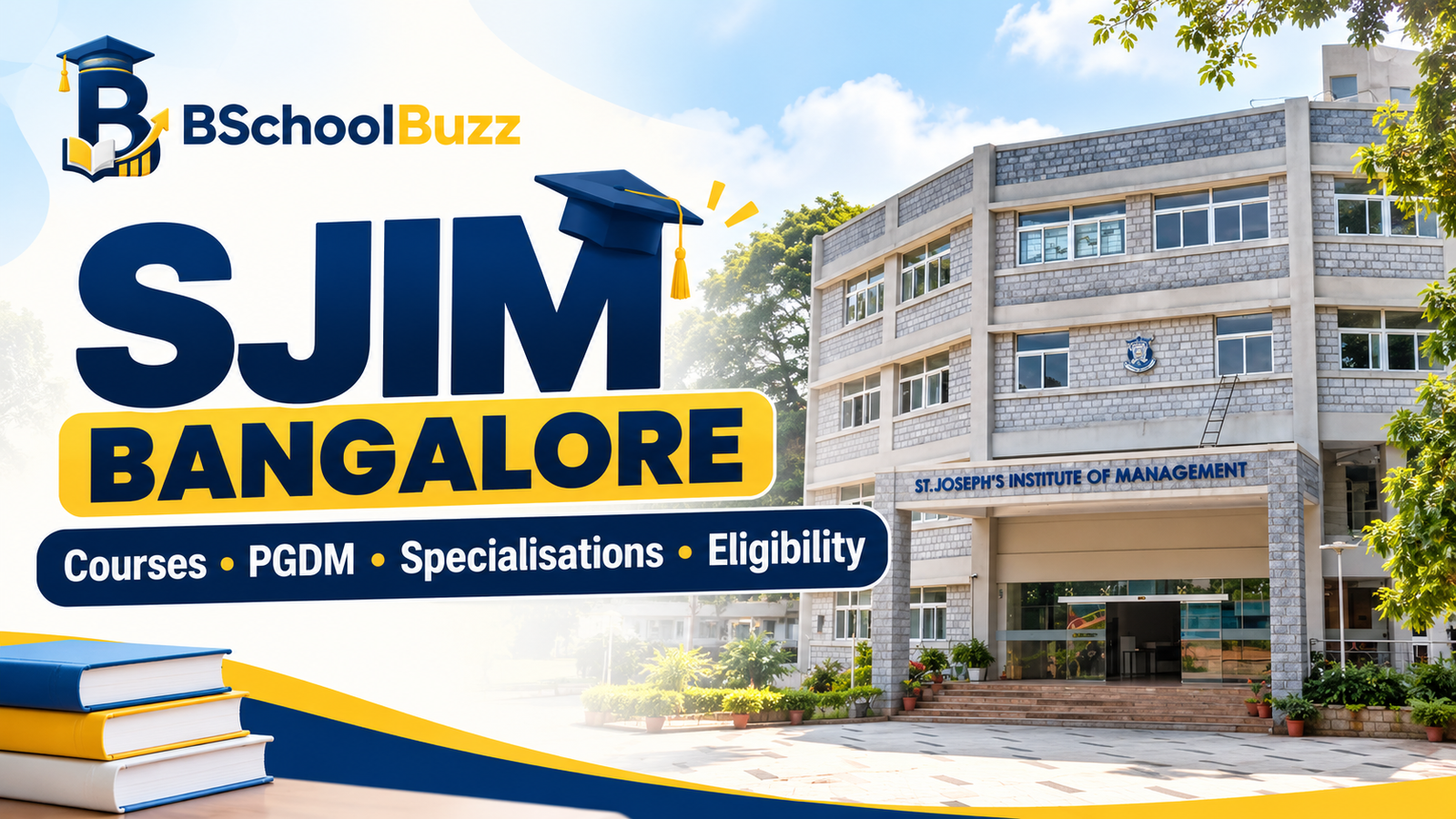
- St. Joseph's Institute of Management (SJIM) is located on Primrose Road, off MG Road, Bengaluru.
- SJIM's flagship programme is a two-year, full-time Post Graduate Diploma in Management (PGDM).
- The institute states that its PGDM is AIU-equivalent to an MBA, AICTE-approved and NBA-accredited.
- Students can select two specialisations from Finance, Marketing, Human Resources Management, Operations and Supply Chain Management, and Business Analytics.
- The published 2026 admission criteria specify at least 60% marks in Class 10, Class 12 and graduation.
- Accepted entrance examinations listed for the 2026 intake include CAT, MAT, XAT, CMAT, GMAT and ATMA.
- The institute's published selection criteria assign 40% weightage to the personal interview, including communication skills.
- The published 2026–28 tuition fee is ₹10.80 lakh for two years, with a separately listed refundable caution deposit of ₹20,000.
- SJIM lists admission scholarships, general merit scholarships and merit-cum-means scholarships.
- Applicants should verify the latest admission, fee and scholarship conditions through the official institute website.
St. Joseph's Institute of Management Courses & Programs: MBA/PGDM Specialisations, Duration & Eligibility
Table of Contents
Introduction to St. Joseph's Institute of Management, Bangalore
SJIM Bangalore Courses and Programmes Offered
Understanding the PGDM Programme
SJIM Bangalore Specialisations
Dual Specialisation Combinations
PGDM Curriculum and Course Structure
Course Duration and Learning Methodology
Eligibility Criteria for SJIM Bangalore
Entrance Exams Accepted
SJIM Bangalore Admission Process
Selection Criteria and Interview Process
Documents Required for Admission
SJIM PGDM Fees and Payment Structure
Scholarships and Financial Assistance
Hostel Facilities and Student Life
Internship and Industry Exposure
Career Opportunities After PGDM
Placement Information and How to Evaluate It
Difference Between PGDM and MBA
How to Choose the Right Specialisation
Important Details to Verify Before Applying
Frequently Asked Questions
Conclusion
1. Introduction to St. Joseph's Institute of Management, Bangalore
St. Joseph's Institute of Management (SJIM) is a management education institution located on Primrose Road, off MG Road, in Bengaluru, Karnataka. The institute traces its history to 1968 and operates within the Jesuit educational tradition. It was previously known as St. Joseph's College of Business Administration (SJCBA).
SJIM's flagship management qualification is the Post Graduate Diploma in Management (PGDM), a two-year, full-time programme that the institute states is equivalent to an MBA through AIU recognition. The programme is approved by the All India Council for Technical Education (AICTE) and accredited by the National Board of Accreditation (NBA), according to the institute's published programme information.
For students comparing management programmes, SJIM offers a dual-specialisation structure. Students can choose two areas from Finance, Marketing, Human Resources Management, Operations and Supply Chain Management, and Business Analytics. This allows students to combine complementary business functions instead of concentrating on just one area.
The institute's official 2026–28 admission brochure describes a six-term, full-time PGDM with an industry internship and case-study-based learning. It also lists CAT, MAT, XAT, CMAT, GMAT and ATMA among the accepted entrance examinations.
Applicants should distinguish the institute's flagship PGDM from a university-awarded MBA. Although SJIM states that its PGDM has MBA equivalence, students should check the programme's current approval, accreditation and equivalence documentation before applying, particularly if they intend to pursue further education or employment that requires a specific qualification.
Official website: https://sjim.edu.in/
2. SJIM Bangalore Courses and Programmes Offered
When searching for St. Joseph Institute of Management courses, it is important to understand how the institute organises its academic offerings.
SJIM's principal management programme is the PGDM. Students can pursue this programme with two specialisations selected from the institute's published functional areas.
The official 2026–28 brochure highlights the flagship PGDM rather than presenting several separate, independently awarded MBA degrees. The specialisations form part of the PGDM programme.
| Programme or academic option | Description | Duration |
|---|---|---|
| PGDM | Flagship postgraduate management programme | 2 years, full-time |
| PGDM with Finance specialisation | Management studies with a finance focus | Within the 2-year PGDM |
| PGDM with Marketing specialisation | Management studies with a marketing focus | Within the 2-year PGDM |
| PGDM with Human Resources Management specialisation | Management studies with an HR focus | Within the 2-year PGDM |
| PGDM with Operations and Supply Chain Management specialisation | Management studies with an operations focus | Within the 2-year PGDM |
| PGDM with Business Analytics specialisation | Management studies with an analytics focus | Within the 2-year PGDM |
| PGDM with dual specialisation | Two selected functional areas combined within the programme | Within the 2-year PGDM |
The table describes the main programme and specialisation options; it does not imply that each combination is a separate degree.
Is SJIM mainly an MBA or PGDM institute?
SJIM awards a PGDM rather than a conventional university-awarded MBA. The institute's official website describes the PGDM as equivalent to an MBA through AIU recognition.
This distinction matters when comparing institutions. An MBA is generally awarded by a university or a college authorised to award that degree, while an autonomous management institute can offer a PGDM subject to the applicable regulatory framework.
Students should therefore compare the qualification actually awarded, its recognition and its curriculum instead of relying solely on the use of the word MBA in general search results.
Does SJIM offer different specialisations as separate courses?
The institute's flagship PGDM allows students to choose two specialisation areas. The specialisations are not automatically separate standalone programmes.
For example, a student choosing Finance and Business Analytics studies within the PGDM framework while developing knowledge in both areas. The precise combination of electives depends on the curriculum and the options made available to the relevant batch.
3. Understanding the PGDM Programme
The PGDM is the central programme for students researching St. Joseph Institute of Management Bangalore courses. It is designed to develop knowledge across business functions while allowing students to build expertise in selected areas.
The institute describes the programme as a two-year, full-time course spread across six terms. The published curriculum includes core subjects, electives and an industry internship project.
What does PGDM mean?
PGDM stands for Post Graduate Diploma in Management. It is a postgraduate management qualification offered by an eligible management institute.
The curriculum usually covers business fundamentals such as finance, marketing, human resources, operations, economics, analytics and strategy. Students then use electives and specialisations to study particular areas in greater depth.
At SJIM, the programme's dual-specialisation approach is a defining feature. Students are expected to develop an understanding of management as a whole while exploring two functional areas.
How is SJIM's PGDM structured?
The institute's official programme page identifies the following broad components:
| Programme component | Published information |
|---|---|
| Qualification | Post Graduate Diploma in Management |
| Duration | 2 years |
| Study mode | Full-time |
| Academic structure | 6 terms, according to the 2026–28 brochure |
| Specialisation model | Dual specialisation |
| Industry exposure | Internship and case-study-based learning |
| Regulatory status | AICTE-approved programme |
| Accreditation | NBA accreditation stated by the institute |
| MBA equivalence | AIU equivalence stated by the institute |
Source: SJIM's official 2026–28 admission brochure and PGDM programme page.
Who should consider the PGDM?
The programme may be worth investigating for graduates who want a structured management qualification and the opportunity to combine two business specialisations.
It can also be relevant to students from different academic backgrounds because the institute's admission information accepts bachelor's degrees in multiple disciplines, subject to the published academic requirements.
However, applicants should not choose a management programme solely because it offers multiple specialisations. They should compare the subjects taught, practical learning opportunities, fees, admission criteria and career outcomes with their own objectives.
4. SJIM Bangalore Specialisations
SJIM's flagship PGDM offers five principal specialisation areas:
Finance
Marketing
Human Resources Management
Operations and Supply Chain Management
Business Analytics
The institute's programme information states that students can select two specialisations. The purpose of this structure is to let students develop expertise in complementary functions.
Finance
Finance focuses on how organisations manage money, evaluate investments and make financial decisions. At SJIM, the curriculum includes areas such as corporate finance, financial accounting, cost and management accounting, and finance-related electives.
The official curriculum lists elective subjects including financial statement analysis, commercial banking, derivatives management, financial markets and services, financial modelling using Excel, international financial management, mergers and acquisitions, portfolio management and taxation.
Students interested in Finance should be comfortable working with numerical information, interpreting financial statements and analysing business performance.
Finance can also be combined with another specialisation. For example, Finance and Business Analytics may interest students who want to work with financial data, while Finance and Marketing can be relevant to commercial roles involving financial products.
Marketing
Marketing focuses on customers, markets, product positioning, sales and communication. SJIM's published curriculum includes Principles of Marketing and Marketing Management, along with electives such as consumer behaviour, digital marketing, marketing analytics, marketing research, retail marketing, sales and distribution, services marketing and strategic brand management.
Students considering Marketing should explore whether they enjoy understanding customer behaviour, researching markets, developing campaigns and supporting sales strategies.
The specialisation can also be combined with Operations and Supply Chain Management for students interested in distribution, retail operations and business-to-business marketing.
Human Resources Management
Human Resources Management focuses on the people-related functions of an organisation. It includes recruitment, employee development, performance management, workplace policies and organisational effectiveness.
SJIM's published curriculum lists Human Resources Management among its core subjects. HR-related electives include industrial relations and collective bargaining, HR analytics, international human resource management, labour and employment relations laws, organisational development, performance management, talent management, training and development, and total rewards management.
Students interested in HR should examine whether they enjoy working with people, analysing organisational problems and understanding employment-related processes.
A combination of HR and Finance may also be worth considering for students interested in compensation, benefits and people-related financial decisions.
Operations and Supply Chain Management
Operations and Supply Chain Management examines how organisations produce and deliver goods and services. It involves processes, inventory, procurement, logistics, quality and resource utilisation.
SJIM's published elective list includes enterprise resource planning, Lean Management and Six Sigma, productivity management, project management, service operations management, supply chain management and total quality management.
Students interested in systems, process improvement, logistics and operational problem-solving may want to examine this specialisation.
It can also complement Finance or Marketing. Finance and Operations may suit students interested in combining financial knowledge with process management, while Marketing and Operations can connect customer-facing activities with distribution and delivery.
Business Analytics
Business Analytics focuses on using data to understand business performance and support decision-making.
SJIM's curriculum lists Business Analytics for Managers among its core subjects. Its published electives include business intelligence and reporting, data management and SQL, predictive modelling and machine learning, and prescriptive analytics.
Students considering this area should examine the quantitative content of the programme and their willingness to work with data, analytical methods and business problems.
Business Analytics can be combined with Finance for financial analysis or with Marketing for customer, campaign and market-related analytics.
How do these specialisations differ?
| Specialisation | Main academic focus | Example of a business question |
|---|---|---|
| Finance | Financial information and resource allocation | Is an investment financially viable? |
| Marketing | Customers, markets and sales | How can a business improve customer acquisition? |
| Human Resources Management | Employees and organisational effectiveness | How can an organisation improve employee retention? |
| Operations and Supply Chain Management | Processes, logistics and delivery | How can a business reduce delays and improve efficiency? |
| Business Analytics | Data-based business decisions | What does the data reveal about business performance? |
These examples explain the broad focus of each area. Actual job responsibilities depend on the employer, role and experience of the individual.
5. Dual Specialisation Combinations
A major feature of SJIM's PGDM is the ability to choose two specialisations. The combination matters because many business roles require knowledge across functional boundaries.
The institute's programme information describes combinations such as Finance and Marketing, Human Resources Management and Finance, Marketing and Human Resources Management, Finance and Operations, Marketing and Operations, and Business Analytics combined with Finance or Marketing.
The availability of particular combinations should be checked against the current curriculum and elective allocation rules.
Finance and Marketing
This combination can be relevant to students interested in businesses that sell financial products or services.
The finance component provides knowledge of financial markets, banking and financial services. Marketing adds an understanding of consumer behaviour, sales and distribution.
Possible areas of interest include financial-product marketing, customer acquisition, commercial banking and sales-related roles. These are potential career areas, not guaranteed placement outcomes.
Finance and Human Resources Management
Finance and HR can be a useful combination for students interested in the financial aspects of people management.
The combination can connect knowledge of employee compensation, rewards and HR strategy with financial analysis and budgeting.
Students should review the elective choices to determine how much depth is available in each area.
Marketing and Human Resources Management
Marketing and HR can connect brand management and communication with employee engagement, talent acquisition and internal communication.
For example, a student may be interested in how employer branding influences recruitment or how communication supports employee participation.
The combination can be useful for students who prefer work that involves both people and communication.
Finance and Operations
Finance and Operations can connect financial decision-making with process efficiency, supply chains and resource utilisation.
Students interested in logistics, productivity, project management and the financial side of operational decisions may want to investigate this combination.
Marketing and Operations
Marketing and Operations connects customer demand with the processes required to fulfil it. The combination can be relevant to retail, distribution, business-to-business marketing and service operations.
Students should examine whether the curriculum allows them to study the operational and marketing subjects needed for their intended direction.
Business Analytics and Finance
This combination brings together financial knowledge and data analysis. Students may explore questions related to financial performance, cash flow, profitability and forecasting.
The actual analytical skills developed will depend on the electives, projects and technical tools covered in the curriculum.
Business Analytics and Marketing
This combination focuses on using data to understand customers and evaluate marketing performance.
Relevant academic interests can include customer behaviour, campaign effectiveness, customer retention and marketing analytics.
How should students select a combination?
A useful selection process involves three questions:
Which subjects genuinely interest you?
Which combination provides complementary knowledge rather than simply repeating similar subjects?
Does the current curriculum support the roles or further study you are considering?
Students should also ask whether every combination is available to all students, whether elective allocation depends on demand or academic performance, and whether minimum class sizes apply.
6. PGDM Curriculum and Course Structure
SJIM's published curriculum includes foundational management subjects, functional courses, electives and an industry internship project.
The exact sequence of subjects may be revised between academic years. Applicants should consult the current curriculum page and the handbook applicable to their admission batch.
First-year core subjects
The published curriculum lists subjects such as:
| Academic term | Examples of subjects |
|---|---|
| First term | Business and Management Environment, Financial Accounting, Information Systems for Managers, Managerial Economics, Operations Management, Organisational Behaviour |
| Second term | Business and Management Environment, Business Analytics for Managers, Business Ethics, Corporate Finance, Human Resources Management, International Business Economics, Principles of Marketing |
| Third term | Business and Management Environment, Business Research Methodology, Cost and Management Accounting, Leadership in Action, Marketing Management, Operations Research, Organisations and Management |
The table summarises the curriculum page; students should use the official syllabus for the complete course list and current credit structure.
Why are core subjects important?
Management roles often require an understanding of more than one business function. A marketing manager may need to understand budgets, a finance professional may need to interpret operational performance, and an HR manager may need to use analytics to assess workforce trends.
Core subjects help establish this shared foundation before students move deeper into their chosen specialisations.
Second-year courses and electives
The published curriculum includes core subjects such as Business Strategy, Corporate Social Responsibility, Environment and Sustainability, and Entrepreneurship and Innovation.
Students can also explore elective courses in areas such as finance, HR, marketing, operations and business analytics.
This structure gives students an opportunity to combine foundational management knowledge with more focused study.
Industry internship project
The curriculum includes an industry internship project during the summer term. The official 2026–28 brochure describes an eight-week industry internship.
Students should confirm the current internship dates, reporting requirements and assessment process with the institute.
An internship can help a student understand workplace expectations and apply classroom concepts to practical assignments. However, the quality of the learning experience depends on the project, the organisation, the student's responsibilities and the guidance provided.
Case-study-based learning
SJIM's admission brochure identifies case-study pedagogy as a programme feature. Case studies help students examine business situations, evaluate different options and explain their reasoning.
For applicants, it is useful to understand that management education requires active participation. Reading, discussion, presentations, group assignments and project work can all form part of the learning experience.
7. Course Duration and Learning Methodology
The SJIM flagship PGDM is a two-year, full-time programme organised into six terms, according to the official 2026–28 brochure.
| Feature | Published detail |
|---|---|
| Total duration | 2 years |
| Mode of study | Full-time |
| Academic terms | 6 |
| Internship | 8 weeks, as stated in the 2026–28 brochure |
| Teaching approach | Case-study-based learning |
| Specialisation model | Dual specialisation |
What does full-time study involve?
A full-time management programme typically requires regular attendance, examinations, assignments, group projects and participation in academic activities.
Students should not assume that the course can be completed through occasional attendance or entirely online study. Applicants with employment or other commitments should ask the admissions office for the current timetable and attendance requirements.
How should students prepare for the academic workload?
Before joining, students can refresh basic quantitative concepts, practise written communication and improve their ability to interpret business information.
Students from non-commerce backgrounds may find introductory accounting or finance topics unfamiliar at first. Likewise, students who have not worked with data may need additional practice with spreadsheets and quantitative reasoning.
The objective is not to master every subject before joining. It is to build enough confidence to participate actively in the programme.
8. Eligibility Criteria for SJIM Bangalore
Eligibility is one of the most important factors when evaluating St. Joseph Institute of Management Bangalore courses.
SJIM's published 2026 admission page states that applicants should have a bachelor's degree in a recognised discipline through regular mode. It also specifies a consistent first-class academic record, with at least 60% marks in Class 10, Class 12 and graduation.
The page states that final-year candidates awaiting results may apply. Candidates with more than two arrears are advised not to apply, and applicants who clear subjects on their first attempt are preferred.
These criteria are specific to the published 2026 admission information. Applicants for a future intake should confirm whether the same conditions remain applicable.
Published eligibility requirements
| Eligibility factor | SJIM's published 2026 criterion |
|---|---|
| Qualifying degree | Bachelor's degree in a recognised discipline |
| Mode of graduation | Regular mode, according to the admission page |
| Class 10 marks | Minimum 60% |
| Class 12 marks | Minimum 60% |
| Graduation marks | Minimum 60% |
| Final-year applicants | May apply while awaiting results, according to the published page |
| Academic arrears | More than two arrears: applicants are advised not to apply |
| Entrance test | A qualifying score in an accepted examination |
| Work experience | Considered in shortlisting; not stated as compulsory on the cited admission page |
Source: SJIM's official PGDM admission page.
Can graduates from any stream apply?
The admission page lists BE, BTech, BCom, BBA, BSc, BA and other bachelor's degrees from recognised universities. This indicates that the programme is not restricted to one undergraduate discipline.
However, candidates must meet the published academic and entrance examination requirements. Applicants should also verify the institute's recognition requirements if their degree was awarded through an unusual mode of study.
Is 60% required in every academic stage?
The published 2026 admission page specifies minimum 60% marks in Class 10, Class 12 and graduation. Applicants should therefore avoid assuming that a high graduation percentage automatically compensates for lower school-level marks.
If a candidate's marks fall below the published threshold in one stage, the appropriate step is to contact SJIM's admissions office and obtain clarification rather than assuming that an exception will be granted.
Can final-year students apply?
Yes. The published admission page allows candidates who have appeared for their final graduate-level examination and are awaiting results to apply.
However, applying before the result is declared does not remove the requirement to satisfy the final eligibility conditions. Candidates should confirm the date by which final marksheets and degree documents must be submitted.
Are academic backlogs permitted?
SJIM's published 2026 admission page states that candidates with more than two arrears need not apply and that students who have cleared all subjects on the first attempt are preferred.
Applicants with backlogs should disclose them accurately and contact the admissions office for confirmation of the current rules. They should not assume that a backlog policy from an older brochure automatically applies to a new intake.
9. Entrance Exams Accepted
SJIM's official 2026–28 admission brochure lists six entrance examinations:
CAT
MAT
XAT
CMAT
GMAT
ATMA
The admission page specifies qualifying score thresholds for the examinations and score periods relevant to the 2026 intake. The listed CAT, XAT, MAT, CMAT, GMAT and ATMA requirements should be checked against the applicable admission instructions.
Entrance examination requirements listed for 2026
| Examination | Published requirement on the admission page |
|---|---|
| CAT 2025 | 60 percentile or above |
| XAT 2026 | 60 percentile or above |
| MAT | 60 percentile or above in the listed examination sessions |
| CMAT | 60 percentile or above |
| GMAT | 60 percentile or above is stated on the page; confirm the exact score interpretation with SJIM |
| ATMA | 60 percentile or above |
The published page presents these requirements in the context of the 2026 admission cycle. Candidates applying for a later intake must check the relevant year's examination and score-validity rules.
Important: Percentiles and scores are not interchangeable. CAT, XAT, MAT, CMAT, GMAT and ATMA may report results differently. Candidates should verify the specific format and threshold that SJIM applies to their chosen examination.
Which entrance exam should you take?
The appropriate examination depends on your preparation, the examination calendar and the other institutions to which you intend to apply.
Students should compare the syllabus, test format, registration deadline and score reporting method before selecting an examination.
If you already have a valid score, confirm whether it is accepted for the target intake. Do not assume that a score from an earlier year will automatically remain valid.
Is one entrance examination sufficient?
The admission page lists several accepted examination routes; it does not state that all applicants must take every listed test.
Candidates should confirm the score submission requirements and ensure that their chosen examination is accepted for the relevant academic year.
10. SJIM Bangalore Admission Process
The SJIM admission process includes application submission, eligibility screening, shortlisting, interviews and final admission confirmation.
The detailed procedure can change between admission cycles, so the current official admissions page should be treated as the final reference.
Step 1: Review programme eligibility
Before applying, check the minimum academic marks, qualifying degree, acceptable entrance examinations and arrears conditions.
Applicants should also confirm that they are applying for the correct PGDM intake.
Step 2: Complete the application form
SJIM's published admission instructions describe an online application process. Applicants should enter accurate academic information, examination details and any work experience requested.
The institute's published 2026 application fee is ₹1,500, with payment gateway charges applicable where specified. Candidates should check the latest application portal before paying, because application fees and deadlines may change for future cycles.
Step 3: Upload supporting documents
The published checklist includes school marksheets, graduation marksheets, a degree certificate if available, entrance examination scorecard and work experience certificate if applicable.
Candidates should follow the exact file formats and upload instructions shown on the current application portal.
Step 4: Eligibility screening and shortlisting
The institute reviews applications against its eligibility requirements. Its published admission page states that shortlisting considers academic performance, entrance examination scores and work experience.
Submitting an application does not guarantee an interview invitation.
Step 5: Attend the selection process
SJIM's published admission page describes a personal interview and English language test. The 2026 admissions process document also describes further interview stages.
Applicants should follow the interview instructions sent through official communication channels. The format, location and scheduling should be confirmed from the current invitation.
Step 6: Review the admission decision
Candidates who receive an offer should read the programme name, fee schedule, payment deadlines and conditions carefully.
They should use the official payment channel and retain the offer letter and payment receipt.
Step 7: Complete document verification
Candidates may be required to present original academic records for verification. Final-year students should confirm the deadline for providing final graduation results and degree documents.
11. Selection Criteria and Interview Process
Meeting the minimum eligibility requirements does not guarantee admission to SJIM. The institute's published selection criteria assign weight to academic performance, entrance examination results, work experience and interview performance.
The official selection criteria page provides the following weightage:
| Selection component | Published weightage |
|---|---|
| Class 10 | 10% |
| Class 12 | 10% |
| Degree | 10% |
| Work experience | 15% |
| All-India entrance test score | 15% |
| Personal interview, including communication skills | 40% |
| Total | 100% |
Source: SJIM's official PGDM selection criteria page.
Applicants should verify that this weighting remains applicable to the intake for which they are applying.
Why does the interview carry significant weight?
The published criteria allocate 40% to the personal interview, including communication skills. This means candidates should prepare to explain their academic background, motivation for pursuing management education and future interests clearly.
The interview may also help the selection panel understand how candidates approach problems, communicate ideas and reflect on their experiences.
How should candidates prepare?
Applicants can prepare by reviewing their academic projects, internships, professional experience and reasons for choosing a PGDM.
They should be ready to explain why they are interested in their preferred specialisations and how the programme fits their goals.
It is also useful to practise clear, structured answers to questions about business issues, teamwork, decision-making and communication. These are preparation suggestions rather than a guaranteed list of interview questions.
Does work experience help?
SJIM includes work experience as a factor in its published selection criteria. However, its FAQ states that work experience is not compulsory, although it is preferable.
Fresh graduates should therefore not assume that they are automatically ineligible. They should focus on academic preparation, entrance examination performance and interview readiness while checking the current selection policy.
12. Documents Required for Admission
Preparing documents early can help candidates avoid delays during application screening and admission confirmation.
SJIM's published 2026 admission page identifies the following supporting documents:
| Document | Purpose |
|---|---|
| Class 10 marksheet | Verification of school-level academic performance |
| Class 12 marksheet | Verification of higher-secondary academic performance |
| Graduation marksheets | Verification of undergraduate results |
| Degree certificate, if available | Evidence of completion of the qualifying degree |
| Entrance examination scorecard, if available | Verification of the qualifying test result |
| Work experience certificate, if applicable | Supporting evidence for declared employment experience |
Applicants should also keep identity documents, recent photographs and any other files requested by the current application portal ready.
Final-year candidates
Students awaiting final graduation results should upload the available records and follow the instructions provided by SJIM. They should confirm the deadline for submitting the final marksheet and degree certificate.
Why should all information be accurate?
SJIM's published instructions warn applicants against hiding information or providing incorrect details. Candidates should disclose repeated subjects and other requested academic information accurately.
Before submitting the application, check that marks, dates, examination details and personal information match the supporting records.
13. SJIM PGDM Fees and Payment Structure
The cost of a management programme is an important part of the admission decision. Applicants should compare the total tuition fee, refundable deposits, hostel charges and any other costs that apply to their situation.
SJIM's official fee page publishes the following tuition fee structure for the 2026–28 PGDM batch.
| Fee component | Amount |
|---|---|
| First-year tuition fee | ₹5,40,000 |
| Second-year tuition fee | ₹5,40,000 |
| Total tuition fee for two years | ₹10,80,000 |
| Refundable caution deposit | ₹20,000 |
| Application fee for the published 2026 admission cycle | ₹1,500 |
Source: SJIM's official fee structure and admission pages.
The tuition fee is ₹10.80 lakh for the two-year 2026–28 PGDM batch. The refundable caution deposit is listed separately and should not be confused with tuition.
Tuition fee instalments
SJIM's published 2026–28 fee page lists four tuition instalments:
| Instalment | Amount | Published due date |
|---|---|---|
| First | ₹2,70,000 | At the time of admission |
| Second | ₹2,70,000 | 15 September 2026 |
| Third | ₹2,70,000 | 15 March 2027 |
| Fourth | ₹2,70,000 | 15 September 2027 |
| Total | ₹10,80,000 | — |
These dates relate to the published 2026–28 fee schedule. Applicants should verify the applicable payment instructions and any revised dates directly with SJIM before transferring money.
What should students budget beyond tuition?
Students should calculate the total cost of attendance rather than considering tuition alone.
Possible additional expenses include accommodation, food beyond the included hostel meal plan, travel, books, a laptop, personal expenses and optional activities.
The actual amount depends on the student's living arrangements and spending habits. Applicants should not assume that hostel and mess charges are included in the published tuition fee unless the official fee document explicitly states so.
Is the caution deposit refundable?
SJIM's fee page identifies the ₹20,000 caution deposit as refundable. Candidates should confirm the refund conditions, deduction rules and procedure before paying.
Can fees change?
A published fee schedule applies to its stated batch. Applicants should not automatically use the 2026–28 figures for a future intake. Check the latest official fee page and offer letter for the exact programme and academic year.
14. Scholarships and Financial Assistance
SJIM publishes admission scholarships, general merit scholarships and merit-cum-means scholarships for its PGDM programme. The amount and eligibility conditions differ by scholarship category.
Admission scholarships
The official scholarship page lists the following admission scholarship bands for the 2026–28 PGDM batch:
| Entrance examination | Published score band | Scholarship amount |
|---|---|---|
| CAT/XAT | Above 90 percentile | ₹2,25,000 |
| CAT/XAT | 85–89 percentile | ₹1,20,000 |
| CAT/XAT | 80–84 percentile | ₹90,000 |
| CAT/XAT | 75–79 percentile | ₹70,000 |
| CAT/XAT | 70–74 percentile | ₹60,000 |
| CMAT/MAT | Above 95 percentile | ₹1,20,000 |
| CMAT/MAT | 90–94 percentile | ₹85,000 |
| CMAT/MAT | 85–89 percentile | ₹65,000 |
| CMAT/MAT | 80–84 percentile | ₹45,000 |
| CMAT/MAT | 75–79 percentile | ₹25,000 |
Source: SJIM's official scholarship page.
The published scholarship rules also specify academic conditions, including a consistent record of at least 60% in Class 10, Class 12 and graduation. Continuation into the second year is subject to the stated CGPA and disciplinary conditions.
Students should read the current scholarship policy carefully. Meeting a score band alone may not be sufficient if other academic or programme conditions are not met.
General merit scholarships
SJIM's published scholarship information lists awards of ₹60,000 each for the top 25 first-year students and the top 25 second-year students.
These awards are based on merit under the institute's applicable rules. Students should confirm the evaluation criteria, timing and any conditions attached to the scholarship.
Merit-cum-means scholarships
The institute also lists ₹50,000 awards for five meritorious students from economically disadvantaged backgrounds in the first year and five in the second year.
Applicants should confirm the financial documentation, eligibility requirements and selection procedure before relying on this support in their budget.
How should scholarships affect fee planning?
A scholarship should be treated as financial assistance subject to the official conditions, not as an automatic reduction for every applicant.
Students should plan for the published fee and then assess whether they meet the scholarship requirements. They should also confirm when the scholarship is credited, whether it is split across years and what academic performance is required for continuation.
15. Hostel Facilities and Student Life
SJIM publishes information about hostel accommodation for students who need to live away from home.
The institute describes separate accommodation for men and women. The men's hostel is located on Victoria Road, close to the campus, while the women's hostel is on campus.
The official hostel page describes Wi-Fi facilities and food arrangements. Students should confirm current room availability, rules, security arrangements and the exact accommodation terms before accepting a place.
Hostel fee information
SJIM's published hostel page lists the following charges for ten months:
| Hostel component | Published amount |
|---|---|
| Accommodation and mess | ₹1,38,000 |
| Refundable security deposit | ₹20,000 |
| Period covered | 10 months |
The published meal plan includes breakfast and dinner on all days, plus breakfast, lunch and dinner on Sundays and college holidays.
Applicants should confirm whether these charges apply to their intended stay, whether rooms are available for the relevant batch and whether the fee has been revised.
How much does tuition plus hostel cost?
Using the published 2026–28 tuition fee and the hostel charge for the stated ten-month period, a student can make an initial budget.
| Cost component | Published amount |
|---|---|
| Two-year PGDM tuition | ₹10,80,000 |
| Hostel accommodation and mess for one stated ten-month period | ₹1,38,000 |
| Refundable tuition-related caution deposit | ₹20,000 |
| Refundable hostel security deposit | ₹20,000 |
This table does not represent the complete two-year residential cost because the hostel amount shown covers ten months. Students must confirm the number of hostel periods they will need and any charges for additional accommodation or meals.
Campus location
SJIM is located at No. 28/1, Primrose Road, off MG Road, Bengaluru – 560025. Its city-centre location may be relevant to students evaluating commuting, accommodation and access to business districts.
Applicants should assess actual travel time and living expenses based on their chosen accommodation rather than assuming that proximity to the campus automatically makes a particular housing option affordable.
16. Internship and Industry Exposure
Practical learning is an important part of management education because business decisions often involve uncertainty, competing priorities and real-world constraints.
SJIM's official 2026–28 brochure describes an eight-week industry internship and case-study-based learning. The curriculum also includes an industry internship project.
What is the purpose of an internship?
An internship allows students to observe workplace practices and apply classroom concepts in an organisational setting. Depending on the assigned role, students may work on research, analysis, business processes or other tasks relevant to the host organisation.
The quality of the experience depends on the internship assignment, the level of responsibility, guidance from supervisors and the student's participation.
How can students prepare?
Before beginning an internship, students can review the organisation's business model, prepare basic research skills and practise professional communication.
They should also understand the reporting expectations, deadlines and assessment requirements set by the institute and host organisation.
Is an internship a job guarantee?
No. An internship may help students develop practical experience and professional contacts, but it does not guarantee a permanent role or a specific salary.
Applicants should ask about the internship process, whether students secure positions independently or through institute-supported opportunities, and how the internship is evaluated.
17. Career Opportunities After PGDM
The career opportunities available to a PGDM graduate depend on the chosen specialisation, skills, internship experience, academic performance and the requirements of employers.
SJIM's dual-specialisation model allows students to study two business areas, which can help them understand how different functions interact.
Career areas related to Finance
Finance-related academic preparation can be relevant to roles involving financial analysis, corporate finance, banking, financial services, reporting and related business functions.
The actual requirements vary by employer. Some roles may require additional technical skills, relevant experience or professional qualifications.
Career areas related to Marketing
Marketing-related study can be relevant to sales, brand management, market research, digital marketing, customer analysis and business development.
Students should examine whether their interests lean towards creative communication, data analysis, relationship management or commercial execution.
Career areas related to Human Resources Management
HR-related knowledge can be relevant to recruitment, talent management, training, employee engagement, performance management and HR analytics.
Candidates should consider whether they prefer people-facing work, policy-related responsibilities or analytical HR functions.
Career areas related to Operations and Supply Chain Management
Operations-related study can be relevant to logistics, supply-chain planning, procurement, project management, service operations and process improvement.
Students should examine their interest in systems, efficiency, planning and problem-solving.
Career areas related to Business Analytics
Business Analytics can support roles involving reporting, data interpretation, predictive analysis and business decision support.
Students should review the technical content of their curriculum and develop practical skills in relevant analytical tools.
Does dual specialisation guarantee better placements?
No. Studying two specialisations does not guarantee a particular role or salary. Employers also evaluate communication, analytical ability, internship performance, technical skills and suitability for the position.
Students should use the specialisation structure to build a coherent profile rather than assuming that having two specialisations automatically doubles their career opportunities.
18. Placement Information and How to Evaluate It
Placement information can help applicants understand the roles and organisations that recruit from an institute. However, a placement headline should not be the only factor in selecting a PGDM programme.
SJIM publishes a placement guide for recruiters for the 2025–26 cycle, covering its 2024–26 graduating batch. Its 2026–28 admission brochure also highlights a highest package of ₹22 lakh.
The brochure's headline figure should be checked against the relevant placement report to establish the reporting period, whether the figure is domestic or international, and the methodology used.
What should students check?
| Placement indicator | Why it matters |
|---|---|
| Highest package | Shows the highest reported compensation, but may represent one individual |
| Average package | Provides a mean figure across the reported group, if methodology is disclosed |
| Median package | Can help describe the middle outcome and reduce the influence of extreme values |
| Number of students placed | Helps establish the scope of the reported outcome |
| Batch size | Provides context for placement coverage |
| Recruiter list | Shows which organisations participated, but not necessarily the number of offers from each |
| Role profiles | Helps applicants understand the kinds of jobs offered |
| Placement year | Ensures figures relate to the relevant graduating batch |
Applicants should use the latest official placement report and verify that the numbers refer to the correct batch. They should not combine placement statistics from different years or programmes.
How should placement figures influence a decision?
Students can compare placement data with tuition fees, living expenses, preferred roles and alternative institutions. However, a headline salary does not establish the likely outcome for every student.
It is also useful to examine role descriptions, recruiter participation, internship opportunities and the relevance of the programme's curriculum to the roles students want to pursue.
19. Difference Between PGDM and MBA
Students often search for an MBA at SJIM, but the institute's principal qualification is the PGDM.
Although both qualifications can provide postgraduate management education, the awarding structure differs.
| Comparison factor | PGDM at SJIM | University-awarded MBA |
|---|---|---|
| Qualification awarded | Post Graduate Diploma in Management | Master of Business Administration |
| Awarding institution | Management institute | University or authorised degree-awarding institution |
| Programme structure | Determined by the institute within applicable rules | Determined by the university within applicable rules |
| Recognition | SJIM states that its PGDM is AICTE-approved and AIU-equivalent to an MBA | Depends on the university and applicable recognition |
| Specialisation options | Dual specialisation, according to SJIM's published programme | Depends on the university's programme |
| Duration | Two years, full-time | Depends on the particular MBA programme |
SJIM states that its PGDM has AIU equivalence to an MBA. Applicants should verify the current documentation and the requirements of any employer, university or examination authority where the qualification will be used.
The distinction is particularly important for students planning further education, public-sector opportunities or roles with specific qualification rules.
20. How to Choose the Right Specialisation
Selecting a specialisation is a decision about the subjects you want to study and the kinds of business problems you want to understand.
Students should consider their strengths, interests and willingness to develop new skills.
Start with your academic interests
Students who enjoy numbers and financial statements may want to explore Finance. Those interested in customers, brands and sales may prefer Marketing. Students drawn to people management may examine HR, while those who enjoy systems and process improvement may investigate Operations and Supply Chain Management.
Business Analytics can be suitable for students who want to work with data, but they should first review the programme's quantitative and technical content.
Compare the available electives
The specialisation name does not tell the whole story. The actual elective list helps reveal what the programme teaches.
For example, a student interested in digital marketing should look for subjects related to digital marketing, analytics and customer behaviour. A student interested in finance should examine financial modelling, financial markets and other relevant courses.
Consider complementary combinations
Dual specialisation is most useful when the two areas connect to a coherent interest.
Finance and Analytics may appeal to students interested in data-led financial decisions. Marketing and Analytics may suit students interested in customer data and campaign performance. HR and Finance may be relevant to students interested in compensation and workforce planning.
These examples are intended to support exploration rather than predict career outcomes.
Ask about specialisation allocation
Before admission, candidates should confirm whether their preferred combination is available to every student, whether allocation depends on demand and whether any minimum academic performance is required.
This can help avoid choosing a programme based on an assumed combination that may not be available to the student's batch.
21. Important Details to Verify Before Applying
Admission rules, fee schedules and entrance examination requirements can change between academic years. Applicants should verify the latest official information before making a payment or accepting an offer.
| Item | What to confirm |
|---|---|
| Programme | Confirm that the application is for SJIM's flagship PGDM |
| Eligibility | Verify marks requirements, qualifying degree and arrears rules |
| Entrance examinations | Check accepted tests and applicable score thresholds |
| Application fee | Confirm the amount and refund conditions |
| Tuition fee | Verify the total fee and instalment dates for the intended batch |
| Scholarships | Review score bands, academic conditions and continuation rules |
| Hostel | Confirm room availability, charges and deposit conditions |
| Internship | Check the duration and assessment requirements |
| Specialisations | Confirm available dual-specialisation combinations |
| Recognition | Verify AICTE approval, NBA accreditation and AIU equivalence |
| Selection | Confirm interview stages and any additional assessments |
| Deadlines | Use the latest official admission calendar |
Official sources
SJIM official website: https://sjim.edu.in/
PGDM programme: https://sjim.edu.in/pgdm.php
Admission information: https://www.sjim.edu.in/pgdm_admission.php
Curriculum: https://sjim.edu.in/pgdm_curriculum.php
Fee structure: https://sjim.edu.in/pgdm-fee-structure.php
Scholarships: https://www.sjim.edu.in/pgdm-Schloarships.php
Hostel accommodation: https://sjim.edu.in/hostel-accommodation.php
Selection criteria: https://sjim.edu.in/pgdm-selection-criteria.php
For any difference between an older brochure and the current website, check the admission year and obtain confirmation from SJIM's admissions office.
Conclusion
St. Joseph's Institute of Management, Bangalore, offers a two-year, full-time PGDM programme with a dual-specialisation structure. The institute's published options include Finance, Marketing, Human Resources Management, Operations and Supply Chain Management, and Business Analytics.
The programme combines foundational management subjects with electives, case-study-based learning and an industry internship. Its admission requirements include a recognised bachelor's degree, the academic thresholds stated on the applicable admission page and a qualifying entrance examination score.
For the 2026–28 batch, SJIM publishes a total tuition fee of ₹10.80 lakh, excluding separately listed deposits and living expenses. The institute also lists scholarship options subject to academic, entrance examination and continuation conditions.
Before applying, students should compare the curriculum, specialisation combinations, total cost, hostel arrangements and placement information. The final decision should be based on the current official admission rules and the student's own academic and career objectives.
About MBA Compass
MBA Compass helps management aspirants understand courses, eligibility requirements, entrance examinations, fees, specialisations and admission procedures. Its editorial content is designed to make programme information easier to compare and use when evaluating education options.
Applicants should verify final admission conditions, fees, deadlines and recognition directly with SJIM before making a decision.
Also Read
MBA vs PGDM: Key Differences in India
MBA Entrance Exams: Eligibility and Preparation
How to Choose the Right PGDM Specialisation
PGDM in Business Analytics: Curriculum and Career Options
MBA Admission Process: Documents and Selection Stages
Key Takeaways
SJIM offers a flagship PGDM rather than a separately awarded university MBA.
The PGDM is a two-year, full-time programme organised into six terms, according to the 2026–28 brochure.
Dual specialisation allows students to combine two management areas within the programme.
The official curriculum includes finance, marketing, HR, operations, analytics and foundational management subjects.
Applicants should check the minimum academic marks and accepted entrance examination requirements for their admission year.
Final-year students may apply under the published criteria but must verify the final-result submission conditions.
Work experience is considered in selection but is not stated as compulsory in the cited admission information.The published tuition fee for the 2026–28 batch is ₹10.80 lakh, excluding separately listed deposits and living expenses.
Scholarship eligibility depends on the applicable entrance examination, academic performance and continuation rules.
Placement figures should be assessed using the latest official report and the correct graduating batch.
Frequently Asked Questions
What courses are offered at St. Joseph's Institute of Management, Bangalore?
SJIM's principal offering is its two-year, full-time PGDM programme. Students can select two specialisations from Finance, Marketing, Human Resources Management, Operations and Supply Chain Management, and Business Analytics.
What is the duration of the SJIM PGDM programme?
The flagship PGDM is a two-year, full-time programme organised into six terms, according to the official 2026–28 admission brochure.
What are the specialisations available at SJIM Bangalore?
SJIM lists Finance, Marketing, Human Resources Management, Operations and Supply Chain Management, and Business Analytics. Students can choose two specialisations, subject to the current curriculum and allocation rules.
What is the eligibility criteria for SJIM Bangalore PGDM admission?
The published 2026 admission page requires a recognised bachelor's degree and at least 60% marks in Class 10, Class 12 and graduation. Applicants should confirm the latest requirements for their intended intake.
Which entrance exams are accepted by SJIM?
The 2026–28 brochure lists CAT, MAT, XAT, CMAT, GMAT and ATMA. Applicants should verify the applicable score thresholds and examination-year requirements before applying.
What is the total PGDM fee at SJIM Bangalore?
SJIM's published fee structure for the 2026–28 batch lists total tuition fees of ₹10.80 lakh for two years. A refundable caution deposit of ₹20,000 is listed separately, and hostel and other living expenses should be budgeted separately.
Does SJIM offer scholarships?
Yes. SJIM publishes admission scholarships, general merit scholarships and merit-cum-means scholarships. Eligibility depends on the relevant scholarship rules, academic performance, entrance examination results and continuation conditions.
Is work experience compulsory for SJIM PGDM admission?
The institute's published FAQ says work experience is not compulsory, although it is preferable. Work experience is included as a component of the published selection criteria, so applicants should review the current admission policy.
Is SJIM's PGDM equivalent to an MBA?
SJIM states that its flagship PGDM has AIU equivalence to an MBA and is approved by AICTE and accredited by NBA. Applicants should verify current recognition documents for their intended batch.
Where can I find official information about SJIM courses and admissions?
Visit https://sjim.edu.in/ for the official website, https://sjim.edu.in/pgdm.php for programme information and https://www.sjim.edu.in/pgdm_admission.php for admission requirements. The official fee, curriculum, scholarship and selection criteria pages provide additional details.
Ask a question
Still confused? Leave your question and our team will help you.