
Quick Summary
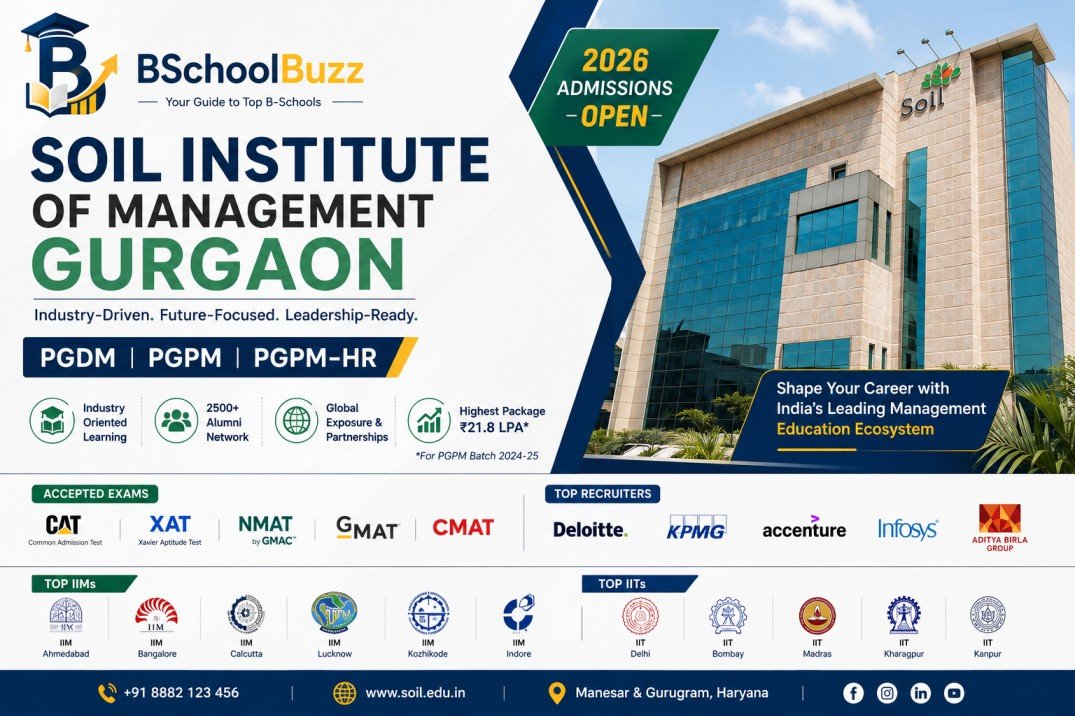
- SOIL Institute of Management offers two-year PGDM and one-year PGPM/PGPM-HR programs focused on experiential learning, leadership development, design thinking, and industry exposure. The institute provides specializations in Marketing, Finance, HR, and Analytics, with admissions based on accepted entrance exams, academic profile, and selection rounds. For 2026, SOIL’s fees range from approximately ₹14.5 lakh to ₹17.2 lakh, while reported placement outcomes include average packages of around ₹11–12.3 LPA, depending on the program.
For MBA and PGDM aspirants looking beyond the traditional IIM route, SOIL Institute of Management has become a business school worth evaluating, particularly for students interested in experiential learning, design thinking, leadership development and industry exposure.
SOIL, which stands for School of Inspired Leadership, was established in 2008 and was co-created with 32 Indian and multinational companies. The institute says its programs are designed around developing leaders with character, competence and enthusiasm, with a strong emphasis on ethics, sustainability, practical learning and industry interaction.
For the 2026 admission cycle, SOIL offered three full-time postgraduate management programs: the two-year PGDM, the one-year PGPM in Business Leadership and the one-year PGPM-HR. The PGDM is based at the Manesar campus, while the one-year PGPM and PGPM-HR programs are based at the Gurugram campus.
What makes the institute different is not simply its program duration or location. SOIL has built its academic identity around design thinking, experiential learning, leadership development, live projects, mentoring and exposure to industry professionals. The PGDM, in particular, combines business education with design thinking and liberal arts, while offering specializations in areas such as Marketing, Finance, Human Resources and Analytics.
This article covers the information a student needs before considering SOIL in 2026, including courses, eligibility, entrance exams, fees, admission process, curriculum, placements, scholarships, campus life, career opportunities, ROI and the factors that should be considered before accepting an offer.
SOIL Institute of Management at a Glance
| Particular | Details |
|---|---|
| Institute | SOIL Institute of Management |
| Established | 2008 |
| Location | Gurugram and Manesar, Haryana |
| PGDM duration | 2 years |
| PGPM duration | 1 year |
| PGPM-HR duration | 1 year |
| PGDM campus | Manesar, New Gurgaon |
| PGPM campus | Gurugram |
| PGPM-HR campus | Gurugram |
| PGDM work-experience eligibility | Freshers and candidates with less than 3 years of experience |
| PGPM work-experience requirement | Minimum 2 years |
| PGDM entrance exams | CAT, XAT, GMAT, MAT, CMAT, NMAT and other accepted scores depending on the cycle |
| PGDM 2026-28 fee | Approximately ₹17.20 lakh plus refundable security deposit |
| PGPM fee listed for the relevant 2026 cycle | ₹15.33 lakh including applicable GST and refundable caution deposit |
| PGPM-HR fee listed for the relevant 2026 cycle | ₹14.50 lakh including applicable GST and refundable security deposit |
| PGPM latest published average CTC | ₹12.30 LPA |
| PGPM latest published highest CTC | ₹21.80 LPA |
| PGDM latest published average salary for Class of 2023-25 | ₹11.17 LPA |
| PGDM latest published highest salary for Class of 2023-25 | ₹20.70 LPA |
The figures above should be read with their respective batch and reporting year. SOIL's current website has moved on to subsequent admission cycles in some sections, so applicants should always confirm the fee and admission schedule for the specific batch they are applying to.
What Is SOIL Institute of Management?
SOIL Institute of Management is a private management education institution based in the Gurugram-Manesar region of Haryana. It was founded in 2008 with participation from corporate leaders and organizations and has positioned itself around leadership, experiential learning and responsible management.
According to the institute, SOIL was co-created by 32 leading companies and supported by 25 NGOs. Its stated objective is to develop managers who can balance business performance with social and environmental considerations.
The institute's corporate consortium is an important part of its identity. SOIL describes the consortium as a group of Indian and multinational companies that have been involved in areas such as networking, mentoring, workshops and career opportunities.
This industry connection is reflected in the way SOIL describes its academic model. Instead of relying entirely on lectures and conventional examinations, the school emphasizes projects, simulations, design-thinking exercises, leadership events, case-based problem solving and interactions with industry professionals.
The institute also says that it has more than 2,800 alumni from its postgraduate programs, with its broader executive education and consulting network extending across more than 30 countries.
Students considering SOIL should therefore understand that its positioning is somewhat different from a conventional university-style MBA. The institution places considerable emphasis on the application of management concepts rather than treating the classroom as the only learning environment.
Why Is SOIL Different From a Traditional B-School?
There are several elements that distinguish SOIL's academic positioning.
Industry-created approach
SOIL's association with 32 Indian and multinational companies is one of the school's most frequently highlighted differentiators. The institute says these companies contribute to the ecosystem through mentoring, workshops, networking and career-related opportunities.
This does not mean that every student automatically receives a job from a consortium company. Rather, the consortium is part of the broader industry ecosystem surrounding the programs.
Design thinking
Design thinking is central to the PGDM experience. SOIL describes its two-year PGDM as integrating business, design thinking and liberal arts.
Students are exposed to the design-thinking process through activities involving empathy, problem definition, ideation, prototyping and testing. The same philosophy also appears in the admissions process, where shortlisted applicants participate in a Design Thinking Workshop before the personal interview.
Experiential learning
SOIL states that a significant portion of its learning approach involves experiential immersion. For the PGPM, the institute currently describes approximately half of the curriculum as experiential immersion and highlights live projects, mentoring and industry exposure.
For a student who learns better by doing rather than simply memorizing concepts, this can be an important advantage.
Leadership development
Leadership is another major theme throughout SOIL's programs.
The one-year PGPM is specifically positioned around leadership development and career acceleration. The institute describes the program as a 12-month full-time course for professionals seeking faster career progression and broader managerial capabilities.
Location
SOIL's campuses are located in the Gurugram-Manesar business ecosystem. Gurugram is one of India's major corporate hubs, which gives students geographical proximity to a large number of companies, startups, consulting firms and corporate offices.
Location alone does not guarantee placements, but it can contribute to opportunities for industry interaction, events, networking and internships.
Courses Offered at SOIL Institute of Management
For the 2026 cycle, students could broadly consider three full-time postgraduate management options:
Two-year PGDM
One-year PGPM in Business Leadership
One-year PGPM-HR
The three programs are designed for different student profiles.
| Program | Duration | Typical candidate profile | Location |
|---|---|---|---|
| PGDM | 2 years | Freshers and early-career candidates | Manesar |
| PGPM | 1 year | Working professionals | Gurugram |
| PGPM-HR | 1 year | Candidates targeting HR careers with relevant experience requirements | Gurugram |
SOIL's media information describes these as its three full-time postgraduate programs, with the PGDM being AICTE approved and integrating design thinking and liberal arts.
SOIL PGDM 2026
The two-year PGDM is the program most relevant to fresh graduates and early-career candidates.
SOIL describes it as an AICTE-approved two-year PGDM that integrates Business, Design Thinking and Liberal Arts. The program offers specialization areas including Finance, Marketing, Human Resources and Analytics.
The 2026-28 admission information states that freshers and candidates with less than three years of full-time work experience as of June 30, 2026, were eligible. Internships and part-time jobs were not treated as full-time work experience.
The PGDM is particularly relevant for students who want a two-year campus-based management education and are not yet eligible or interested in a one-year executive-style management program.
PGDM specializations
SOIL lists four major specialization areas:
Finance
Marketing
Human Resources
Analytics
The combination is useful for students who want to build a broad management foundation and then develop deeper capability in a particular business function.
What makes the PGDM curriculum distinctive?
The program combines conventional management subjects with design thinking and liberal arts.
This can be useful because modern management roles increasingly require more than functional knowledge. A marketing manager may need analytics. A finance professional may need communication and strategic thinking. A product manager may need customer empathy and design thinking.
SOIL's curriculum is therefore built around the idea that management education should combine analytical, creative, interpersonal and leadership capabilities.
SOIL PGDM Eligibility 2026
For the 2026-28 PGDM cycle, the broad eligibility requirements included:
A bachelor's degree in any discipline from a recognized institution.
Freshers and candidates with less than three years of full-time work experience as of June 30, 2026.
Candidates needed to have completed their undergraduate degree within the specified admission timeline.
Candidates were required to submit an accepted management entrance examination score.
SOIL's 2026 PGDM admission information listed GMAT, CAT, XAT, MAT and CMAT among the accepted examinations, with NMAT considered subject to the conditions specified by the institute.
The institute also states that applicants may submit multiple examination scores and that the best score can be considered during shortlisting.
Does SOIL PGDM Accept CAT?
Yes. CAT is among the entrance examinations accepted for the PGDM.
For the 2026-28 cycle, SOIL's application portal specifically referred to CAT 2025 takers, XAT 2026 takers and NMAT 2025 takers, along with accepted GMAT and MAT scores.
The exact accepted examination year changes from one admission cycle to another, so applicants should not assume that an older CAT, XAT or NMAT score will automatically remain valid for a future cycle.
SOIL PGDM Admission Process
The SOIL admission process is more than an entrance-test score.
The 2026 PGDM process included several stages:
Application: Candidates complete the online application and submit their academic, test-score and profile information.
Profile shortlisting: SOIL states that it evaluates candidates on their overall profile rather than relying exclusively on the entrance examination score.
Design Thinking Workshop: Shortlisted candidates participate in a hands-on activity built around design thinking.
Personal Interview: Candidates who proceed through the workshop participate in a personal interview. SOIL describes the interview as involving faculty and senior industry members.
Final selection: The final decision is based on the overall evaluation.
This approach means that applicants should not prepare for SOIL only by focusing on their CAT or XAT percentile. Their academic background, achievements, communication skills, problem-solving approach, work experience and interview performance can also matter.
SOIL PGDM Design Thinking Workshop
The Design Thinking Workshop is one of the more distinctive parts of the SOIL admission process.
Candidates are introduced to the design-thinking methodology and are required to work through five broad stages:
Empathize
Define
Ideate
Prototype
Test
The objective is not simply to see whether a candidate knows the textbook definition of design thinking. The activity gives the admissions team an opportunity to observe how candidates understand a problem, collaborate, generate solutions and communicate their thinking.
For applicants, preparation should therefore focus on structured thinking rather than memorized answers.
SOIL PGDM Fees 2026
For the 2026-28 batch, the published fee information indicates a total academic fee of approximately ₹17.20 lakh, with a refundable security deposit of ₹30,000. The detailed fee structure includes tuition, program fees, student activity charges, insurance, knowledge resources and alumni subscription.
A broad breakdown reported for the 2026-28 structure is:
| Fee component | Amount |
|---|---|
| Tuition fee | ₹9.85 lakh |
| Program fee | ₹6.70 lakh |
| Student activity charges | ₹47,000 |
| Personal accidental benefit/insurance | ₹5,000 |
| Knowledge resources | ₹3,000 |
| Alumni subscription | ₹10,000 |
| Total academic fee | ₹17.20 lakh |
| Refundable security deposit | ₹30,000 |
The exact amount payable and payment schedule should be confirmed from the offer letter and official fee communication because individual charges and policies can change between admission cycles. The official SOIL FAQ currently lists ₹17.20 lakh as the PGDM fee for the 2027-29 batch, while the 2026 application material confirms the 2026-28 program and its admission structure.
SOIL PGPM 2026
The one-year PGPM is designed for candidates with prior professional experience.
Unlike the two-year PGDM, the PGPM is a 12-month full-time program based in Gurugram. SOIL describes it as a Business Leadership program focused on career acceleration, leadership development and experiential learning.
For the relevant 2026 admission cycle, SOIL required:
A bachelor's degree in any discipline from a recognized institution.
At least 50% marks in graduation.
More than 60% in both Class 10 and Class 12.
Minimum two years of prior work experience.
A valid accepted entrance score, with CAT, NMAT and XAT among the accepted tests.
Candidates without one of the specified scores could take the SOIL SAT according to the admission rules.
This makes the PGPM fundamentally different from the PGDM.
A recent graduate looking for a first management degree would generally be more relevant to the PGDM, whereas a professional with at least two years of experience may evaluate the PGPM as a one-year career-acceleration option.
SOIL PGPM Specializations
SOIL lists Finance, Marketing and Analytics as specialization areas for the one-year PGPM. Students can select their specialization from the second term onward, while the first term provides a common foundation.
This structure gives students an opportunity to build general management capabilities before moving toward a functional area.
For example, someone with experience in sales may choose Marketing, while a professional from an operations or technology background may consider Analytics depending on their career goals.
SOIL PGPM Fees 2026
SOIL's official PGPM fee page lists the following fee structure for the relevant program:
| Fee component | Amount before GST | GST | Total |
|---|---|---|---|
| Tuition & Academic Fee | ₹8,12,000 | ₹1,46,160 | ₹9,58,160 |
| Program Fee | ₹4,56,921 | ₹82,245 | ₹5,39,166 |
| Alumni Association Membership | ₹5,000 | ₹900 | ₹5,900 |
| Refundable Caution Deposit | ₹30,000 | — | ₹30,000 |
| Total | ₹13,03,921 | ₹2,29,305 | ₹15,33,226 |
The institute states that the displayed total excludes certain expenses such as accommodation, books, course materials and other personal expenses.
Therefore, a student calculating the actual cost of attending the PGPM should not look only at the headline academic fee. Living expenses and other personal costs need to be included in the financial plan.
SOIL PGPM-HR 2026
The PGPM-HR is the specialized one-year program for candidates interested in Human Resources and people-management careers.
The curriculum includes HR-focused learning alongside broader business education. SOIL also highlights HR Labs, consulting projects and experiential activities as part of the program.
The program is particularly relevant for candidates targeting careers in areas such as:
Talent management
Human resources consulting
Learning and development
Compensation and benefits
Performance management
Employee relations
HR business partnering
People analytics
SOIL PGPM-HR Fees 2026
The official fee page lists the PGPM-HR total at ₹14.50 lakh, including applicable GST and the refundable security deposit.
| Fee component | Amount before GST | GST | Total |
|---|---|---|---|
| Tuition & Academic Fee | ₹7,66,626 | ₹1,37,993 | ₹9,04,618 |
| Program Fee | ₹4,31,763 | ₹77,718 | ₹5,09,482 |
| Alumni Subscription | ₹5,000 | ₹900 | ₹5,900 |
| Refundable Security Deposit | ₹30,000 | — | ₹30,000 |
| Total | ₹12,33,389 | ₹2,16,611 | ₹14,50,000 |
Accommodation, books, course materials and personal expenses may be additional depending on the student's circumstances.
SOIL Institute of Management Placements
Placements are one of the most important factors for students evaluating a private B-school, and SOIL publishes placement figures for its programs.
The latest placement information displayed by SOIL for its PGPM reports:
Highest CTC: ₹21.80 LPA
Average CTC: ₹12.30 LPA
Top 25% CTC: ₹18.80 LPA
Top 50% CTC: ₹15.40 LPA
Top 75% CTC: ₹13.50 LPA
SOIL also reports sector-wise hiring participation, with IT & ITES accounting for 54% of offers, followed by BFSI at 10%, Consulting at 10%, Manufacturing at 7%, Pharma at 3% and other sectors at 16%.
These numbers are more useful when read as a distribution rather than focusing only on the highest package.
A ₹21.80 LPA highest CTC is not the salary that every student should expect. The average and top-quartile figures provide a more meaningful indication of the range of outcomes reported by the school.
SOIL PGPM Placement Highlights
SOIL's PGPM placement material also reports:
₹21.8 LPA highest CTC
₹18.8 LPA CTC for the top 25%
₹15.4 LPA average for the top 50% placed students
70+ visiting firms
More than 2,000 alumni
A reported 2.2x increase in average CTC post-PGPM
The institute also highlights a strong presence of roles in consulting, product, strategy, marketing, finance, operations and analytics.
For experienced professionals, the relevance of the PGPM therefore depends heavily on the candidate's pre-MBA experience, function and career objective.
SOIL PGDM Placements
The PGDM placement figures should be evaluated separately from the one-year PGPM.
SOIL's current FAQ reports that the average salary for the Class of 2023-25 was ₹11.17 LPA, while the highest placement was ₹20.70 LPA.
The institute's older PGDM career page also displays other placement metrics, including a ₹15 lakh highest CTC and ₹8.61 lakh average CTC. Because these figures refer to an earlier placement dataset, they should not be mixed with the more recent Class of 2023-25 figures.
This distinction is important when comparing B-schools. Placement numbers should always be attached to a specific graduating batch and program.
Who Recruits From SOIL?
SOIL highlights recruiters and corporate relationships across sectors.
Recruiter names mentioned by SOIL across its program and placement material include organizations such as:
Aditya Birla Group
Infosys
Accenture
Deloitte
KPMG
PwC
ICICI
HDFC
Marico
Mahindra & Mahindra
Cognizant
Volvo Eicher
Paytm
HCL
The actual companies and number of offers can vary by batch and program, so the presence of a company in the school's broader recruiter ecosystem should not be interpreted as a guarantee that every batch receives offers from that organization.
What Roles Can SOIL Graduates Get?
The career opportunities after SOIL depend on the program, specialization, previous experience and individual performance.
Common functional areas include:
Marketing
Students interested in marketing can target roles in:
Brand management
Digital marketing
Product marketing
Sales and marketing
Market research
Growth marketing
Category management
Business development
Finance
Finance-oriented candidates can explore:
Corporate finance
Financial analysis
Investment-related roles
Banking
BFSI
Risk
Business finance
Financial planning and analysis
The availability of highly specialized investment-banking or front-office finance roles should not be assumed simply because Finance is a specialization. Students targeting such careers should compare SOIL with schools that have particularly strong finance placement ecosystems.
Analytics
Analytics-oriented roles can include:
Business analyst
Data analyst
Business intelligence
Strategy analytics
Marketing analytics
Operations analytics
Product analytics
Candidates entering these roles may benefit from combining management education with practical skills such as Excel, SQL, Power BI, Python or other analytical tools.
Human Resources
HR roles may include:
HR business partner
Talent acquisition
Learning and development
Compensation and benefits
HR consulting
Performance management
People analytics
Consulting and Strategy
SOIL's programs also expose students to consulting and strategic problem-solving. However, students should differentiate between general management/consulting roles and highly selective strategy-consulting roles.
The latter are heavily dependent on profile, academic record, interview performance and the recruiting landscape of the particular batch.
SOIL Institute of Management Placement Reality: How Should Students Read the Numbers?
The most important lesson when looking at SOIL placements is not to focus only on the highest package.
Suppose a student sees ₹21.80 LPA as the highest PGPM CTC. That number is useful, but it does not answer the question: "What salary can I realistically expect?"
The average of ₹12.30 LPA provides another reference point. The top 25% figure of ₹18.80 LPA and top 50% figure of ₹15.40 LPA provide additional context.
A student should also ask:
What was the median CTC?
How many students were in the batch?
How many students received offers?
What proportion of the package was fixed?
Which roles were offered?
Which companies hired for those roles?
How many students changed functions?
How much previous work experience did the placed students have?
The answer to these questions is more valuable than looking at a single highest package.
SOIL ROI: Is It Worth the Fee?
Return on investment is one of the most important questions for a private B-school.
For the PGDM, the reported 2026-28 academic fee is around ₹17.20 lakh, excluding the refundable security deposit and potentially other living or personal expenses.
For the PGPM, the official listed total is ₹15.33 lakh before considering accommodation and other personal expenses.
This means the student should not evaluate ROI simply as:
Average salary ÷ tuition fee
A more realistic calculation includes:
Total education cost + living cost + financing cost + opportunity cost
For a fresher joining the PGDM, two years without a full-time salary also represent an opportunity cost.
For an experienced professional joining the PGPM, the opportunity cost may be even more important because the candidate leaves the workforce for a year.
At the same time, a higher post-MBA salary can potentially offset the cost over several years.
The right ROI question is therefore not simply "Is SOIL cheap?" but "Does the expected career improvement justify the total cost for my profile?"
SOIL Scholarships
SOIL offers scholarships across its programs.
The institute states that it has allocated scholarships worth ₹2 crore across its programs and lists categories such as:
Merit-based scholarships
Dr. Vikram Batra Scholarship
Women in Leadership Scholarship
Scholarships connected with NGO/non-profit work
Other program-specific scholarship categories
The PGDM information also mentions need-based, merit-based, unique achievement, Dr. Verghese Kurien and defence-related scholarship categories.
Scholarship rules, deadlines and eligibility conditions can vary, so students should check the scholarship deadline associated with the admission cycle rather than assuming that a scholarship application remains open until the final admission deadline.
SOIL Education Loan Options
Students who require financing can explore education loans.
SOIL's official pages mention relationships or financing options involving institutions such as Bank of Baroda, Axis Bank, Credila, Yes Bank, IDFC First Bank, ICICI Bank, Avanse, Tata Capital and other providers.
Loan terms vary by lender, borrower profile, collateral requirements, interest rate, repayment period and approval conditions.
Students should compare the total repayment amount rather than choosing a loan based only on the advertised interest rate.
SOIL Faculty and Learning Environment
SOIL describes its faculty ecosystem as a combination of experienced academic faculty, visiting professors, industry leaders and international faculty.
The institute says its faculty includes people associated with institutions such as IIMs, ISB and international universities.
The learning approach includes:
Case-based learning
Simulations
Design thinking
Live projects
Industry interaction
Leadership sessions
Mentoring
Experiential immersion
Consulting projects
This style is particularly suited to students who enjoy discussions, presentations, group work and practical problem solving.
Students who prefer a highly examination-oriented environment may find the experience different from what they expect from a conventional university.
SOIL Leadership Events
Leadership development is an important part of the institute's positioning.
SOIL states that it conducts more than 100 leadership events and invites leaders from different backgrounds to interact with students.
Such events can provide exposure to career stories, management challenges and industry perspectives that are difficult to reproduce through textbooks alone.
However, the value a student gets from these opportunities depends heavily on participation. Simply having industry events on campus does not automatically create career value; students need to network, ask questions, build relationships and follow up professionally.
SOIL International Immersion
International exposure is another component promoted by SOIL.
The PGDM international immersion program is designed to expose students to international education, culture and business environments.
The 2026 PGDM admission material describes the Global Immersion Experience as an optional overseas study opportunity that can involve additional costs depending on the destination and value-added experiences.
Students should therefore distinguish between an international immersion opportunity and a guaranteed international placement. They are not the same thing.
SOIL Campus and Location
SOIL operates across two locations.
The one-year PGPM and PGPM-HR are associated with the Gurugram campus at Plot 76, Sector 44, Gurugram. The PGDM is based at Plot 23, Sector 2, Phase 1, Manesar, New Gurgaon.
The Gurugram location provides access to one of India's major corporate ecosystems.
The Manesar campus, meanwhile, provides a more residential business-school environment for the two-year PGDM.
SOIL's information also mentions digital library resources, smart classrooms, design labs and digital infrastructure for PGDM students.
Does SOIL Have Hostel Facilities?
Hostel arrangements differ by program and current policy.
SOIL's current PGPM FAQ states that it does not provide a dedicated hostel but has partnered with nearby accommodation providers.
The older PGDM admission material describes hostel accommodation and residential arrangements for the PGDM program. Because accommodation policies can change between batches, students should confirm the exact residential arrangement for their admission year before making financial or relocation plans.
SOIL Student Life
Student life at a management institute is not limited to classes.
SOIL describes student activities, clubs, cultural events, wellness activities and leadership-oriented experiences as part of its broader campus environment.
The experiential nature of the program also means that students can spend substantial time working on group assignments, presentations, simulations, projects and workshops.
This can be demanding.
A student joining SOIL should be prepared for collaborative work rather than expecting an MBA to consist primarily of lectures followed by examinations.
SOIL for Freshers
SOIL can be considered by fresh graduates because its two-year PGDM accepts freshers and candidates with less than three years of work experience.
For a fresher, the major advantages of the two-year format include:
More time for academic development
Internship opportunity
Campus experience
Functional specialization
Peer learning
Leadership activities
Career preparation
Time to build professional networks
At the same time, freshers should be realistic about placements.
A management degree does not automatically convert into a high-paying job. A fresher's final outcome depends on academic performance, communication, internships, projects, interview preparation, functional skills and the recruitment market.
SOIL for Candidates With Work Experience
For professionals, the one-year PGPM is arguably the more relevant program.
The institute specifically requires a minimum of two years of prior work experience for PGPM eligibility.
The program is intended to accelerate careers rather than simply provide a first management qualification.
SOIL says that its PGPM participants can move into roles such as Senior Manager, Associate Director, Head of Function and General Manager depending on their previous experience and career trajectory.
However, students should not interpret these titles as guaranteed outcomes. Career progression after a one-year MBA-equivalent program is highly dependent on prior professional experience and the quality of the student's profile.
SOIL for Marketing Aspirants
Marketing is one of the specialization areas available in both the PGDM ecosystem and PGPM.
Students interested in marketing can use the program to develop skills across:
Consumer behaviour
Brand management
Digital marketing
Marketing analytics
Sales
Product marketing
Growth
Market research
Business development
For someone who wants a career in digital or performance marketing, it is also useful to develop practical skills outside the classroom, such as Google Ads, Meta Ads, SEO, analytics, CRM and marketing automation.
The degree can provide the management foundation, but functional skill depth still matters.
SOIL for Finance Aspirants
SOIL offers Finance as a specialization area.
Students interested in finance should, however, be precise about their intended career.
There is a substantial difference between:
Corporate finance
FP&A
BFSI
Credit
Risk
Wealth management
Equity research
Investment banking
Private equity
Financial analytics
A student targeting highly selective front-office finance roles should compare SOIL's recruiter mix and role quality with schools that have particularly strong finance placement ecosystems.
For corporate finance, banking, BFSI and analytical roles, the opportunity set may be broader.
SOIL for Analytics Aspirants
Analytics is another specialization area.
The value of an analytics-focused management program is highest when students combine management knowledge with technical capability.
Students should consider building skills in:
Advanced Excel
SQL
Power BI
Tableau
Python
Statistics
Data visualization
Business experimentation
A B-school can teach the business context, but employers often evaluate whether candidates can actually use analytical tools to solve business problems.
SOIL for HR Aspirants
The PGPM-HR is specifically designed for students targeting Human Resources.
The program uses HR-focused practical experiences such as HR Labs and consulting projects, according to SOIL's program information.
Students interested in HR should consider whether they want to work in:
Talent acquisition
HR consulting
Learning and development
Compensation
Employee relations
HRBP roles
People analytics
Organizational development
The PGPM-HR may be more directly relevant than choosing a general management program and attempting to move into HR later.
SOIL vs IIMs
SOIL and IIMs should not be treated as interchangeable institutions.
The Indian Institutes of Management generally have much longer institutional histories, larger alumni networks and stronger brand recognition in the management education market.
However, admission competitiveness, fees, program duration and career objectives differ significantly.
A student who has a realistic opportunity to join a highly preferred IIM program should normally compare the specific IIM program against SOIL rather than treating the two simply as generic MBA degrees.
For candidates who do not convert their preferred IIMs, SOIL can become part of a broader private B-school decision set.
The right comparison should include:
Program
Fees
Placement quality
Median salary
Recruiter quality
Role quality
Alumni network
Location
Batch size
Career services
Personal profile
Opportunity cost
SOIL vs Other Private B-Schools
The same principle applies when comparing SOIL with other private management institutes.
Do not rank colleges solely according to a generic "Tier 1/Tier 2/Tier 3" label.
Instead, compare the actual program.
For example, a student targeting marketing may value a college with strong FMCG and digital marketing recruiters. A finance candidate may prefer a college with a deeper banking and finance recruiter base. A candidate targeting analytics may prioritize business analytics and technology roles.
The best college for one profile is not necessarily the best college for another.
Is SOIL Institute of Management Worth It?
The answer depends on the student's profile.
SOIL can make sense for a candidate who values:
Experiential learning
Design thinking
Industry interaction
Leadership development
Gurugram location
A private B-school environment
Marketing, Finance, HR or Analytics specialization
A structured career-management ecosystem
The financial calculation is particularly important.
For the two-year PGDM, the 2026-28 academic fee was around ₹17.20 lakh. For the one-year PGPM, the official fee page lists ₹15.33 lakh including applicable GST and the refundable deposit.
Therefore, a candidate should not accept an offer simply because the highest package appears attractive.
The decision should be based on the combination of career objective, existing profile, expected placement opportunity, total cost and alternative colleges available.
Who Should Consider SOIL?
SOIL may be worth serious consideration if you fall into one of these categories:
Fresh graduate with a moderate entrance score: The two-year PGDM can provide a structured management education and access to the business-school recruitment ecosystem.
Early-career professional: Candidates with limited work experience can use the PGDM to transition into a broader management role.
Experienced professional: Candidates with at least two years of work experience can evaluate the one-year PGPM for career acceleration.
HR-focused professional: The PGPM-HR provides a more specialized route into people-management careers.
Student interested in design thinking: The integration of business, design thinking and liberal arts is one of SOIL's distinctive academic features.
Student who prefers practical learning: Projects, simulations, workshops and industry interactions may be more appealing than a purely lecture-based model.
Who Should Think Twice Before Joining SOIL?
SOIL may not be the right choice for everyone.
A student should be cautious if:
They have a significantly stronger college option available.
They are joining solely because of the highest advertised package.
They have not calculated the complete cost of attendance.
They expect a guaranteed placement.
They want a very strong investment-banking-focused ecosystem.
They are unwilling to participate in group projects and experiential activities.
They are uncomfortable with the financial burden of a private B-school.
Their primary objective is a specific role that SOIL does not recruit strongly for.
The best B-school decision is not about finding the institution with the most impressive marketing message. It is about finding the institution that provides the strongest fit for the candidate's career objective and available alternatives.
How to Prepare for SOIL Admission
Applicants can improve their preparation by focusing on four broad areas.
Build a strong application
Your application should clearly communicate:
Academic background
Work experience
Achievements
Leadership experiences
Extracurricular activities
Career goals
Why management education
Why the particular SOIL program
Prepare for the Design Thinking Workshop
Do not memorize design-thinking definitions.
Instead, practice:
Problem identification
User empathy
Structured brainstorming
Prioritization
Creative thinking
Collaboration
Presentation
Prepare for the personal interview
Common areas can include:
Academic background
Work experience
Current role
Career goals
Why MBA/PGDM
Why SOIL
Strengths and weaknesses
Leadership experiences
Current affairs
Industry knowledge
Academic fundamentals
Understand your career goal
A vague answer such as "I want to become a successful manager" is unlikely to demonstrate a strong career plan.
A better answer explains:
Current background → skill gap → management education → target function → target industry → long-term career direction
Documents Required for SOIL Admission
Applicants should be prepared to provide documents such as:
Class 10 marksheet
Class 12 marksheet
Graduation marksheets
Graduation certificate or proof of completion
Entrance examination scorecard
Government identity proof
Work-experience documents, where applicable
Certificates supporting achievements
Other documents requested by the admissions team
SOIL also states that background verification is conducted for enrolled candidates and that original academic documents may be required for verification.
SOIL Application Fee
For the 2026 PGDM application, the application fee was ₹2,000 and was non-refundable.
Applicants should pay application fees only through the official application process and should be cautious about unofficial coupon or payment schemes. SOIL's application portal specifically warns applicants against unauthorized application-fee coupon schemes.
SOIL Admission Deadlines
Admission deadlines vary by program and cycle.
For the 2026 PGDM cycle, SOIL's application material referenced the 2026-28 program and the June 2026 academic start. The institute's pages also show that the school operates multiple admission cycles.
Students should not rely on a deadline copied from an older article because admission dates can change.
For the latest application information, candidates should check the official SOIL admissions page before submitting an application.
SOIL Rankings
SOIL's own admissions page highlights several ranking positions, including rankings in private B-school and one-year MBA categories.
Third-party ranking platforms also publish their own 2026 rankings. For example, Collegedunia reports SOIL at #85 among 350 MBA colleges in India in one of its 2026 ranking tables, while its India Today and IIRF tables show different positions.
These numbers should not be treated as a universal ranking of the institute because different agencies use different methodologies.
When evaluating a B-school, rankings should be treated as one input rather than the final decision-making factor.
Accreditation and Recognition
SOIL's two-year PGDM is described by the institute as AICTE approved.
This is important because students should distinguish between different types of management programs and the regulatory framework applicable to them.
The PGDM is not simply identical to an MBA degree issued by a university. It is a postgraduate diploma program approved under the relevant regulatory framework.
Applicants should review the exact qualification awarded by the program they intend to join and understand how it fits their future career, employment and higher-education plans.
What Makes SOIL's PGDM a Business Design Program?
The PGDM is strongly connected to the idea of Business Design.
The basic concept is that management problems are not always solved by applying a standard business formula. Managers need to understand customers, identify problems, generate solutions, test ideas and adapt.
This is why SOIL integrates design thinking into management education.
A student may therefore encounter situations where they are asked to:
Understand a customer problem
Define the underlying issue
Generate alternative solutions
Build a prototype
Test assumptions
Present findings
Work in teams
This learning approach can be especially useful for students considering entrepreneurship, product management, marketing, consulting and innovation-oriented careers.
SOIL and Entrepreneurship
SOIL's PGDM information states that the program provides a foundation in business fundamentals while also emphasizing design thinking, innovation and values-based leadership. It also highlights mentorship, industry connections and potential incubation support as part of the entrepreneurial ecosystem.
For an aspiring entrepreneur, the value of an MBA is not necessarily the placement package.
Networking, access to mentors, structured business knowledge, peer relationships, market understanding and exposure to different industries can be equally valuable.
However, students who already have a strong startup opportunity should calculate the opportunity cost of spending two full years in a residential program.
SOIL Alumni Network
SOIL's media information states that the institute has more than 2,800 alumni from its postgraduate programs and a broader network extending across more than 30 countries.
An alumni network becomes useful when students actively use it.
For example, students can seek alumni guidance regarding:
Interview preparation
Career transitions
Industry knowledge
Internship opportunities
Role expectations
Salary negotiation
Functional skills
Professional networking
The quality of an alumni network should therefore be evaluated not only by its size but also by its relevance to the student's target career.
SOIL Career Development Support
SOIL describes its Career Management Services as supporting students through career preparation and employer connections.
The institute states that its career team works with employers ranging from Fortune 500 companies to startups and that students receive placement support.
Career support can include:
Resume preparation
Interview preparation
Industry interaction
Employer engagement
Career counselling
Placement processes
But students should still treat career development as a shared responsibility.
The most successful students usually do not wait until placement season to build employability.
How to Improve Your Chances of a Good Placement at SOIL
Students can improve their placement prospects by starting early.
Build a strong resume from the first term.
Take internships and live projects seriously.
Develop at least one functional skill that employers can test.
For marketing, learn analytics and digital tools.
For finance, build financial modelling and valuation skills.
For analytics, develop SQL, Excel, Power BI and statistics.
For HR, learn people analytics and HR technology.
For consulting, practice case interviews and structured problem solving.
Also work on communication.
A management graduate is expected to communicate ideas clearly in meetings, presentations, interviews and written documents.
SOIL Institute of Management: Advantages
Several features can make SOIL attractive.
Experiential learning: The institute emphasizes projects, simulations, workshops and real-world learning.
Design thinking: The PGDM integrates design thinking with management and liberal arts.
Industry connection: SOIL was co-created with 32 Indian and multinational companies and maintains an industry-oriented ecosystem.
Gurugram location: Students are located within a major corporate ecosystem.
Multiple programs: Freshers, early-career candidates and experienced professionals have different program options.
Specializations: Students can pursue areas such as Marketing, Finance, HR and Analytics.
Leadership focus: Leadership development is embedded across the institute's positioning.
International exposure: The school offers international immersion opportunities.
SOIL Institute of Management: Limitations to Consider
A balanced evaluation also requires considering the limitations.
Private B-school cost: The total fee is significant, particularly when living and financing costs are added.
Placement variability: Placement outcomes differ across programs and batches.
Highest package is not average package: Students should not use the highest CTC as their expected salary.
Program differences: PGDM and PGPM placement numbers should not be combined.
Career objective matters: A school that works well for marketing or general management may not be equally strong for every specialized career.
Alternative options: Students with stronger admits should compare them carefully before committing.
Location does not guarantee a job: Being in Gurugram provides proximity to companies, but individual placement depends on skills and recruiter requirements.
SOIL Institute of Management 2026: Final Verdict
SOIL Institute of Management is a management school with a distinct emphasis on experiential learning, leadership development, design thinking and industry interaction.
For the 2026 cycle, its two-year PGDM was designed for freshers and early-career candidates, while the one-year PGPM targeted professionals with at least two years of work experience. The PGPM-HR provided a specialized route for candidates interested in human resources.
The placement figures published by SOIL show a meaningful range of outcomes. For the latest PGPM placement information displayed by the institute, the average CTC is ₹12.30 LPA and the highest CTC is ₹21.80 LPA, while the top 25% and top 50% figures provide additional context.
For the PGDM, SOIL reports ₹11.17 LPA as the average salary for the Class of 2023-25 and ₹20.70 LPA as the highest placement.
The most important point for an aspirant is that these figures should be interpreted by program and batch.
If you are a fresher looking for a two-year management education, SOIL's PGDM can be evaluated on its curriculum, design-thinking approach, specialization options, internship opportunities and placement ecosystem.
If you already have professional experience, the one-year PGPM may be more relevant because it is specifically structured around career acceleration.
Ultimately, SOIL should be evaluated against the alternatives available to you. Compare the total cost, placement distribution, recruiter roles, career fit, alumni network and opportunity cost rather than relying on a single ranking or highest salary figure.
For official admission updates, fees and application information, students should use SOIL Institute of Management's official website and verify the information for their specific admission cycle.
Frequently Asked Questions
What is SOIL Institute of Management?
SOIL Institute of Management, or School of Inspired Leadership, is a private management education institution established in 2008 with campuses in Gurugram and Manesar. It offers full-time PGDM, PGPM and PGPM-HR programs.
Is SOIL Institute of Management good for an MBA?
SOIL can be a relevant option for students who value experiential learning, leadership development, design thinking and industry exposure. Whether it is the right choice depends on the student's profile, career goal, alternative college options and total cost.
Is SOIL Institute of Management AICTE approved?
SOIL's two-year PGDM is described by the institute as AICTE approved.
Does SOIL accept CAT?
Yes. CAT is accepted for the PGDM, subject to the specific examination year and admission-cycle requirements. For the 2026-28 PGDM cycle, CAT 2025 was among the accepted scores.
What is the SOIL PGDM fee for 2026?
The published 2026-28 fee was approximately ₹17.20 lakh, with a refundable security deposit of ₹30,000. The exact payment schedule and applicable charges should be confirmed from the admission communication.
What is the SOIL PGPM fee?
The official PGPM fee page lists a total of ₹15,33,226 including applicable GST and the refundable caution deposit. Accommodation, books, course materials and some other expenses are additional.
What is the highest package at SOIL?
SOIL's latest published PGPM placement information reports a highest CTC of ₹21.80 LPA.
What is the average package at SOIL?
The latest PGPM placement information displayed by SOIL reports an average CTC of ₹12.30 LPA. For the PGDM, SOIL's FAQ reports an average salary of ₹11.17 LPA for the Class of 2023-25.
What is the average package of SOIL PGDM?
SOIL reports an average salary of ₹11.17 LPA for its Class of 2023-25 PGDM placement data.
Does SOIL accept students without work experience?
Yes. Freshers are eligible for the two-year PGDM. The one-year PGPM, in contrast, requires a minimum of two years of prior work experience.
What entrance exams are accepted by SOIL PGDM?
The 2026 PGDM admission information listed GMAT, CAT, XAT, MAT and CMAT, with NMAT considered subject to the conditions specified by SOIL.
What specializations are available at SOIL?
The PGDM offers specializations in Finance, Marketing, Human Resources and Analytics. The PGPM offers Finance, Marketing and Analytics specializations.
Is SOIL good for freshers?
The two-year PGDM is designed to accommodate freshers and candidates with less than three years of work experience. Whether it is a good option depends on the student's profile, alternatives and career objective.
Is SOIL good for working professionals?
The one-year PGPM is specifically designed for candidates with prior work experience and focuses on career acceleration and leadership development.
Does SOIL offer an HR program?
Yes. SOIL offers a one-year PGPM-HR program focused on Human Resources.
Does SOIL provide scholarships?
Yes. SOIL lists merit-based, need-based and other scholarship categories across its programs. It states that scholarships worth ₹2 crore have been allocated across its programs.
Does SOIL provide education loans?
SOIL lists several education-financing providers and bank relationships, including Bank of Baroda, Axis Bank, Credila, Yes Bank, IDFC and others.
Where is SOIL located?
SOIL's PGPM and PGPM-HR programs are based in Gurugram, while the PGDM campus is located in Manesar, New Gurgaon.
Does SOIL offer international exposure?
Yes. SOIL offers international immersion opportunities, including a Global Immersion Experience for eligible students. The experience can involve additional charges depending on the destination and program.
What is the SOIL admission process?
For the PGDM, the process includes an application, profile shortlisting, a Design Thinking Workshop and a Personal Interview.
Is there a separate SOIL entrance exam?
SOIL can accept specified national-level management entrance examination scores. Candidates without the required scores may have an alternative through the SOIL SAT for certain programs and admission cycles.
What is the SOIL application fee?
For the 2026 PGDM application, the application fee was ₹2,000 and was non-refundable.
Is SOIL worth the fees?
It depends on the student's career objective and alternatives. With a two-year PGDM fee of around ₹17.20 lakh and additional living costs, students should compare SOIL's placement outcomes and career opportunities against other offers before making the final decision.
Conclusion
SOIL Institute of Management occupies a distinct position among India's private management schools because of its emphasis on design thinking, experiential education, leadership development and industry interaction.
The 2026 PGDM offered a two-year route for freshers and early-career candidates, while the PGPM and PGPM-HR provided one-year options for experienced professionals. Its placement figures, specialization choices and Gurugram-Manesar location make it relevant for students considering careers in Marketing, Finance, Analytics, HR, Consulting and general management.
But the right question is not simply whether SOIL is "good" or "bad."
The better question is whether SOIL is the right choice for your profile, career goal and available alternatives.
If your priority is practical learning, industry exposure and a management curriculum built around leadership and design thinking, SOIL deserves consideration. If you have another admission offer, compare the programs using actual placement distributions, recruiter roles, total cost, alumni strength and career fit before paying the final fee.
For current admission information, students should always verify the latest details directly through SOIL's official admissions portal because deadlines, accepted test years, fees and program information can change between admission cycles.
Search Keywords
SOIL Institute of Management, SOIL Institute of Management 2026, SOIL Institute of Management Gurgaon, SOIL Institute of Management Manesar, SOIL Gurgaon, SOIL Manesar, SOIL MBA, SOIL PGDM, SOIL PGPM, SOIL PGPM HR, SOIL Institute of Management admission, SOIL admission 2026, SOIL MBA admission 2026, SOIL PGDM admission 2026, SOIL PGPM admission 2026, SOIL HR admission 2026, SOIL Institute of Management fees, SOIL MBA fees, SOIL PGDM fees, SOIL PGPM fees, SOIL PGPM HR fees, SOIL Institute of Management placement, SOIL placement 2026, SOIL MBA placement, SOIL PGDM placement, SOIL PGPM placement, SOIL average package, SOIL highest package, SOIL average salary, SOIL highest salary, SOIL placement report, SOIL placement report 2026, SOIL eligibility, SOIL MBA eligibility, SOIL PGDM eligibility, SOIL PGPM eligibility, SOIL admission criteria, SOIL selection process, SOIL admission process, SOIL entrance exam, SOIL entrance exams, SOIL CAT cutoff, SOIL CAT percentile, SOIL XAT cutoff, SOIL XAT percentile, SOIL NMAT cutoff, SOIL NMAT score, SOIL GMAT score, SOIL MAT score, SOIL CMAT score, SOIL SAT, SOIL application form, SOIL application fee, SOIL application last date, SOIL admission last date, SOIL 2026 application, SOIL 2026 admission, SOIL PGDM 2026-28, SOIL PGPM 2026, SOIL PGPM HR 2026, SOIL MBA 2026, SOIL courses, SOIL courses and fees, SOIL courses 2026, SOIL specialization, SOIL Finance specialization, SOIL Marketing specialization, SOIL Analytics specialization, SOIL HR specialization, SOIL Business Design, SOIL design thinking, SOIL liberal arts, SOIL experiential learning, SOIL industry exposure, SOIL leadership program, SOIL business school, SOIL B school, SOIL private B school, best MBA colleges Gurgaon, best PGDM colleges Gurgaon, MBA colleges in Gurgaon, PGDM colleges in Gurgaon, MBA colleges in Manesar, PGDM colleges in Manesar, MBA college Haryana, PGDM college Haryana, SOIL vs IIM, SOIL vs IMT, SOIL vs FORE, SOIL vs XIME, SOIL vs Welingkar, SOIL vs Jaipuria, SOIL ROI, SOIL ROI 2026, SOIL MBA ROI, SOIL PGDM ROI, SOIL scholarship, SOIL MBA scholarship, SOIL PGDM scholarship, SOIL education loan, SOIL campus, SOIL campus life, SOIL hostel, SOIL international immersion, SOIL alumni, SOIL faculty, SOIL recruiters, SOIL placements recruiters, SOIL career opportunities, SOIL jobs after MBA, SOIL MBA jobs, SOIL PGDM jobs, SOIL salary after MBA, SOIL career prospects, SOIL consulting jobs, SOIL marketing jobs, SOIL finance jobs, SOIL analytics jobs, SOIL HR jobs, SOIL business analytics, SOIL MBA reviews, SOIL PGDM reviews, SOIL college review, SOIL Gurgaon review, SOIL Institute of Management review, is SOIL good for MBA, is SOIL worth it, is SOIL good for PGDM, SOIL MBA worth it, SOIL PGDM worth it, SOIL admission requirements, SOIL graduation eligibility, SOIL work experience, SOIL fresher MBA, SOIL MBA for freshers, SOIL MBA for working professionals, SOIL one year MBA, SOIL one year PGPM, SOIL executive MBA, SOIL Business Leadership, SOIL HR MBA, SOIL management courses, SOIL AICTE approval, SOIL PGDM AICTE, SOIL ranking 2026, SOIL MBA ranking, SOIL Gurgaon ranking, SOIL North India ranking, SOIL top private B school, SOIL 2026 fees, SOIL 2026 placements, SOIL 2026 cutoff, SOIL 2026 eligibility, SOIL 2026 admission process, SOIL 2026 courses, SOIL 2026 scholarship, SOIL 2026 application, SOIL 2026 placement report
Long-Tail & Short-Tail Searches
SOIL Institute of Management admission 2026, what is SOIL Institute of Management, is SOIL Institute of Management good, is SOIL Gurgaon worth joining, SOIL Institute of Management fees 2026, SOIL PGDM fees 2026-28, SOIL PGPM fees 2026, SOIL PGPM HR fees 2026, SOIL MBA admission process 2026, how to get admission in SOIL, how to apply for SOIL PGDM, how to apply for SOIL PGPM, which exams are accepted by SOIL, does SOIL accept CAT score, does SOIL accept XAT score, does SOIL accept NMAT score, what CAT percentile is required for SOIL, what NMAT score is required for SOIL, what is the SOIL PGDM cutoff, what is the SOIL PGPM cutoff, SOIL interview questions, SOIL personal interview preparation, SOIL design thinking workshop, SOIL admission selection criteria, SOIL MBA eligibility for freshers, can freshers apply to SOIL PGDM, can working professionals apply to SOIL, how much work experience is required for SOIL PGPM, SOIL PGDM without work experience, SOIL MBA for freshers, SOIL one year MBA eligibility, SOIL HR program eligibility, SOIL MBA fees including hostel, SOIL PGDM total cost, SOIL PGPM total cost, SOIL MBA ROI calculation, SOIL average salary after MBA, SOIL highest salary package, SOIL PGDM average package, SOIL PGPM average package, SOIL placement reality, SOIL placement report latest, SOIL placement companies, SOIL recruiters list, SOIL jobs after PGDM, SOIL jobs after PGPM, SOIL MBA career opportunities, SOIL finance placements, SOIL marketing placements, SOIL analytics placements, SOIL HR placements, SOIL consulting placements, SOIL business analytics roles, SOIL marketing career, SOIL finance career, SOIL HR career, SOIL analytics career, SOIL vs other MBA colleges, SOIL vs FORE School, SOIL vs IMT Ghaziabad, SOIL vs XIME Bangalore, SOIL vs Welingkar Mumbai, SOIL vs Jaipuria Institute, SOIL vs IIM, SOIL vs private MBA colleges, best alternatives to SOIL Gurgaon, is SOIL better than XIME, is SOIL better than Jaipuria, should I join SOIL PGDM, should I join SOIL PGPM, SOIL college review 2026, SOIL Gurgaon student life, SOIL Manesar campus life, SOIL hostel facilities, SOIL campus facilities, SOIL faculty review, SOIL industry exposure, SOIL design thinking MBA, SOIL experiential learning MBA, SOIL leadership program review, SOIL international immersion, SOIL alumni network, SOIL scholarship eligibility, SOIL MBA scholarship 2026, SOIL education loan options, SOIL PGDM application fee, SOIL admission deadline 2026, SOIL PGDM 2026-28 admission, SOIL PGDM 2026 batch, SOIL PGPM 2026 batch, SOIL PGPM HR 2026 batch, SOIL MBA application form, SOIL admission requirements 2026, SOIL entrance test requirements, SOIL accepted entrance exams, SOIL AICTE approved PGDM, SOIL business design program, SOIL liberal arts MBA, SOIL MBA design thinking, SOIL Gurugram management college, best private MBA colleges in Gurgaon, best PGDM colleges near Delhi NCR, MBA colleges near Delhi NCR, management colleges in Haryana, MBA in Gurgaon fees, PGDM in Gurgaon fees, one year MBA Gurgaon, one year PGPM Gurgaon, HR MBA Gurgaon, business analytics MBA Gurgaon, marketing MBA Gurgaon, finance MBA Gurgaon, SOIL career management services, SOIL placement support, SOIL salary after PGDM, SOIL salary after PGPM, SOIL package 2026, SOIL placement package, SOIL CTC 2026, SOIL highest CTC 2026, SOIL average CTC 2026, SOIL admission without CAT, SOIL admission through NMAT, SOIL admission through XAT, SOIL admission through GMAT, SOIL admission through MAT, SOIL admission through CMAT, SOIL SOIL SAT eligibility, SOIL MBA application procedure, SOIL personal interview tips, SOIL design thinking interview, SOIL PGDM selection process, SOIL scholarship deadline, SOIL MBA total investment, SOIL PGDM return on investment
Key Takeaways
SOIL Institute of Management offers PGDM, PGPM and PGPM-HR programs.
The PGDM is a two-year program suitable for freshers and early-career candidates.
The PGPM and PGPM-HR are one-year programs designed for experienced professionals.
Specializations include Marketing, Finance, Human Resources and Analytics.
SOIL focuses strongly on experiential learning, design thinking and leadership development.
CAT, XAT, GMAT, MAT and CMAT are among the accepted entrance exams, depending on the program and admission cycle.
2026 fees range approximately from ₹14.5 lakh to ₹17.2 lakh, depending on the program.
SOIL reports average placement packages of around ₹11–12.3 LPA, varying by program and batch.
The institute offers scholarships and education-loan assistance to eligible students.
SOIL's Gurugram-Manesar location provides strong exposure to India's corporate ecosystem.
Candidates should compare fees, placement outcomes, career goals and alternative B-school offers before joining.
Ask a question
Still confused? Leave your question and our team will help you.