
Quick Summary
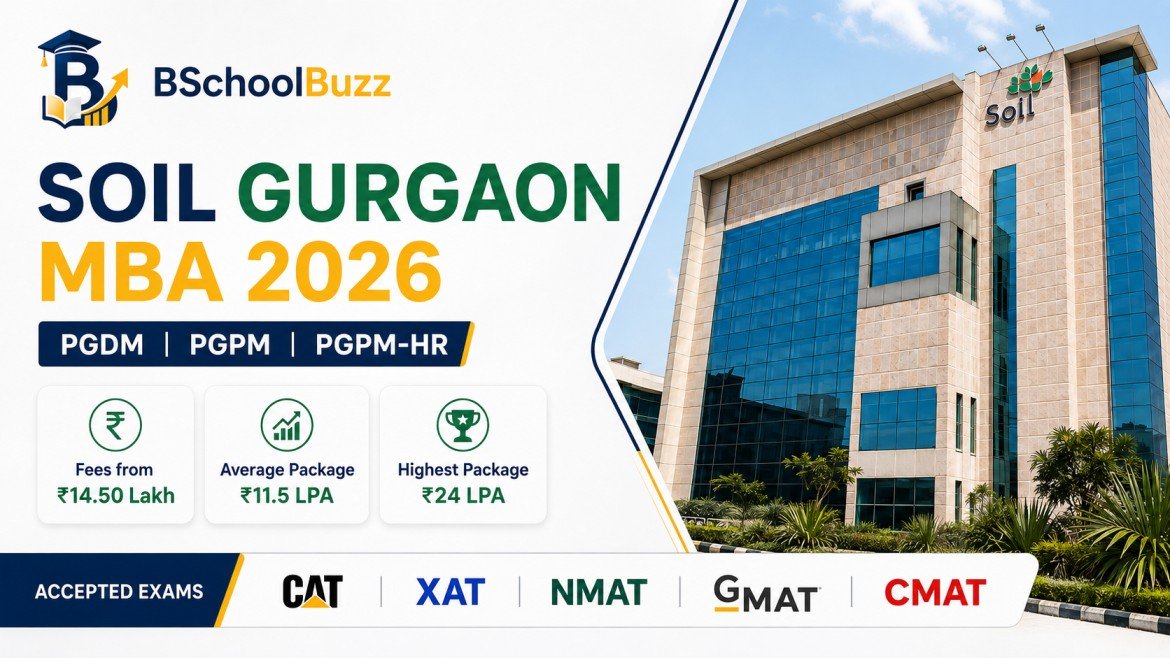
- SOIL Gurgaon offers a two-year PGDM and one-year PGPM and PGPM-HR programs. For 2026, fees were ₹17.20 lakh, ₹15.33 lakh and ₹14.50 lakh respectively. The March 2026 interim PGDM placement report recorded an ₹11.5 LPA average, ₹24 LPA highest package, nearly 80% placements and participation from 130+ companies, with freshers eligible for PGDM and PGPM-HR.
Students searching for SOIL Gurgaon MBA are usually trying to answer several questions at once. Is SOIL an MBA college or a PGDM institute? Which course is suitable for freshers? Is the one-year programme meant only for experienced professionals? What is the actual fee after GST? What does the latest placement report say? Is the programme recognised? Most importantly, is the investment sensible for a particular academic and professional profile?
The short answer is that “SOIL Gurgaon MBA” is an umbrella search term, not the name of one qualification. SOIL Institute of Management offers three distinct full-time management programmes: a two-year Post Graduate Diploma in Management (PGDM), a one-year Post Graduate Program in Management (PGPM), and a one-year Post Graduate Program in Management–Human Resources (PGPM-HR). The PGDM is an AICTE-approved diploma delivered at the Manesar campus. The two one-year programmes are institute-awarded postgraduate programmes delivered at SOIL’s Sector 44, Gurugram campus and operate independently of AICTE approval.
That distinction matters. The three programmes serve different candidate profiles, have different curricula, fees, eligibility rules and placement pools. Comparing their salary figures without separating the cohorts can create a misleading picture.
This article uses information checked through 12 August 2026. The 2026–28 PGDM batch has already started, while SOIL’s official website has moved to admissions for the 2027 intake. For the two-year PGDM, the latest 2026 placement evidence is an interim report for the graduating 2024–26 batch, dated March 2026. For PGPM and PGPM-HR, the latest final programme-wise placement reports available on the official site are for the Class of 2025. Every figure below is labelled with its actual batch or reporting year so that older results are not presented as new 2026 outcomes.
Table of Contents
SOIL Gurgaon MBA at a Glance
| Particular | Verified detail |
|---|---|
| Institute | SOIL Institute of Management / SOIL School of Business Design |
| Established | 2008; the School of Business Design was launched in 2019 |
| Location | Gurugram, Haryana, with programme delivery at Sector 44 and Manesar |
| Full-time programmes | Two-year PGDM, one-year PGPM, one-year PGPM-HR |
| Award for the two-year course | Post Graduate Diploma in Management |
| PGDM approval | AICTE-approved programme |
| One-year programme status | Institute-awarded PGPM/PGPM-HR; SOIL states that these operate independently of statutory or regulatory bodies under the Ministry of Education |
| PGDM target profile | Freshers and candidates with limited work experience |
| PGPM target profile | Working professionals, normally with at least two years of full-time experience |
| PGPM-HR target profile | Graduates committed to an HR career; freshers and experienced candidates may apply |
| Accepted tests | Varies by programme and cycle; CAT, XAT, GMAT, CMAT, MAT, NMAT and other listed tests are used, with the SOIL Aptitude Test available for the one-year programmes |
| Application fee | ₹2,000 for the 2026 admission cycle, non-refundable |
| 2026–28 PGDM programme fee | ₹17.20 lakh plus ₹30,000 refundable security deposit; accommodation and optional global immersion are extra |
| 2026–27 PGPM fee | ₹15,33,226 including GST and ₹30,000 refundable caution deposit |
| 2026–27 PGPM-HR fee | ₹14,50,000 including GST and ₹30,000 refundable security deposit |
| Latest 2026 PGDM placement evidence | March 2026 interim report: ₹11.5 LPA overall average and ₹24 LPA highest; close to 80% placed two months before graduation |
| Latest final PGPM result on official site | Class of 2025: ₹12.3 LPA average and ₹21.8 LPA highest |
| Latest final PGPM-HR result on official site | Class of 2025: ₹11.2 LPA average and ₹20 LPA highest |
The table is a starting point, not a substitute for programme-level evaluation. In particular, salary statistics describe different cohorts. They should not be combined into a single “SOIL average package.”
What SOIL Gurgaon MBA Actually Means
SOIL does not award a university MBA degree under the three full-time programmes discussed here. The most precise terminology is:
PGDM: a two-year Post Graduate Diploma in Management offered by SOIL School of Business Design and approved by the All India Council for Technical Education.
PGPM: a one-year, full-time Post Graduate Program in Management designed mainly for professionals with prior work experience.
PGPM-HR: a one-year, full-time Post Graduate Program in Management focused on Human Resources.
SOIL describes the PGPM and PGPM-HR as accelerated “MBA-equivalent” programmes on its website. A candidate should still distinguish an institute-awarded PGPM from an MBA degree granted by a university. This may not matter for many private-sector roles, where the employer evaluates the school, curriculum, prior experience and job fit. It can matter for higher education, government recruitment, regulated roles or any application that explicitly asks for a recognised master’s degree.
The same care is necessary with the two-year PGDM. AICTE approval confirms regulatory approval for the programme, but MBA equivalence for higher-study purposes is a separate question. The Association of Indian Universities explains that equivalence is accorded to qualifying two-year, full-time PGDM programmes at AICTE-approved autonomous institutions when the programme also meets the prescribed accreditation conditions. SOIL’s 2025 mandatory disclosure lists NBA accreditation as “NA.” Therefore, a student who needs formal MBA equivalence for a PhD, government examination or a specific employer should obtain written confirmation from SOIL and independently check the latest AIU equivalence rules before paying the fee.
This is not a reason to reject the SOIL Gurgaon MBA options. It is a reason to choose the correct credential for the outcome you need.
About SOIL Institute of Management
SOIL was established in 2008. According to the institute, it emerged from collaboration involving corporate leaders and spiritual thinkers and was co-created by 32 Indian and multinational companies, with support from 25 NGOs. The institution positions management education around character, competence, ethical leadership, sustainability and practical business capability.
The official history of SOIL records that Grow Talent Company Limited was formed in 2001, the consortium companies were formed in 2007, and the institute began in 2008 with 58 students. SOIL later developed international collaborations and launched the School of Business Design in 2019 for its two-year PGDM.
This background explains why SOIL’s classroom model looks different from a purely lecture-led business programme. The curriculum includes conventional management subjects, but the institute also gives visible space to design thinking, self-leadership, theatre, social innovation, yoga and wellness, a Himalayan immersion, industry projects and one-to-one mentoring.
The institutional philosophy will appeal to some candidates more than others. A student who wants only technical finance courses and a conventional placement-led campus may see some of these components as peripheral. A student who values reflection, stakeholder empathy, practical exposure and cross-functional thinking may consider them a meaningful part of the programme. The right conclusion depends on career objective and learning preference, not promotional language.
SOIL Campuses and Locations
The SOIL Gurgaon MBA programmes are not all taught at the same address.
Sector 44, Gurugram campus
The one-year PGPM and PGPM-HR are associated with SOIL Institute of Management at Plot 76, Sector 44, Gurugram, Haryana 122003. This campus is in the main Gurugram corporate corridor and is the relevant location for candidates considering either one-year programme.
Manesar campus
The two-year PGDM is delivered at SOIL School of Business Design, Plot No. 23, Sector 2, Phase 1, Institutional Area, Manesar, Gurugram, Haryana 122050. The official accreditation and contact page identifies the Manesar address as the PGDM campus.
This difference affects daily life. Sector 44 provides easier access to central Gurugram, metro-connected areas and a large corporate ecosystem. Manesar is farther south and has a more residential campus routine. Candidates should calculate travel, hostel or PG costs based on their actual programme rather than assuming that every SOIL student studies in central Gurgaon.
A campus visit is particularly useful before accepting the PGDM offer. Ask to see classrooms, the library, student activity spaces, accommodation arrangements and the daily shuttle plan. Also ask current students how much time is spent on campus outside scheduled classes, because project-heavy courses can make proximity important.
SOIL Gurgaon MBA Programmes Compared
| Feature | Two-year PGDM | One-year PGPM | One-year PGPM-HR |
| Duration | 24 months | 12 months | 12 months |
| Campus | Manesar, New Gurugram | Sector 44, Gurugram | Sector 44, Gurugram |
| Best suited to | Freshers and early-career applicants | Professionals seeking management acceleration or a functional shift | Graduates committed to HR and people-management careers |
| Work experience | Freshers and candidates with limited experience; 2026 cycle specified less than three years | Normally at least two years of full-time post-graduation experience | Freshers and experienced candidates eligible |
| Regulatory position | AICTE-approved PGDM | Institute-awarded programme, not AICTE-approved | Institute-awarded programme, not AICTE-approved |
| Academic pattern | Six terms, summer internship, majors and optional minor | Three intensive terms, projects and specialisation | Three intensive terms with HR-focused curriculum |
| Main study areas | Marketing, HR, Finance, Operations and Analytics | Marketing, Finance and Analytics | Human Resources with business foundations and analytics |
| 2026-cycle fee | ₹17.20 lakh plus ₹30,000 refundable security; other costs extra | ₹15,33,226 including GST and refundable caution deposit | ₹14,50,000 including GST and refundable security deposit |
| Latest official placement evidence | Interim batch 2024–26 report dated March 2026 | Final Class of 2025 report | Final Class of 2025 report |
The decision should begin with profile fit. A fresher choosing PGPM merely to finish quickly would not meet the normal experience expectation and would lose the benefit of a peer group built around professional experience. An engineer with four years in IT who wants analytics, consulting or general management may find the PGPM more relevant than returning to a two-year fresher-heavy programme. A graduate certain about a people-management career may prefer PGPM-HR, while someone still exploring marketing, finance and analytics should avoid locking into HR too early.
Two-Year PGDM
The two-year PGDM is the most conventional entry point within the SOIL Gurgaon MBA portfolio for fresh graduates. It combines general management, design thinking and liberal arts, followed by specialisation and industry exposure.
Programme structure
The official PGDM curriculum describes six terms. Students move from business foundations to analytical and operational skills, immersive experiences, specialisation electives, deeper domain learning and a final integrative stage. A summer internship separates the first and second academic years.
The institute publishes 1,035 hours for the core curriculum and 1,090 hours for learning beyond the conventional classroom. These figures should be interpreted as the school’s curriculum design rather than as independent measures of quality. What is more useful is the visible mix of activities:
core courses in marketing, accounting, economics, organisational behaviour, finance, operations and analytics;
design thinking and business design;
liberal arts subjects such as sociology, anthropology, psychology, theatre and ethics;
social innovation and rural or Himalayan immersion;
tools including R, Python, Power BI, Tableau, advanced Excel and AI applications;
industry visits, mentorship, simulations, live projects and case discussions;
a two-to-three-month summer internship after the first year.
The programme offers majors in Marketing, Human Resources, Finance, and Operations & Analytics. Minors are listed in Marketing, Human Resources, Finance, Operations and Analytics. Students should verify the minimum cohort size, elective bidding rules and whether every advertised elective runs in their year. Business schools commonly modify elective availability based on faculty and enrolment.
Who benefits most from the PGDM
The PGDM is suitable for a student who needs time to build business foundations, complete an internship and explore functions before committing to a role. It is also more suitable than the one-year PGPM for a candidate with no substantial full-time experience.
The 2025 PGDM cohort profile published by SOIL reported an average age of 22.5 years, average work experience of 15.4 months and 68% freshers. That composition confirms that classroom discussions will include some experienced voices but remain oriented strongly toward early-career development.
What to examine before joining
The most important due-diligence questions are not limited to the highest salary. Ask for the final 2025–26 placement report when released, the number of eligible students, the number placed, role-wise salary ranges, internship conversion rates and the distribution of offers by function. Also ask how the newly stated intake and programme tracks are organised. SOIL’s 2025 mandatory disclosure lists sanctioned capacity across PGDM and PGDM (Business Design and Innovation). A larger cohort can broaden the network, but it can also increase competition for preferred roles.
One-Year PGPM
The flagship one-year PGPM is designed for professionals who already understand workplace expectations and want to move toward managerial, consulting, analytics, marketing or finance responsibilities. It is not simply the two-year curriculum compressed into half the time.
Academic intensity
The programme is full-time and lasts 12 months. The official PGPM curriculum presents 900 hours of core learning and 350 hours beyond the classroom. Courses are delivered across three terms and cover foundational business areas, analytical tools, leadership and specialisation subjects.
Students can specialise in Marketing, Finance or Analytics. The curriculum also includes corporate strategy, digital transformation, project management, supply-chain analytics, financial planning, valuation, digital marketing, business forecasting, machine learning, big data and cloud computing. Not every candidate studies all electives; the list represents available pathways.
The one-year format reduces the length of the career break, but it increases weekly academic pressure. There is less time to recover from weak fundamentals or make repeated career experiments. Candidates transitioning from a technical role into finance, for example, should begin accounting and Excel preparation before the programme starts.
Work-experience fit
For the 2026–27 batch, the official brochure stated a normal requirement of two or more years of experience and noted that exceptional candidates with 21 or more months by 30 April 2026 could be considered. The application portal treats only full-time post-graduation employment as qualifying experience; internships and part-time work do not count.
The published Class of 2025 profile reported average work experience of 44.6 months and an average age of 26.5 years. This is the real peer-group signal. A candidate with around three to five years of quality experience is more likely to contribute examples, understand organisational context and use the one-year format productively.
Career transition expectations
The PGPM can support a change in function, industry or responsibility level, but a complete triple jump—new function, new industry and a major salary increase—is difficult at any business school. Recruiters still evaluate pre-MBA experience. A software engineer may transition into IT consulting or analytics more easily than into core investment banking. A sales professional may move into account management, product marketing or strategy roles more naturally than into a data-science position without evidence of technical skill.
Applicants should ask the career team for examples matching their own background, not just the most successful alumni story.
One-Year PGPM-HR
PGPM-HR is the specialist option in the SOIL Gurgaon MBA portfolio. It is intended for students who want to build a career in Human Resources, people consulting, talent management, employee relations, HR analytics, compensation, learning and development or organisational development.
Curriculum focus
The official PGPM-HR curriculum publishes 900 hours of core curriculum and 350 hours beyond the classroom. It combines business foundations with HR-specific subjects and applied learning. The stated outcomes include capability in talent management, employee relations, organisational development, HR analytics and the connection between business strategy and people strategy.
Experiential components include HR labs, live organisational projects, industry mentoring, theatre and ethics, self-leadership, social innovation and a Himalayan immersion. The purpose is to develop both technical HR competence and interpersonal judgement.
Freshers versus experienced applicants
Unlike the general PGPM, the PGPM-HR admissions page says freshers and candidates with work experience are eligible. The Class of 2025 profile reported average work experience of 29.2 months, while 26% of that cohort were freshers. This creates a mixed classroom.
A fresher should nevertheless demonstrate informed commitment to HR. Saying “I like interacting with people” is not enough. Stronger evidence includes HR internships, psychology or organisational-behaviour coursework, employee engagement projects, campus leadership, recruitment exposure, labour-law interest, people analytics work or a clear understanding of HR career tracks.
An experienced applicant should explain why a full-time HR programme is necessary. Someone already working in recruitment might want to move into HR business partnering, compensation, organisation design or HR consulting. The statement of purpose and interview should connect that objective to specific courses and projects.
SOIL Gurgaon MBA Eligibility Criteria
Eligibility differs across the three programmes and may be updated between admission cycles. The following requirements reflect official 2026 documents and programme pages.
| Requirement | Two-year PGDM 2026–28 | PGPM 2026–27 | PGPM-HR 2026–27 |
| Bachelor’s degree | At least 50% in a recognised bachelor’s degree of minimum three years after 10+2 | Completed bachelor’s degree in any discipline with at least 50% | Completed bachelor’s degree in any discipline with at least 50% |
| School marks | No separate 60% requirement shown in the 2026 PGDM eligibility terms | More than 60% in both Class 10 and Class 12 | More than 60% in both Class 10 and Class 12 |
| Final-year students | Eligible for PGDM if conditions and document deadline are met | Graduation must be complete | Graduation must be complete |
| Work experience | Freshers and applicants with less than three years as of 30 June 2026 | Normally two or more years; 2026 brochure allowed exceptional profiles with 21+ months | Freshers and experienced graduates eligible |
| Entrance score | Mandatory national management aptitude score | Recognised test score or SOIL Aptitude Test | Recognised test score or SOIL Aptitude Test |
PGDM graduation condition
The 2026 admissions information required applicants to hold a bachelor’s degree with at least 50% aggregate from a recognised university in India or abroad. Final-year students appearing in 2026 could apply, but had to provide interim confirmation and submit the final marksheet and degree certificate by the stated deadline. Students should confirm the equivalent requirement for the active admission year because the website is now displaying 2027 dates.
How work experience is counted
For the one-year PGPM, work experience generally means full-time employment after graduation. Part-time work and internships are excluded. Entrepreneurship and full-time work in a family business may be considered if the experience is genuine and adequately documented.
Quality is more important than the number alone. Admissions interviewers may ask about responsibility, outcomes, difficult decisions, stakeholder management, failure and learning. A candidate with 24 months of substantive work can present a stronger case than someone with four years of repetitive activity and no evidence of growth.
Students from non-engineering backgrounds
Candidates from Arts, Commerce, Science, Law, Humanities and other recognised disciplines can apply. Management classrooms benefit from academic diversity, and SOIL’s selection process gives weight to the whole profile. Non-engineers should not assume analytics is inaccessible, but they should prepare quantitative basics. Engineers should not assume technical credentials compensate for weak communication or unclear career goals.
Entrance Exams and Cutoff
The SOIL Gurgaon MBA cutoff is one of the most frequently misreported aspects online. Third-party sites publish CAT, XAT or NMAT estimates ranging from modest percentiles to much higher values. These should not be treated as official unless the institute publishes them for the relevant cycle.
PGDM accepted exams for the 2026 cycle
The 2026 PGDM application information listed GMAT, CAT, XAT, NMAT and MAT, while the broader admissions material also referenced CMAT and other AICTE-approved aptitude tests. The active official PGDM page now lists CAT, XAT, GMAT, CMAT, MAT, NMAT, SNAP and ATMA, with conditions attached to NMAT and SNAP. Applicants must follow the exact test-validity rules shown for the cycle in which they apply.
For the 2026–28 class, the official terms specified:
GMAT scores taken after 1 January 2022;
CAT 2025;
XAT 2026;
NMAT 2025;
MAT scores from 2025 and 2026.
These validity windows change each year. A score accepted for 2026 admission may not remain valid for 2027 admission.
Official 2026 PGDM cutoff information
SOIL’s published AICTE mandatory disclosure for academic year 2026–27 states a 60-percentile benchmark in CAT, XAT, GMAT, CMAT or MAT for the 2026–28 batch. The same disclosure assigns 35% weight to the admission test.
This does not mean everyone at 60 percentile will be admitted. It is best understood as a published minimum benchmark, while final selection also considers academics, personal interview, group exercise, extracurricular or diversity factors and work experience. A stronger score improves competitiveness, but the school’s process is not based on the test alone.
Current official FAQs for the subsequent intake state that SOIL does not use a fixed application cutoff or sectional cutoff and follows profile-based selection. Because the official statements refer to different admission cycles, a 2027 applicant should ask the admissions office for the active written rule. A 2026 article should not convert an unofficial “expected 75 or 80 percentile” into a fact.
Tests for PGPM and PGPM-HR
The 2026 one-year programme brochures accepted specified editions of CAT, XAT, GMAT, MAT, CMAT and NMAT, or the institute’s own aptitude test. The active 2027 admission pages refer to CAT 2025/26, NMAT 2026/27, XAT 2026/27, CMAT 2026/27, qualifying GMAT scores and SOIL SAT.
SOIL SAT is a 60-minute assessment for candidates who have not submitted a recognised aptitude score. The official admissions page describes Aptitude, Data Interpretation, Verbal Ability and Critical Thinking as the assessed areas. It is not a substitute for preparation: candidates should practise timed quantitative reasoning, interpretation and reading-based questions even though the school says extensive preparation is not required.
Is there a safe CAT percentile?
There is no universal “safe” percentile because selection depends on programme, academics, experience, interview performance and applicant pool. For the 2026 PGDM, 60 percentile was the published minimum benchmark. A score comfortably above the minimum gives the profile more room, but does not guarantee conversion. A candidate near the floor needs a particularly coherent academic, extracurricular and interview story.
SOIL Gurgaon MBA Admission Process
The application process combines a written profile with a group exercise or design-thinking activity and a personal interview. For the PGDM, the official selection model is unusually transparent.
PGDM selection weightage
| Component | Official weight for the 2026–28 PGDM selection |
| Aptitude-test score | 35% |
| Academic performance | 15% |
| Personal interview | 25% |
| Group exercise | 15% |
| Sports, extracurricular, academic and gender diversity | 5% |
| Work experience | 5% |
| Total | 100% |
The current consolidated admission page combines group exercise and personal interview into a 40% GE/PI component, which is consistent with the separate 15% and 25% weights in the 2026 disclosure.
Online application
The application asks for academic details, exam scores, achievements, work experience where applicable, supporting documents and a statement of purpose. The 2026 application fee was ₹2,000 and non-refundable.
Complete every field accurately. SOIL states that it conducts background verification after enrolment. Inconsistent dates, inflated job responsibilities or unverifiable achievements can result in cancellation. Save copies of the submitted form, payment receipt and uploaded documents because edits may not be possible after final submission.
Profile shortlisting
SOIL evaluates academic record, entrance score, leadership potential, activities, intellectual capacity and work experience. The one-year programmes also describe five capacities: the capacity to think, learn, act, relate and communicate.
These labels provide a useful framework for the application. Instead of merely listing certificates, show behaviour and outcome:
Think: a problem you analysed differently or an original idea you developed.
Learn: a difficult skill acquired and applied in limited time.
Act: an initiative you took without waiting for formal authority.
Relate: a conflict resolved or a diverse team brought together.
Communicate: a complex recommendation explained to a non-specialist audience.
Design Thinking Workshop or group exercise
The PGDM group exercise is described as a 60–75-minute design-thinking workshop. Participants work in teams on a real-world problem and use a user-centred process involving empathy, definition, ideation, prototyping and testing.
The exercise is not a conventional debate in which the loudest speaker wins. Assessors are likely to observe listening, inclusion, problem framing, clarity, creativity, time management and the ability to improve an idea after feedback.
Useful behaviour includes asking who is affected by the problem, separating symptoms from root causes, making assumptions visible, inviting quieter teammates and helping the group converge. Poor behaviour includes interrupting constantly, forcing a solution before understanding the user, dismissing other ideas or spending all the time on theory without producing a workable proposal.
Personal interview
Official pages describe interviews of roughly 30–45 minutes, normally involving faculty and industry representatives. Prepare for questions about:
academic choices and performance;
entrance-test strengths and weaknesses;
internships or full-time work;
a leadership or teamwork example;
failure, conflict and feedback;
knowledge of the target function;
why SOIL rather than another business school;
why the selected programme fits the candidate’s experience;
expected post-programme role and realistic alternatives;
ethical judgement and social responsibility.
An effective “Why SOIL?” answer should not repeat the website. Connect two or three specific programme components to gaps in your profile. For example, an operations engineer might connect analytics electives, design thinking and industry projects to a move into process consulting. A PGPM-HR applicant might connect HR analytics, organisational development and live people projects to a move from recruitment into an HR business-partner role.
Final decision and offer acceptance
SOIL states that admission results are generally communicated within a few weeks of the interview. Outcomes may include an offer, a request for another interview or non-selection. The 2026 PGDM offer required an initial enrolment payment of ₹2.10 lakh. The one-year programme application terms referred to an initial payment of ₹2 lakh.
Read the offer letter before paying. Confirm the refund rule, programme name, campus, commencement date, fee components, scholarship process, loan timeline and document conditions. Verbal counselling statements should be obtained in writing if they influence the decision.
How to Build a Strong SOIL Application
Write a specific statement of purpose
A useful statement of purpose answers four questions: What have you done? What problem or opportunity in your career now requires management education? Why does this particular programme address that need? What role do you intend to pursue after graduation?
Avoid claiming that an MBA is necessary simply to “enhance skills and become a leader.” Name the skills. If the goal is analytics, identify the analytical work already attempted and the business decisions you want to influence. If the goal is HR, explain the people problems that interest you. If the goal is marketing, show evidence of customer, sales, brand or digital exposure.
Quantify work without exaggerating
Good evidence includes revenue influenced, process time reduced, clients handled, team size coordinated, errors prevented, campaign response improved or costs saved. If exact business figures are confidential, use percentages, ranges or scope. Never invent numbers.
Prepare programme-specific career logic
The admissions panel knows that students apply to several colleges. A convincing applicant can still explain why the chosen SOIL Gurgaon MBA route is logical:
PGDM: time for foundations, internship, exploration and a two-year transition;
PGPM: short career interruption, experienced cohort and accelerated functional development;
PGPM-HR: focused people-management curriculum and specialist career preparation.
Revise business awareness
Follow business news, but move beyond headlines. Practise explaining how a development affects customers, employees, costs, competition and regulation. Read about the industry you want to enter. A PGPM applicant with work experience should be ready to discuss major changes in the current sector and the economics of the employer’s business.
Prepare questions for the panel
Thoughtful questions also reveal judgement. Ask how the career team works with a candidate of your background, how elective allocation operates, how mentors are matched, which roles recruited from the most recent batch, and how many students obtained the target function. Avoid asking only information already visible on the website.
SOIL Gurgaon MBA Fees and Other Expenses
Fee comparison requires care because the PGDM amount is quoted without accommodation, while the one-year fees include GST but exclude accommodation and some experiences. A student budget should include all compulsory and likely expenses.
Two-year PGDM fee for the 2026–28 batch
The 2026 AICTE mandatory disclosure states a total programme fee of ₹17.20 lakh for two years, plus a ₹30,000 refundable security deposit. The same total is split into these payments:
| Payment | Due date stated for 2026–28 | Amount |
| Enrolment fee | At admission | ₹2,10,000 |
| First instalment | On or before 16 May 2026 | ₹4,00,000 |
| Second instalment | On or before 5 September 2026 | ₹4,00,000 |
| Third instalment | On or before 6 February 2027 | ₹3,70,000 |
| Fourth instalment | On or before 7 August 2027 | ₹3,70,000 |
| Total programme fee | Across the programme | ₹17,20,000 |
| Refundable security | Separate | ₹30,000 |
The disclosure estimates hostel boarding and lodging at approximately ₹2.30 lakh per year. That estimate can materially increase the two-year outlay. Optional global immersion, visa, insurance, personal travel, laptop and other living expenses may be additional. The active official PGDM fee page should be checked before each intake because inclusions and dates can change.
One-year PGPM fee for 2026–27
| Component | Base amount | GST | Total |
| Tuition and academic fee | ₹8,12,000 | ₹1,46,160 | ₹9,58,160 |
| Programme fee | ₹4,56,921 | ₹82,245 | ₹5,39,166 |
| Alumni membership | ₹5,000 | ₹900 | ₹5,900 |
| Refundable caution deposit | ₹30,000 | Not applicable | ₹30,000 |
| Total | ₹13,03,921 | ₹2,29,305 | ₹15,33,226 |
The official 2026 PGPM brochure says the fee includes reading material and experiential activities such as the Himalayan Retreat and Social Innovation Program. International exchange is extra. Accommodation is also excluded.
One-year PGPM-HR fee for 2026–27
| Component | Base amount | GST | Total |
| Tuition and academic fee | ₹7,66,626 | ₹1,37,993 | ₹9,04,618 |
| Programme fee | ₹4,31,763 | ₹77,718 | ₹5,09,482 |
| Alumni subscription | ₹5,000 | ₹900 | ₹5,900 |
| Refundable security deposit | ₹30,000 | Not applicable | ₹30,000 |
| Total | ₹12,33,389 | ₹2,16,611 | ₹14,50,000 |
Accommodation, books or material not included under the stated fee, the Sidhbari or related trip where separately charged, personal costs and international travel should be confirmed from the offer letter. The official PGPM-HR fee page is the controlling public reference.
Build a complete cost estimate
Use this formula before accepting any SOIL Gurgaon MBA offer:
Total economic cost = non-refundable academic fee + accommodation + food not included + travel + laptop and materials + loan interest + foregone salary − confirmed scholarship.
The opportunity cost is especially important for experienced candidates. A PGPM applicant earning ₹6 lakh a year is not investing only ₹15.33 lakh; the economic cost also includes the salary and experience foregone during the full-time year. Conversely, returning to employment after one year rather than two can make the accelerated format more efficient than a two-year programme.
Do not subtract an expected scholarship until it has been awarded in writing. Do not treat the refundable deposit as a permanent cost, but maintain cash for it. Do not assume that the highest CTC will be your salary.
Scholarships and Education Loans
SOIL lists merit, need, defence, farmer-family and achievement-based support. Scholarship terms differ between PGDM and the one-year programmes.
PGDM scholarships
The PGDM fee page lists:
need-based scholarship for applicants whose gross annual family income in the previous financial year is below ₹8 lakh;
merit-based scholarship evaluated through academic record and entrance-exam performance;
Dr. Verghese Kurien Scholarship for wards of farmers meeting the stated income condition;
scholarship for wards of serving defence personnel, ex-servicemen and eligible forces families;
Unique Achievement Award for recognised accomplishment in sports, fine arts, social work or related fields.
SOIL’s 2025 mandatory disclosure reported that 64 students in the 2025–27 batch received scholarships totalling ₹77 lakh. This is historical evidence of awards, not a guarantee for a 2026 or 2027 applicant.
PGPM and PGPM-HR scholarships
The official one-year programme fee pages state that SOIL has allocated a ₹2 crore scholarship pool across all programmes. The published awards include:
need-based support up to ₹2 lakh for applicants meeting the family-income condition;
merit-based support up to ₹2 lakh;
Capt. Vikram Batra Scholarship for defence candidates or wards of defence-service members;
Dr. Verghese Kurien Scholarship for eligible wards of farmers;
Unique Achievement Award for exceptional accomplishments or social leadership.
For the one-year pages, the need-based income threshold is shown as family income, excluding the applicant’s income, below or up to ₹10 lakh per year. The merit calculation uses school and graduation results, and the exact stated range differs slightly between the PGPM and PGPM-HR pages. Candidates should use the programme-specific page, not assume one rule applies to all.
One unusual point is that the official scholarship FAQ says the amount is awarded after successful completion of the course. Ask whether it is adjusted against a final payment, reimbursed after graduation or handled through another mechanism. This timing affects the loan amount and cash flow.
Education loans
SOIL lists several funding partners, including Bank of Baroda, Axis Bank, Credila, Avanse, Yes Bank, IDFC First Bank, Tata Capital, ICICI Bank and other education-finance platforms. Listing a lender is not the same as loan approval. Interest rate, collateral, co-borrower requirement, moratorium, processing fee and insurance depend on the applicant and lender policy.
Request written loan illustrations from at least two lenders. Compare the annual percentage cost rather than only the advertised interest rate. Ask when interest begins accruing, whether unpaid interest is capitalised during study and moratorium, and what the EMI becomes under realistic repayment periods.
Curriculum and Learning Model
The main differentiator of the SOIL Gurgaon MBA experience is not a single specialisation. It is the combination of conventional management education with design thinking, liberal arts, self-awareness and experiential learning.
Business foundations
All three programmes include core management areas such as economics, marketing, finance, organisational behaviour, communication, analytics, operations and strategy, although the balance varies. The PGDM develops these over six terms. The PGPM covers them at accelerated pace for an experienced cohort. The PGPM-HR uses them as the commercial foundation for people decisions.
Design thinking
Design thinking begins with the user rather than the proposed solution. In a business context, it asks managers to understand stakeholder needs, define the right problem, create alternatives, test prototypes and learn from evidence.
This can be useful in product design, customer experience, service operations, HR process redesign, social innovation and organisational change. Its value depends on execution. A short workshop produces vocabulary; repeated application to ambiguous projects develops judgement.
SOIL integrates design thinking into admissions, core coursework and projects. Candidates should ask for examples of recent student projects and how outcomes were evaluated.
Liberal arts and ethical reflection
The PGDM includes sociology, anthropology, psychology, theatre and ethics components. These subjects help future managers examine culture, incentives, behaviour, power and moral trade-offs. They are especially relevant in marketing research, change management, consumer behaviour and leadership.
The benefit is not automatic. Students who treat these courses as low-priority credits will gain little. Those who connect them to business decisions may develop stronger qualitative reasoning and stakeholder awareness.
Analytics and digital tools
The official curricula list Excel, R, Python, SQL, Power BI, Tableau, AI tools, predictive analytics, machine learning, big data, cloud computing and data visualisation across relevant tracks. These are useful signals, but course presence does not equal professional mastery.
An analytics candidate should ask:
how many hours involve hands-on lab work;
whether assignments use real or realistic datasets;
which tools are mandatory versus elective;
whether coding prerequisites are taught;
what portfolio projects students complete;
which recruiters offered analytics roles and what tests they used.
Cases, simulations and projects
SOIL describes case discussions, business simulations, consulting assignments, social projects, internships and industry challenges. Simulations can teach trade-offs under uncertainty, while live projects can expose students to imperfect information and stakeholder constraints.
Project quality varies based on sponsor involvement, scope and faculty supervision. Ask whether the sponsor provides feedback, whether the work is implemented and whether students may discuss it in interviews.
Self-leadership and immersion
The programmes include combinations of self-leadership, theatre and ethics, yoga and wellness, Himalayan or rural immersion and social innovation. These elements support reflection, resilience and interpersonal learning. They may also make the SOIL Gurgaon MBA experience more demanding than a classroom-only timetable.
Candidates with health, accessibility, religious or personal concerns should ask what activities are compulsory and what reasonable alternatives exist. Experiential education should be evaluated for learning outcome, safety, inclusion and cost.
Specialisations and Career Paths
Marketing
Marketing pathways can lead to sales, account management, product or brand support, digital marketing, market research, customer experience and business development. Recruiters often value prior industry knowledge and evidence of customer-facing work.
Students should build capability in consumer insight, segmentation, positioning, pricing, digital measurement, sales economics and presentation. A portfolio can include a market-entry analysis, campaign measurement project, customer-journey redesign or product recommendation.
Finance
Finance coursework may support roles in corporate finance, banking, financial services, research, risk, valuation and financial planning. Core investment-banking roles are highly selective and should not be assumed from the presence of finance electives.
Candidates need accounting fluency, financial-statement analysis, Excel modelling and a clear understanding of target roles. Relevant certifications or projects may strengthen the profile but do not replace interview preparation and prior evidence.
Analytics and operations
Analytics roles can include business analyst, data analyst, BI analyst, marketing analyst and operations analyst. The job title “data scientist” normally requires deeper statistics and coding than a general management specialisation alone provides.
Operations pathways include project management, supply chain, service operations, process improvement and logistics. Students should combine tools with domain understanding. A dashboard is useful only when it answers a decision question.
Human Resources
HR pathways include talent acquisition, HR business partnering, learning and development, employee relations, compensation, people analytics, HR consulting and organisational development. The PGPM-HR provides the deepest specialist preparation, while the PGDM offers HR as a major or minor.
Candidates should understand that entry roles differ in strategic scope. Recruitment may be a starting point, but strong HR careers require business understanding, labour-law awareness, data literacy, consulting ability and credibility with line managers.
SOIL Gurgaon MBA Placements
Placement analysis should answer four questions: Which batch does the report cover? Is it interim or final? What percentage participated? What is the distribution beyond the highest package?
PGDM placement update for 2026
The most current official 2026 evidence is the SOIL PGDM Interim Placements Report 2025–26, dated March 2026. It covers final placements for the 2024–26 batch and states that close to 80% of students had been placed two months before graduation.
| PGDM placement measure | March 2026 interim result |
| Highest salary | ₹24 LPA |
| Overall average salary | ₹11.5 LPA |
| Top 25% average | ₹14.5 LPA |
| Top 50% average | ₹13.4 LPA |
| Companies participating | 130+ |
| Placement progress | Close to 80% placed two months before graduation |
The report identified BFSI/financial services as 37% of offers, IT/ITES as 32%, automotive/manufacturing as 9%, FMCG/retail as 7%, and consulting/research as 5%. The leading functions were Sales/KAM/CRM at 40%, IT consulting at 20%, finance at 11%, analytics at 7% and HR at 6%.
These functional figures are important. A student attracted by the ₹24 LPA maximum should also recognise that sales, account management and customer-relationship roles formed the largest functional group in the interim report. That can be an excellent outcome for a sales-oriented candidate but a weaker fit for someone seeking only strategy consulting.
The same report lists recruiters including Accenture, Aditya Birla Capital, Anand Rathi, Apollo Tyres, Axis Bank, BlackRock, Cognizant, Delhivery, Grant Thornton, HCL Technologies, ICICI Bank, Infosys, Korn Ferry, Kotak Mahindra Bank, Lenskart, Policybazaar, Royal Enfield, S&P Global, Schneider Electric, Tata Consumer, Tech Mahindra, TresVista, WNS, Genpact, Jio-bp and others.
Because this was an interim report, it should not be called the final placement outcome. The final proportion placed, median, total eligible count and final role mix may change. Candidates should request the final 2025–26 report when SOIL publishes it.
PGDM Class of 2025 final report
For context, the official final Class of 2025 PGDM report stated:
| Measure | Class of 2025 |
| Highest CTC | ₹20.7 LPA |
| Average CTC | ₹11.17 LPA |
| Median CTC | ₹10.9 LPA |
| Top 25% CTC average | ₹14.27 LPA |
| Top 50% CTC average | ₹12.97 LPA |
| Companies | 130+ |
SOIL reported that 93% opted for placements and that 98% of that participating group were placed, at a stated average of ₹11.33 LPA for the placed group. The overall report headline used ₹11.17 LPA. The distinction likely reflects different denominators, which is precisely why candidates should examine the report definitions.
PGPM Class of 2025 placements
The official PGPM placement report available in August 2026 is labelled Class of 2025, not Class of 2026.
| PGPM placement measure | Class of 2025 |
| Highest CTC | ₹21.8 LPA |
| Average CTC | ₹12.3 LPA |
| Top 25% CTC average | ₹18.8 LPA |
| Top 50% CTC average | ₹15.4 LPA |
| Companies | 60 |
| Students opting for placements | 95% |
| Placement rate stated for participants | 95% |
The report says 5% did not opt for placements, including candidates pursuing entrepreneurship or returning to company sponsorship/sabbatical arrangements. The PGPM brochure identifies IT/ITES as the largest recruiting sector in the referenced placement data, followed by consulting, BFSI, manufacturing, e-commerce, education technology and other sectors.
The PGPM figure should not be directly compared with the PGDM average without considering prior salary and work experience. PGPM students entered with an average of roughly 3.7 years of experience, while most PGDM students were freshers. The starting baseline and roles differ.
PGPM-HR Class of 2025 placements
The official PGPM-HR placement report is also labelled Class of 2025.
| PGPM-HR placement measure | Class of 2025 |
| Highest CTC | ₹20 LPA |
| Average CTC | ₹11.2 LPA |
| Top 25% CTC average | ₹16.5 LPA |
| Top 50% CTC average | ₹13.7 LPA |
| Companies | 60 |
| Students opting for placements | 98% |
| Placement rate stated for participants | 98% |
These are HR-specific cohort outcomes and should be assessed against target roles, not only against the general PGPM. Ask for the number of offers in HR business partnering, talent acquisition, people analytics, consulting, compensation, learning and organisational development.
CTC is not take-home salary
CTC can include fixed pay, variable pay, joining or retention bonus, employer provident-fund contribution, insurance and other benefits. The highest CTC may represent one or a very small number of offers. Before using placement data for a loan decision, ask for:
median CTC;
average fixed pay;
variable-pay range;
number of students at each salary band;
domestic versus international offers;
number eligible, participating and placed;
function and location of offers;
previous work experience of lateral hires.
The median is often more useful than the maximum because it describes the centre of the distribution without being pulled upward by a small number of high offers.
Placement assistance versus placement guarantee
SOIL provides career support and recruiter access, but the student must convert interviews. No ethical business school can guarantee a particular role or salary. Market conditions, academic performance, communication, experience, location flexibility and interview skill affect outcomes.
For the one-year programmes, some candidates may be company-sponsored, return to an employer or pursue entrepreneurship. “Did not opt for placement” is not automatically a negative outcome, but the categories should be transparent.
Recruiters and Roles
Across official SOIL material, recruiter names include Accenture, Aditya Birla Group or Aditya Birla Capital, Axis Bank, BlackRock, Cognizant, Genpact, HCL Technologies, ICICI Bank, Infosys, Kotak Mahindra Bank, S&P Global, Tech Mahindra, WNS and several manufacturing, financial-services, retail and consulting organisations. A logo shows that a company participated or hired in a referenced cycle; it does not prove that every function or salary level was available to every programme.
Typical role families mentioned in official programme material include:
sales, key-account management and customer relationship management;
IT consulting and business consulting;
financial analysis, corporate finance, risk and banking;
business intelligence and analytics;
marketing, brand, digital and market research;
project, operations and supply-chain management;
HR business partnering, talent, employee relations and HR consulting;
general management and management-trainee positions.
Ask the placement team for a role-wise report. “Consulting” can mean strategy, operations, technology implementation, research or HR advisory. “Finance” can mean core corporate finance, relationship management, banking sales, risk, research or operations. Titles alone do not reveal job content.
Is SOIL Gurgaon MBA Worth It? An ROI Analysis
SOIL Gurgaon MBA can be worth the investment for a candidate whose target role matches the programme, who can finance the course without dangerous debt and who has a realistic path to use the school’s curriculum and recruiter network. It is less attractive when the candidate is choosing only because of a headline package, needs a formally recognised university master’s degree, or has no clear connection between prior profile and target employment.
Return on investment is personal. The same programme can be financially sensible for one student and risky for another.
A simple PGDM cost scenario
Consider a fresher joining the 2026–28 PGDM:
programme fee: ₹17.20 lakh;
estimated boarding and lodging: about ₹2.30 lakh per year, or ₹4.60 lakh for two years, based on the mandatory disclosure;
refundable security: ₹30,000, which affects cash flow but is not a permanent cost if returned;
laptop, travel and personal expenses: candidate-specific;
optional international immersion: extra;
foregone salary: low or zero for a fresher, higher for someone leaving a job.
Before loan interest, a residential student could therefore approach or exceed ₹22 lakh in non-refundable programme and living costs. If the student borrows most of this amount, interest raises the effective cost.
The March 2026 interim PGDM report showed ₹11.5 LPA average CTC. That is useful context, not a prediction. The student’s actual fixed pay may be below CTC and the first-year savings after tax and living costs may be modest. Repayment should be tested against a conservative salary, not against the ₹24 LPA highest offer.
A simple PGPM cost scenario
Consider a professional earning ₹7 LPA who joins PGPM:
published fee: ₹15.33 lakh;
accommodation and personal living cost: additional;
one year of gross salary foregone: approximately ₹7 lakh;
loan interest: additional if financed;
total economic cost before any scholarship: potentially well above ₹22 lakh.
The latest official final PGPM average is ₹12.3 LPA for the Class of 2025. If the candidate receives a similar CTC, the headline increase from ₹7 lakh is meaningful. However, the payback period depends on fixed pay, tax, EMI and post-MBA living costs. If the candidate already earns ₹11–12 lakh, joining for an average salary outcome may not make financial sense unless the programme enables a more valuable function, long-term trajectory or personal objective.
A simple PGPM-HR cost scenario
The PGPM-HR fee is ₹14.50 lakh before accommodation and opportunity cost. The latest official final average is ₹11.2 LPA for the Class of 2025. A fresher has low salary opportunity cost but may need a larger loan. An HR professional earning ₹6 lakh may see both a salary and role-development opportunity. An experienced professional already earning close to the reported average should focus on role quality and long-term mobility rather than expecting an immediate financial jump.
A practical ROI formula
Use a five-year comparison, not a one-year salary ratio:
Five-year net benefit = post-programme after-tax income over five years − income without the programme over the same period − fee − living cost during study − interest − relocation cost.
Run at least three cases:
Conservative: salary below the reported average, delayed placement and normal increments.
Base: salary near the median or realistic role-specific outcome.
Optimistic: stronger-than-average placement with faster progression.
If the conservative case produces an unaffordable EMI or forces dependence on the highest package, the financial plan is too fragile.
Non-financial return
ROI also includes function change, managerial exposure, professional network, confidence, geographic mobility and learning. These benefits can be substantial, but they should be concrete. “Networking” is valuable when the student actively builds relationships and the alumni base is relevant to the target industry. “Leadership development” is valuable when it leads to better decisions and responsibility. Abstract benefits should not be used to justify unlimited debt.
Campus Life and Accommodation
SOIL describes student life through business academies, cultural activities, debates, clubs, case challenges, hackathons, theatre, film appreciation, sports, entrepreneurship activities and “Experiential Fridays.” The intention is to integrate professional capability with creativity and wellbeing.
Life at the Manesar PGDM campus
The PGDM routine is likely to be residential or accommodation-dependent because classes, team projects and activities extend beyond a standard college day. The 2026 application terms described hostel accommodation and collaboration outside class as important, while the current fee page says the institute assists students in finding accommodation close to campus at extra cost. This language has changed over time, so the offer letter should be treated as decisive.
The official mandatory disclosure lists hostel facilities with shuttle service to an off-campus building and estimates annual boarding and lodging at ₹2.30 lakh. Verify:
room occupancy and gender-specific arrangements;
distance from campus and shuttle frequency;
meal plan and weekend food;
Wi-Fi, laundry, security and power backup;
curfew or attendance rules;
refund conditions;
whether accommodation is compulsory for the full period;
arrangements during the summer internship.
Students with dietary, medical or accessibility needs should inspect the facility and receive written confirmation of support.
Accommodation for the one-year programmes
The PGPM brochure says numerous PG accommodations are available near the Sector 44 campus with options such as meals, laundry, Wi-Fi and security. Accommodation is not included in the published fee. The one-year application terms say hostel use is not mandatory but is recommended because group assignments often continue outside class.
Central Gurugram rents vary substantially by distance, room type and amenities. Ask current students for actual monthly budgets rather than relying on a generic city estimate. Include deposit, brokerage, electricity, transport and meals when comparing options.
Student workload
The PGPM and PGPM-HR are compressed programmes with limited recovery time. Expect concurrent classes, team submissions, career preparation, mentoring and events. The PGDM offers more calendar time but adds a summer internship, term projects, clubs and placement preparation.
Before joining, discuss workload honestly with family and employers. A full-time programme should not be planned around continuing a demanding job in parallel unless the institute explicitly permits it—which these programmes are not designed for.
International Exposure
SOIL lists global partnerships with POLIMI Graduate School of Management in Italy, CEDEP in France, Shizenkan University in Japan, Royal Roads University and the University of New Brunswick in Canada, and Johannesburg Business School in South Africa. Partnerships can support visiting faculty, collaborative courses, exchange or immersion, but the exact opportunity varies by programme and year.
The official international immersion page describes global business courses with Shizenkan University and a “Future of Capitalism” elective involving international institutions and faculty. It also references exchange or immersion opportunities.
Candidates should distinguish among:
an online collaborative course;
visiting international faculty;
a short study tour;
a credit-bearing exchange;
a semester abroad;
an optional paid immersion.
These experiences have different academic and financial value. For the PGPM 2026–27 brochure, international exchange costs are explicitly additional. The PGDM fee page also says global immersion may involve extra programme charges, visa fees and medical insurance and depends on travel conditions and management approval.
Ask for the previous cohort’s destination, duration, number of participants, credits, total student cost and selection method. Do not assume every admitted student travels abroad.
Student Profile and Diversity
Peer quality is a large part of business education because students learn through cases, projects, clubs and career conversations. SOIL publishes programme-wise batch profiles, which are more informative than a single institute-level claim.
PGDM Class of 2025 profile
| Profile measure | Published figure |
| Average age | 22.5 years |
| Average work experience | 15.4 months |
| Freshers | 68% |
| Women | 46% |
| States represented | 24 |
| Average Class 10 score | 81.4% |
| Average Class 12 score | 80.3% |
| Average undergraduate score | 74.4% |
This is a young cohort with substantial geographic representation and near-balanced gender diversity. A fresher should find many peers at a similar stage. An applicant with close to three years of experience should consider whether a fresher-heavy classroom serves the desired level of discussion.
PGPM Class of 2025 profile
| Profile measure | Published figure |
| Average age | 26.5 years |
| Average work experience | 44.6 months |
| Women | 38% |
| States represented | 19 |
| Average undergraduate score | 71.4% |
The cohort’s prior industries included IT, manufacturing, BFSI, e-commerce and retail, education and others. The average experience is consistent with the programme’s working-professional positioning.
PGPM-HR Class of 2025 profile
| Profile measure | Published figure |
| Average age | 24.5 years |
| Average work experience | 29.2 months |
| Freshers | 26% |
| Women | 65% |
| States represented | 13 |
| Average undergraduate score | 74.3% |
The mix supports classroom discussion between fresh graduates and professionals. Nearly half of the published pre-programme function mix came from HR, while other students came from consulting, analytics, legal, software and specialised roles.
Batch profiles change annually. Use these figures to understand recent composition, not to predict the exact 2026 or 2027 classroom.
Faculty, Mentoring and Industry Engagement
SOIL’s model combines full-time faculty, visiting faculty and practitioners. The 2025 mandatory disclosure listed 44 permanent faculty and a stated permanent faculty-to-student ratio of 1:18 for the School of Business Design at the time of reporting. Faculty rosters can change, so candidates should inspect the current programme page and identify who teaches core and specialisation courses.
One-to-one industry mentoring is a prominent feature of the one-year PGPM and appears across SOIL’s programme communication. Mentoring can help clarify career goals, interpret feedback and build industry perspective, but its value depends on mentor match, meeting frequency and student preparation.
Ask these questions:
How are mentors assigned?
Is every student guaranteed a mentor?
How many meetings are scheduled?
Can a student request a rematch?
Does the mentor participate in assessment or placement?
What confidentiality rules apply?
Industry lectures and consortium connections also need practical evaluation. The strongest engagement occurs when companies contribute cases, projects, internships and hiring—not only guest talks.
Rankings: How Much Weight Should Students Give Them?
SOIL cites positions from private ranking publications in its brochures and admissions material. Such rankings can provide visibility but use different samples and methodologies. A rank for one-year private programmes is not directly comparable with an all-India ranking of two-year MBA schools.
As of 12 August 2026, the official NIRF site’s latest published Management ranking is India Rankings 2025; the 2026 Management ranking had not yet been published. Students should not accept an “NIRF 2026 rank” claimed before the Ministry of Education releases the list.
For the SOIL Gurgaon MBA decision, place more weight on:
regulatory status of the exact programme;
final audited or institute-issued placement report;
role distribution and median salary;
batch size and profile;
current faculty and elective delivery;
internship quality;
alumni outcomes relevant to the target function;
full cost and loan burden;
conversations with recent students and alumni.
A private ranking can be a secondary signal, not the main reason to borrow ₹15–22 lakh.
Advantages and Limitations
Potential advantages
Distinct learning model: The integration of business, design thinking, liberal arts, ethics and experiential components is more differentiated than a standard lecture-and-exam programme.
Programme choices for different profiles: Freshers can choose the two-year PGDM, experienced professionals can consider the PGPM, and HR-focused graduates can choose PGPM-HR.
Transparent programme-wise placement pages: SOIL publishes separate results for PGDM, PGPM and PGPM-HR, including top-quartile and participation information. This is more useful than one blended average.
Current PGDM momentum: The March 2026 interim report showed ₹11.5 LPA average, ₹24 LPA highest and 130+ participating companies, with placements still underway.
Industry and project exposure: Mentoring, live projects, summer internships, simulations and company interaction can support practical learning.
Gurugram location: Access to a major corporate hub can support speakers, projects and professional networking, though the PGDM campus is in Manesar rather than central Gurgaon.
Career-break efficiency for PGPM: A one-year format allows experienced candidates to return to employment earlier than a two-year course.
Limitations and risks
High total cost: Fees plus accommodation, interest and opportunity cost create a substantial investment. The average salary does not produce an instant financial payback for every student.
Credential distinction: The one-year programmes are institute-awarded and are not AICTE-approved. The PGDM is AICTE-approved, but candidates requiring formal MBA equivalence for higher studies must verify it separately.
Placement distribution matters: The PGDM interim report had a large share of sales/KAM/CRM and IT consulting roles. Candidates seeking narrow front-end consulting, product management or investment roles should verify actual availability.
Interim versus final data: The most recent PGDM 2026 report is interim. Final placement completion and median data should be requested when available.
Programme intensity: The one-year curriculum leaves little time to repair weak fundamentals or explore many unrelated career paths.
Accommodation is extra: The one-year programme fees exclude accommodation. PGDM boarding and lodging can add roughly ₹4.6 lakh across two years based on the disclosed annual estimate.
Elective availability can vary: Advertised course lists may be subject to student demand, faculty availability and scheduling.
Brand recognition is uneven: SOIL has a growing alumni and recruiter base, but its brand may not carry the same automatic recognition as older national institutions across every employer, city or overseas market.
Who Should Apply to SOIL Gurgaon MBA?
A strong PGDM candidate
The two-year PGDM is a plausible fit if you are a fresher or early-career graduate who wants a full management foundation, summer internship, structured career preparation and exposure to analytics, design thinking and liberal arts. You should be comfortable with the Manesar location, a two-year commitment and the total residential cost.
It may be less suitable if you already have four or five years of substantial experience, need a university MBA degree, or want only a narrow specialised finance or strategy pathway unavailable in sufficient volume.
A strong PGPM candidate
The one-year PGPM is a plausible fit if you have at least two years of quality full-time experience, can explain the next career step, want a shorter interruption and see a clear match with Marketing, Finance, Analytics, consulting or general-management roles.
It may be less suitable if you are a fresher, have no clear target, need a long internship to change careers, or already earn close to or above the reported placement range without a strong non-financial reason to join.
A strong PGPM-HR candidate
PGPM-HR is a plausible fit if you have informed commitment to Human Resources and want structured development across talent, employee relations, organisational development, HR analytics and people strategy. Both freshers and experienced candidates can apply, but the application must show credible HR motivation.
It may be less suitable if HR is only a backup after other MBA options, if you want broad functional exploration, or if your preferred career is finance, marketing or operations.
SOIL Gurgaon MBA Versus Other Management Options
SOIL PGDM versus a university MBA
Both can prepare students for management careers, but the award and governance differ. A university MBA is a degree. SOIL’s two-year programme awards a PGDM under AICTE approval. Compare curriculum, accreditation or equivalence needs, recruiter base, fees, internships and alumni rather than assuming the terms are interchangeable.
SOIL PGPM versus a two-year MBA or PGDM
PGPM offers speed and a more experienced cohort. A two-year programme offers more time for foundations, internships, clubs and career exploration. Professionals with clear goals often benefit from the one-year format; freshers and major career switchers may benefit from the two-year runway.
SOIL PGPM-HR versus a general MBA with HR specialisation
PGPM-HR provides a concentrated HR identity and peer group. A general MBA with an HR major offers broader first-year exploration and may carry a degree or different regulatory status. Candidates certain about HR may value the specialist depth; uncertain candidates may prefer general management.
Compare offers using the same frame
Create a spreadsheet with these rows for every school:
exact credential and approval;
programme duration;
total compulsory fee;
accommodation and food;
opportunity cost;
batch size and work-experience distribution;
latest final median and average CTC;
percentage opting for placement and percentage placed;
target-role count;
fixed-pay range;
internship outcomes;
alumni in the target industry;
location and personal constraints.
Do not compare SOIL’s top-25% average with another school’s whole-batch average. Do not compare an interim report with a final report without labelling the difference. Do not compare a one-year experienced cohort with a fresher cohort as if they started from the same salary base.
Questions to Ask Current Students and Alumni
Speak with several people, including at least one average-profile student rather than only an admissions ambassador. Useful questions include:
Which advertised courses actually ran?
How many students are in your cohort and section?
How accessible are faculty outside class?
How often did you meet your mentor?
What was the real weekly workload?
Which companies hired more than one student?
How many roles matched your specialisation?
What proportion of CTC was fixed?
How transparent was the placement process?
How many students were still unplaced near graduation?
What is the actual rent or hostel expense?
Which immersion activities were compulsory and valuable?
What would you change about the programme?
Would you take the same loan again?
Look for patterns across responses. One unhappy or enthusiastic individual does not define the programme. Repeated observations from independent students deserve attention.
Application Checklist
Prepare the following before beginning the SOIL Gurgaon MBA application:
Class 10 and 12 marksheets;
semester-wise and final graduation marksheets;
degree or provisional certificate;
entrance-test scorecard valid for the cycle;
updated one-page résumé;
government identity proof;
employment offer and relieving letters where relevant;
recent salary slips or other experience evidence;
documentation for entrepreneurship or family-business work;
certificates for achievements claimed;
concise statement of purpose;
scanned photograph and signature if requested;
application-fee payment method;
scholarship income, defence, farmer-family or achievement documents where applicable.
Before submitting:
verify dates across résumé and application;
convert CGPA according to the university’s official rule;
use a professional email address;
proofread programme name and career goal;
save a PDF or screenshots of the final form;
note the application ID and payment reference;
add interview and fee deadlines to the calendar.
After receiving an offer:
read refund conditions;
confirm all fee inclusions and exclusions;
obtain loan sanction before relying on finance;
ask for scholarship timing in writing;
verify accommodation availability;
request the latest final placement report;
speak with students from the same programme;
confirm whether the credential meets any higher-study or government-career requirement.
Mistakes to Avoid
Treating all SOIL programmes as one MBA
This causes wrong comparisons of fees, eligibility and placement outcomes. Always name PGDM, PGPM or PGPM-HR.
Using an unofficial cutoff as a guarantee
A third-party estimate is not an admission promise. The 2026 PGDM disclosure published a 60-percentile benchmark, but final selection used multiple components.
Looking only at the highest package
The maximum is an outlier. Median, fixed pay, role mix and placement participation are better planning metrics.
Ignoring opportunity cost
For working professionals, salary foregone can equal a large part of tuition. Include it in ROI.
Assuming “MBA-equivalent” answers every recognition question
Private-sector acceptance and formal academic equivalence are not identical. Verify the requirement relevant to your future path.
Choosing PGPM-HR without HR conviction
Specialist programmes narrow the career story. Apply because the function fits, not because the application is open.
Borrowing against an optimistic salary
Model EMI against a conservative take-home amount. The highest CTC is not the repayment base.
Skipping a campus or accommodation check
The PGDM is in Manesar, while the one-year programmes are in Sector 44. Location changes commute, cost and daily experience.
Frequently Asked Questions
Does SOIL Gurgaon offer an MBA degree?
SOIL offers a two-year PGDM, a one-year PGPM and a one-year PGPM-HR. Students commonly search for these as SOIL Gurgaon MBA, but the awards are not a university MBA degree. The PGDM is AICTE-approved; the one-year programmes are institute-awarded.
Is SOIL Gurgaon MBA AICTE approved?
The two-year PGDM is AICTE approved. SOIL’s official FAQ says the one-year PGPM and PGPM-HR operate independently of statutory or regulatory bodies under the Ministry of Education and are not AICTE-approved programmes.
Which SOIL programme is best for freshers?
The two-year PGDM is designed strongly around freshers and early-career candidates. PGPM-HR also accepts freshers who have a clear HR career goal. The general one-year PGPM normally requires at least two years of full-time experience.
What is the SOIL Gurgaon MBA fee for 2026?
For the 2026–28 PGDM, the published programme fee was ₹17.20 lakh plus a ₹30,000 refundable security deposit; accommodation and optional global immersion were extra. The 2026–27 PGPM fee was ₹15,33,226 including GST and a refundable ₹30,000 caution deposit. The 2026–27 PGPM-HR fee was ₹14,50,000 including GST and a refundable ₹30,000 security deposit.
What is the SOIL Gurgaon application fee?
The application fee for the 2026 cycle was ₹2,000 and non-refundable. Applicants for a later intake should check the active application portal before paying.
What was the SOIL Gurgaon MBA cutoff in 2026?
The official mandatory disclosure for the 2026–28 PGDM batch stated a 60-percentile benchmark in CAT, XAT, GMAT, CMAT or MAT. Selection was holistic, and the test carried 35% weight. Unofficial 75–80 percentile estimates on other sites should not be described as official cutoffs.
Does SOIL have sectional cutoffs?
The current official PGDM FAQ says there are no sectional cutoffs. Because admission rules can change by cycle, candidates should confirm this for the intake they are applying to.
Which entrance exams does SOIL accept?
The list varies by programme and cycle. Official materials include CAT, XAT, GMAT, CMAT, MAT, NMAT and other approved tests. The one-year programmes allow the SOIL Aptitude Test for applicants without an accepted score. NMAT or SNAP may have additional conditions for the PGDM, so read the current rules.
Can I apply to SOIL without CAT?
Yes, depending on the programme. The PGDM accepts several national aptitude tests other than CAT. PGPM and PGPM-HR can consider other listed tests or the SOIL Aptitude Test. A qualifying aptitude score remains part of the process.
What is the SOIL Aptitude Test?
It is a 60-minute assessment used for one-year programme candidates who do not submit another recognised management-test score. The official page lists aptitude, data interpretation, verbal ability and critical thinking.
What is the latest SOIL PGDM average package?
The March 2026 interim report for the 2024–26 PGDM batch stated an overall average of ₹11.5 LPA and a highest salary of ₹24 LPA. The report was interim, with close to 80% placed two months before graduation. The final report may differ.
What is the latest final SOIL PGPM average package?
The latest final report available on the official site in August 2026 is for the Class of 2025. It states ₹12.3 LPA average CTC and ₹21.8 LPA highest CTC.
What is the latest final PGPM-HR average package?
The official Class of 2025 PGPM-HR report states ₹11.2 LPA average CTC and ₹20 LPA highest CTC.
Does SOIL guarantee 100% placement?
SOIL provides placement assistance and publishes high placement rates for participating students in recent reports, but admission does not guarantee a job or salary. Students must meet eligibility requirements and convert recruiter interviews.
Which companies recruit from SOIL Gurgaon?
Recent official material names companies such as Accenture, Aditya Birla Capital, Axis Bank, BlackRock, Cognizant, Genpact, HCL Technologies, ICICI Bank, Infosys, Kotak Mahindra Bank, S&P Global, Tech Mahindra and WNS, among others. Recruiters and roles change by year and programme.
What specialisations are available?
The PGDM offers majors in Marketing, Human Resources, Finance, and Operations & Analytics, with listed minor options. The PGPM offers Marketing, Finance and Analytics. PGPM-HR is a specialist Human Resources programme.
Is hostel accommodation included in the fee?
No. The two-year PGDM mandatory disclosure estimated boarding and lodging at about ₹2.30 lakh per year. The one-year programme fees exclude accommodation. Actual terms and availability should be confirmed in the offer letter.
Is accommodation compulsory?
The position has varied in programme documents. PGDM materials emphasise residential collaboration, while the current fee page describes assistance with nearby accommodation. The one-year programme accommodation is generally recommended rather than compulsory. Written offer terms should control the decision.
Does SOIL provide scholarships?
Yes. Published categories include need-based, merit-based, defence, Dr. Verghese Kurien and unique-achievement awards. Eligibility, amount and payment timing differ by programme. The one-year pages show awards up to ₹2 lakh in several categories.
Can final-year graduation students apply?
Final-year students could apply to the 2026–28 PGDM subject to the stated marks and document deadline. The one-year programmes require graduation to be completed; PGPM also requires qualifying full-time work experience.
Does internship experience count for PGPM eligibility?
No. Official terms say internships and part-time work do not count as the required full-time experience. Work is normally counted after graduation.
Is family-business experience accepted?
It may be accepted when it is full-time, substantive and documented. Be prepared to explain responsibility, outcomes and proof of work.
Is SOIL good for HR?
SOIL has a dedicated one-year PGPM-HR, HR curriculum, live projects and an official Class of 2025 average CTC of ₹11.2 LPA. It can be a credible choice for a committed HR candidate, but the decision should depend on role distribution, cost, credential needs and comparison with other HR programmes.
Is SOIL good for analytics?
The PGDM and PGPM list analytics specialisations and tools such as Python, R, SQL, Power BI and Tableau. Candidates should verify lab depth, projects and the number of analytics placements rather than judging only from course names.
Is SOIL Gurgaon a tier-1 or tier-2 business school?
“Tier” is not an official category and varies by counsellor. A more useful evaluation uses approval, placement distribution, roles, batch profile, alumni, cost and personal fit. SOIL should be compared directly with the other offers available to the candidate.
Is SOIL Gurgaon MBA worth ₹15–22 lakh?
It may be worth it when the programme matches the candidate’s experience and target role, funding is manageable and realistic salary outcomes support repayment. It is risky when the decision depends on the highest package or when the candidate needs a different type of credential.
When did the 2026 SOIL batches begin?
SOIL’s programme pages listed May 2026 commencement for PGPM and PGPM-HR and June 2026 for PGDM. The School of Business Design site announced PGDM 2026–28 orientation from 5 June 2026.
Are 2026 admissions still open?
As of 12 August 2026, the main SOIL website displays admissions for 2027. The 2026–28 PGDM and 2026–27 one-year batches have begun. Candidates should use the active application portal for the next intake rather than rely on an old 2026 deadline.
What is the next step before applying?
Choose the correct programme, calculate full cost, confirm credential requirements, download the latest placement report, speak to recent students and prepare a programme-specific statement of purpose. Then verify the active deadline and exam-validity rules on the official website.
Final Verdict
SOIL Gurgaon MBA is best understood as three different management routes rather than one generic MBA. The two-year AICTE-approved PGDM is the natural option for freshers and early-career applicants who need business foundations, an internship and time to explore functions. The one-year PGPM is designed for experienced professionals who can use an intensive programme to accelerate or redirect an established career. PGPM-HR is the specialist choice for candidates committed to Human Resources.
The evidence presents a credible but nuanced picture. SOIL has a differentiated learning model, substantial experiential content, relevant recruiters and improving PGDM placement figures. The March 2026 interim PGDM average of ₹11.5 LPA and highest of ₹24 LPA are encouraging, but the report was not final and the largest function was sales/KAM/CRM. The latest final one-year reports remain the Class of 2025 figures: ₹12.3 LPA average for PGPM and ₹11.2 LPA for PGPM-HR. These outcomes should be assessed against cohort experience and full economic cost.
Before paying, verify four things in writing: the exact credential, the full fee including accommodation, the latest final role-wise placement report and the refund or scholarship terms. If those answers align with your career target and conservative loan calculation, SOIL can be a serious shortlist. If they do not, a different MBA, PGDM or specialist programme may be the better decision.
Search Keywords
SOIL Gurgaon MBA, SOIL Gurgaon MBA 2026, SOIL Institute of Management, SOIL Gurgaon, SOIL MBA, SOIL MBA fees, SOIL MBA admission, SOIL MBA placements, SOIL MBA cutoff, SOIL Gurgaon fees, SOIL Gurgaon admission 2026, SOIL Gurgaon placements 2026, SOIL Gurgaon cutoff 2026, SOIL Gurgaon average package, SOIL Gurgaon highest package, SOIL PGDM, SOIL PGDM fees, SOIL PGDM admission, SOIL PGDM placements, SOIL PGDM cutoff, SOIL PGDM eligibility, SOIL PGDM 2026, SOIL PGDM 2026-28, SOIL PGPM, SOIL PGPM fees, SOIL PGPM admission, SOIL PGPM placements, SOIL PGPM eligibility, SOIL PGPM cutoff, SOIL PGPM 2026, SOIL PGPM 2026-27, SOIL PGPM HR, SOIL PGPM HR fees, SOIL PGPM HR admission, SOIL PGPM HR placements, SOIL PGPM HR eligibility, SOIL PGPM HR 2026, SOIL one year MBA, SOIL two year MBA, SOIL School of Business Design, SOIL Manesar, SOIL Sector 44 Gurgaon, SOIL Gurgaon courses, SOIL Gurgaon application form, SOIL application fee, SOIL application last date, SOIL admission process, SOIL selection criteria, SOIL GEPI, SOIL personal interview, SOIL design thinking workshop, SOIL aptitude test, SOIL SAT, SOIL accepted exams, SOIL CAT cutoff, SOIL XAT cutoff, SOIL NMAT cutoff, SOIL CMAT cutoff, SOIL MAT cutoff, SOIL GMAT cutoff, SOIL CAT percentile, SOIL scholarship, SOIL education loan, SOIL hostel fees, SOIL accommodation, SOIL Gurgaon campus, SOIL Manesar hostel, SOIL MBA review, SOIL Gurgaon honest review, SOIL MBA worth it, is SOIL Gurgaon good, is SOIL MBA worth it, SOIL MBA ROI, SOIL PGDM ROI, SOIL PGPM ROI, SOIL placement report, SOIL placement report 2026, SOIL PGDM average package, SOIL PGPM average package, SOIL PGPM HR average package, SOIL recruiters, SOIL placement companies, SOIL MBA specialisations, SOIL marketing MBA, SOIL finance MBA, SOIL analytics MBA, SOIL HR MBA, SOIL operations and analytics, SOIL design thinking MBA, SOIL MBA curriculum, SOIL PGDM curriculum, SOIL PGPM curriculum, SOIL PGPM HR curriculum, SOIL international immersion, SOIL global exchange, SOIL student profile, SOIL batch profile, SOIL faculty, SOIL industry mentorship, SOIL AICTE approval, is SOIL PGDM AICTE approved, is SOIL PGPM AICTE approved, SOIL MBA recognition, SOIL PGDM vs MBA, SOIL PGPM vs PGDM, SOIL PGPM vs MBA, SOIL PGPM HR review, MBA colleges in Gurgaon, PGDM colleges in Gurgaon, one year MBA in Gurgaon, MBA colleges in Delhi NCR, PGDM colleges in Delhi NCR, MBA for working professionals Gurgaon, HR MBA colleges Gurgaon, business design PGDM India, design thinking MBA India, SOIL admission interview questions, SOIL statement of purpose, SOIL application documents, SOIL scholarship eligibility, SOIL placement percentage, SOIL median package, SOIL fee structure 2026, SOIL Gurgaon total cost, SOIL Gurgaon hostel, SOIL Gurgaon ranking, SOIL MBA deadline, SOIL 2027 admission, SOIL Gurgaon official website
Long-Tail & Short-Tail Searches
what is SOIL Gurgaon MBA, does SOIL Gurgaon offer MBA degree, which SOIL programme is best for freshers, which SOIL programme is best for working professionals, how to apply for SOIL Gurgaon, how much is SOIL Gurgaon MBA fee, what is SOIL Gurgaon CAT cutoff, what is SOIL Gurgaon average package, is SOIL Gurgaon worth joining in 2026, is SOIL Gurgaon good for finance, is SOIL Gurgaon good for marketing, is SOIL Gurgaon good for analytics, is SOIL Gurgaon good for HR, does SOIL accept NMAT score, does SOIL accept XAT score, can I get SOIL with 70 percentile in CAT, can I join SOIL without CAT, can freshers apply for SOIL PGPM, can final year students apply for SOIL PGDM, how much work experience is required for SOIL PGPM, does internship count as work experience at SOIL, what is the difference between SOIL PGDM and PGPM, what is the difference between SOIL PGPM and PGPM HR, SOIL one year MBA or two year PGDM, SOIL PGDM versus university MBA, SOIL Gurgaon versus Great Lakes Gurgaon, SOIL Gurgaon versus BIMTECH, SOIL Gurgaon versus FORE School, SOIL Gurgaon versus LBSIM, SOIL Gurgaon versus IMI Delhi, SOIL Gurgaon fees without hostel, SOIL Gurgaon fees including hostel, SOIL Gurgaon education loan EMI, SOIL Gurgaon scholarship amount, who is eligible for SOIL scholarship, how is SOIL design thinking workshop conducted, how to prepare for SOIL personal interview, SOIL GEPI preparation tips, SOIL MBA application last date for next batch, SOIL Gurgaon 2026 placement report PDF, SOIL PGDM final placement report 2026, SOIL PGPM latest placement statistics, SOIL HR placement roles, which recruiters visit SOIL Gurgaon, what roles are offered at SOIL, is SOIL placement guaranteed, what is fixed salary after SOIL MBA, what is SOIL Gurgaon median salary, where is SOIL PGDM campus located, where is SOIL PGPM campus located, is hostel compulsory at SOIL Manesar, what is student life at SOIL Gurgaon, does SOIL offer international exchange, how much does SOIL global immersion cost, is SOIL PGPM recognised, is SOIL PGDM equivalent to MBA, can I do PhD after SOIL PGDM, is SOIL suitable for government jobs, what documents are needed for SOIL admission, how many students are in SOIL PGDM batch, what is the SOIL PGPM batch profile, should I take a loan for SOIL Gurgaon, how to calculate ROI of SOIL MBA, what are the disadvantages of SOIL Gurgaon, what are the advantages of SOIL Gurgaon, is SOIL a tier 1 or tier 2 college, should an IT professional join SOIL PGPM, should a fresher join SOIL PGPM HR, which SOIL course has the best placements, when does SOIL MBA session start, are SOIL 2026 admissions closed, when will SOIL 2027 applications close
Key Takeaways
SOIL Gurgaon offers a two-year PGDM and one-year PGPM and PGPM-HR programs.
The PGDM is AICTE-approved and suitable for freshers and candidates with limited work experience.
The 2026 PGDM fee was ₹17.20 lakh, excluding accommodation and additional expenses.
PGPM and PGPM-HR fees were approximately ₹15.33 lakh and ₹14.50 lakh, respectively.
The March 2026 interim PGDM report recorded an ₹11.5 LPA average and ₹24 LPA highest package.
Nearly 80% of the PGDM batch was placed, with participation from over 130 companies.
PGDM applicants could use CAT, XAT, GMAT, CMAT, MAT or other accepted examination scores.
The official 2026 PGDM admission benchmark was 60 percentile, followed by profile-based selection.
SOIL’s curriculum emphasises design thinking, experiential learning, analytics, leadership and industry exposure.
Applicants should compare total costs, programme recognition, work-experience requirements and placement roles before applying.
Ask a question
Still confused? Leave your question and our team will help you.