
Quick Summary
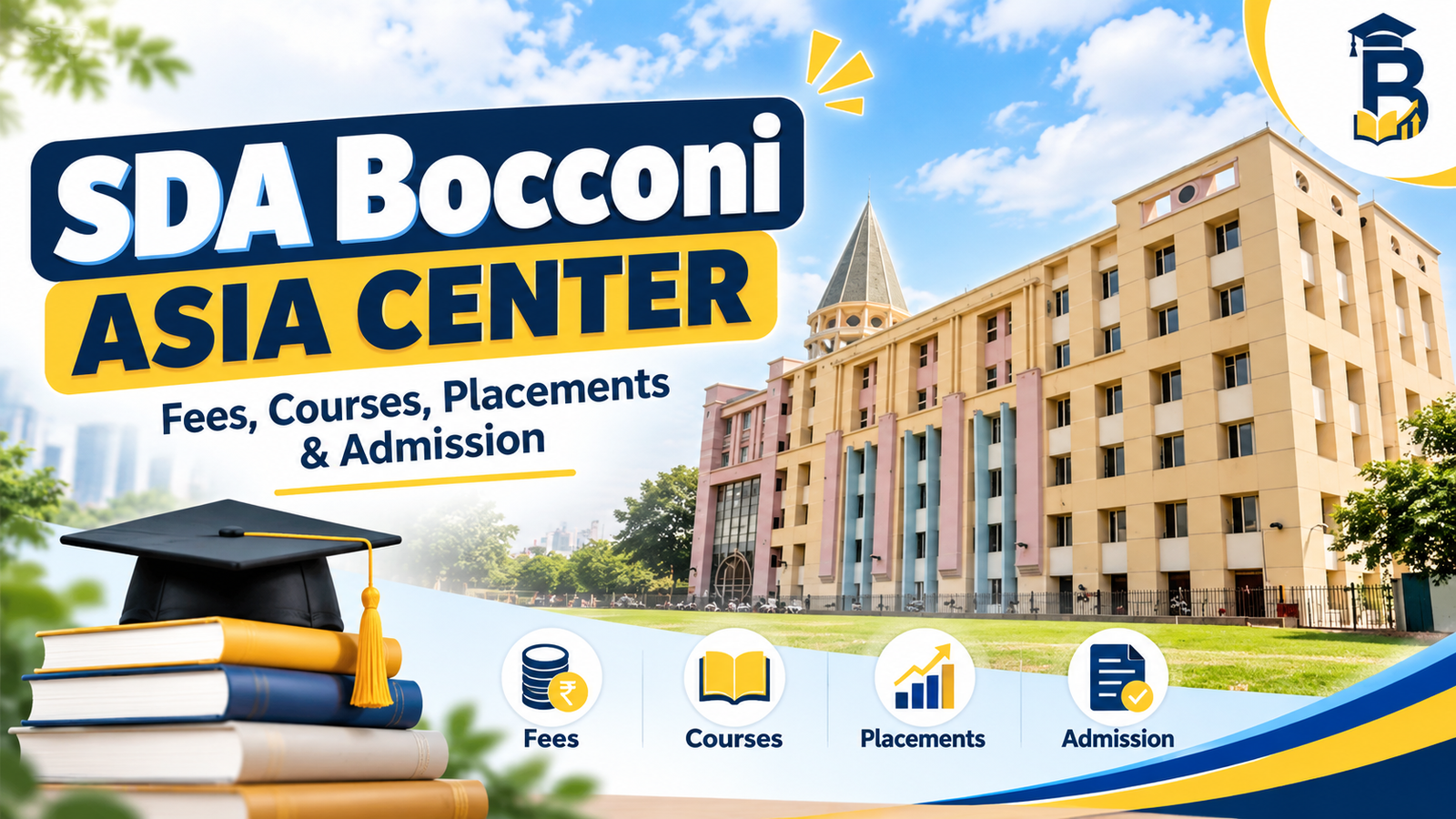
- SDA Bocconi Asia Center is located in Powai, Mumbai, Maharashtra.
- Its flagship postgraduate management programme is the International Master in Business (IMB).
- The IMB programme has a published duration of 22 months, structured into two 11-month modules.
- The programme includes a compulsory four-month international immersion at SDA Bocconi School of Management in Milan, Italy.
- For the published 2026–28 edition, applicants could apply with an undergraduate degree in any discipline or while in their final year, subject to the programme’s conditions.
- The published academic criteria for the 2026–28 edition specify a minimum of 55% across Class 10, Class 12 and undergraduate studies, along with a minimum average of 70% across these stages.
- Accepted entrance tests listed for the 2026–28 admission cycle include CAT, GMAT, NMAT by GMAC, GRE and the Bocconi Test, subject to applicable conditions.
- The admission process includes an online application, submission of documents and test scores, profile evaluation and interview stages.
- The published programme fee for the 2026–28 edition was ₹20.75 lakh, excluding applicable taxes.
- Scholarships and tuition waivers may be available to eligible candidates under the institute’s applicable terms.
- The institute provides career development support and publishes placement information for individual graduating classes.
- Applicants should confirm current fees, eligibility, deadlines and entrance-test requirements before applying.
SDA Bocconi Asia Center Courses & Programs: MBA/PGDM Specialisations, Duration & Eligibility
Introduction
SDA Bocconi Asia Center is a management education institution based in Powai, Mumbai, associated with SDA Bocconi School of Management in Italy. Its flagship International Master in Business (IMB) programme combines business education in India with an international learning experience in Milan. The programme is designed for graduates and early-career professionals seeking management knowledge, international exposure and opportunities across different industries.
Students searching for SDA Bocconi Asia Center courses and programs should understand that the institution’s flagship offering has a specific programme name: International Master in Business. It should not automatically be described as a conventional MBA or PGDM without checking the institute’s official terminology.
The course structure, eligibility requirements, accepted entrance examinations, programme fees and selection process are important considerations before applying. This article explains the main programme, its subject areas, duration, admission requirements, career preparation and the questions applicants should resolve before making a decision.
Table of Contents
Overview of SDA Bocconi Asia Center
Courses and Programs Offered
International Master in Business: Programme Overview
Curriculum and Subject Areas
Specialisations and Elective Options
Course Duration and International Immersion
Eligibility Criteria
Entrance Examinations Accepted
Admission Process
Documents Required
Fees and Scholarships
Teaching Methodology and Practical Learning
Career Development and Placements
Career Opportunities After the Programme
Campus and Student Experience
Who Should Consider SDA Bocconi Asia Center?
How to Evaluate the Programme Before Applying
Quick Summary
Key Takeaways
Frequently Asked Questions
Conclusion
About MBA Compass
Related Search Keywords
1. Overview of SDA Bocconi Asia Center
SDA Bocconi Asia Center is based in Mumbai and serves as a regional hub for management education associated with SDA Bocconi School of Management, Italy. The institution offers postgraduate management education and executive learning opportunities, connecting business concepts with the needs of companies operating in India and international markets.
Its flagship International Master in Business is aimed at fresh graduates and early-career professionals. The programme includes management education in Mumbai and a compulsory international immersion at the parent institution in Milan.
Institute overview
| Particular | Details |
|---|---|
| Institution | SDA Bocconi Asia Center |
| Location | Powai, Mumbai, Maharashtra |
| Flagship programme | International Master in Business (IMB) |
| Programme duration | 22 months |
| Programme format | Postgraduate management education with international immersion |
| Intended participants | Graduates and early-career professionals |
| International component | Compulsory term at SDA Bocconi School of Management, Milan, Italy |
| Official programme title | International Master in Business |
| Admission assessment | Academic profile, test scores, work experience and interview stages |
Students should confirm the programme details for their intended intake because admissions requirements, dates, fees and available course options can change.
2. SDA Bocconi Asia Center Courses and Programs
The institution offers management education through different formats. The right choice depends on whether an applicant is beginning a management career, seeking broader business knowledge or looking for executive education while working.
International Master in Business
The International Master in Business is the flagship postgraduate programme. It is intended for fresh graduates and early-career professionals who want to develop management skills and gain international academic exposure.
The programme combines core business subjects with applied learning, case discussions, projects, corporate exposure and an international immersion. It is relevant to applicants considering careers in areas such as marketing, consulting, finance, business development, analytics, strategy and general management.
Executive education programmes
SDA Bocconi Asia Center also offers executive education programmes for professionals and business leaders. These programmes differ from the IMB in their intended audience, duration and learning objectives.
Some executive programmes focus on specific business areas, such as entrepreneurship, innovation or luxury management. They may be delivered in short or modular formats and can have work-experience requirements.
Applicants should not treat executive education programmes as equivalent to the flagship IMB. The qualification, eligibility, time commitment and fee structure must be evaluated separately.
Comparing the main programme formats
| Programme format | Intended audience | Main purpose | What applicants should verify |
|---|---|---|---|
| International Master in Business | Graduates and early-career professionals | Broad postgraduate management education | Eligibility, entrance tests, total fees and international immersion |
| Executive education | Working professionals and executives | Focused learning in a particular management area | Work experience, programme duration, fee and certificate awarded |
| Short executive programmes | Professionals seeking targeted development | Specialised learning over a shorter period | Course content, delivery format and completion requirements |
The IMB is the main option to examine if the objective is a longer postgraduate management programme after graduation.
3. International Master in Business: Programme Overview
The International Master in Business is a 22-month programme structured around two 11-month modules. One of its defining features is a compulsory international immersion at SDA Bocconi School of Management in Milan, Italy.
The programme is designed to introduce students to the functional and strategic areas of business while developing their ability to work with different markets, cultures and organisational environments.
What makes the programme distinctive?
International learning experience: Students study in Mumbai and participate in a compulsory international component in Milan. This provides exposure to a different academic and business environment.
Management foundations: The curriculum addresses the principal disciplines required to understand organisations, markets, customers, financial decisions and business strategy.
Applied learning: Case discussions, simulations, projects and corporate interactions help students connect classroom concepts with practical situations.
Career development: Students can access structured career support that may include profile development, interview preparation, industry interactions and placement-related activities.
Diverse peer learning: Students from different academic backgrounds and professional experiences can contribute varied perspectives to classroom discussions.
These features should be assessed against the applicant’s own goals. International exposure can be valuable, but its benefit depends on the quality of learning, the student’s participation and the career path the student intends to pursue.
4. Curriculum and Subject Areas
The curriculum is intended to develop a broad understanding of business before students apply that knowledge to particular functions and management problems. Exact subjects and elective availability should be checked in the current programme curriculum.
Core management knowledge
Management education typically requires students to understand how different business functions interact. Marketing decisions influence revenue, financial decisions affect investment and resource allocation, and operations influence the delivery of products and services.
Students therefore benefit from understanding business as an interconnected system rather than as a collection of isolated subjects.
Marketing and customer strategy
Marketing-related learning can help students understand customer behaviour, market positioning, brand strategy and the decisions companies make to reach their target audiences.
These concepts are relevant to careers in brand management, marketing strategy, sales, customer development and business growth.
Finance and business decisions
Finance is important for understanding business performance, investment decisions, budgeting and the financial implications of strategy.
Students interested in corporate finance, financial services, business planning or management roles can benefit from developing financial literacy even when they do not intend to specialise in finance.
Strategy and general management
Strategy examines how organisations choose markets, allocate resources, respond to competition and build long-term advantages.
This area is relevant to consulting, business planning, corporate strategy and general management. It also helps students connect functional decisions with wider organisational objectives.
Analytics and digital transformation
Modern businesses rely on data to evaluate customers, monitor operations and support decisions. Analytics and digital transformation topics can help students understand how information, technology and business processes work together.
Applicants should confirm which analytics, artificial intelligence, machine learning or digital courses are included in the current curriculum rather than assuming that every topic is available as a separate specialisation.
Leadership and communication
Management roles require more than technical knowledge. Teamwork, presentation skills, negotiation, problem-solving and the ability to communicate recommendations are important across industries.
Group assignments, case discussions and interviews can provide opportunities to practise these skills.
5. SDA Bocconi Asia Center Specialisations and Elective Options
Students often search for MBA or PGDM specialisations when evaluating management institutions. In the case of SDA Bocconi Asia Center, it is important to distinguish between the official IMB programme and the subject areas covered within its curriculum.
The International Master in Business is the flagship programme title. Marketing, finance, strategy, analytics and management are useful areas to explore when examining its curriculum, but they should not automatically be presented as separately awarded degrees or guaranteed formal specialisations.
Business areas students may explore
| Business area | What it covers | Potential career relevance |
|---|---|---|
| Marketing | Customers, brands, market positioning and growth | Brand management, marketing, sales and customer strategy |
| Finance | Financial analysis and business resource allocation | Corporate finance, financial planning and selected financial services roles |
| Strategy | Competitive positioning and business decisions | Strategy, consulting and business planning |
| Analytics | Data interpretation and evidence-based decisions | Business analysis, research and analytics-related roles |
| Digital business | Technology-enabled business models and transformation | Digital strategy, product-related and transformation roles |
| General management | Cross-functional business decisions | Management trainee and broader business roles |
| Human resources | People, organisational development and workforce decisions | HR and talent-related roles |
| Operations | Processes, delivery and organisational efficiency | Operations, supply chain and process improvement |
The table identifies broad subject areas and related career directions; it is not a guarantee that each area is available as a formal concentration in every intake.
How to evaluate elective options
Before applying, review the current curriculum and ask the admissions team the following questions:
Which elective subjects are available in the intended batch?
Are electives guaranteed or dependent on demand and scheduling?
Are particular courses offered only during the Milan immersion?
Can students combine subjects from different functional areas?
Are any concentration certificates or additional credentials awarded?
What academic requirements must be met to take an elective?
These questions help applicants distinguish between subjects discussed in marketing materials and the courses they can actually select.
6. Course Duration and International Immersion
The International Master in Business is a 22-month programme. Its published structure comprises two 11-month modules and includes a compulsory four-month international immersion at SDA Bocconi School of Management in Milan.
Programme structure
| Component | Published structure |
|---|---|
| Overall duration | 22 months |
| Module structure | Two modules of 11 months each |
| Main Indian location | Mumbai |
| International location | Milan, Italy |
| International component | Compulsory four-month immersion |
| Learning methods | Management courses, applied learning and corporate exposure |
Students should confirm the exact calendar for their batch, including when the international term begins, travel arrangements, accommodation expectations and any additional costs.
Why the international immersion matters
Studying in another country can help students understand how business practices differ across markets. It may also provide opportunities to interact with international faculty, students and business professionals.
However, the practical value of the experience depends on more than location. Applicants should consider the courses taught during the immersion, the academic expectations, the opportunities for networking and the total financial commitment.
International travel also introduces logistical considerations. Students should plan for passports, visas where applicable, travel, accommodation, insurance and living expenses according to the institute’s instructions.
7. Eligibility Criteria for SDA Bocconi Asia Center
Eligibility is one of the most important parts of the application process. Applicants should use the criteria published for their specific admission cycle rather than relying on older admission summaries.
For the IMB 2026–28 edition, the published criteria specify an undergraduate degree in any discipline, or final-year undergraduate status at the time of application. The academic criteria also specify a minimum of 55% across Class 10, Class 12 and undergraduate studies, along with a minimum aggregate average of 70% across these stages.
Eligibility overview
| Requirement | Published requirement for IMB 2026–28 |
|---|---|
| Educational qualification | Undergraduate degree in any discipline |
| Final-year applicants | Eligible to apply while in the final year, subject to the programme’s conditions |
| Minimum academic marks | At least 55% across Class 10, Class 12 and undergraduate studies |
| Combined academic average | Minimum 70% average across Class 10, Class 12 and undergraduate studies |
| Work experience | Programme designed for freshers and young professionals with up to five years of experience |
| Entrance assessment | At least one accepted test score or the Bocconi Test, according to the applicable admission rules |
Applicants should ask the admissions team how the combined average is calculated and how final-year applicants are assessed. They should also confirm whether any additional documentation is needed if the degree certificate has not yet been issued.
Does academic eligibility guarantee admission?
No. Meeting the minimum academic requirements allows a candidate to be considered, but admission depends on the overall evaluation.
The institute considers academic ability, test scores, work experience, extracurricular participation, soft skills and interview performance. Candidates should therefore prepare a strong application rather than relying only on their marks or entrance test result.
8. Entrance Examinations Accepted
The published IMB admission information lists several accepted tests. The applicable testing years and score validity conditions depend on the admission cycle.
Accepted tests for the published 2026–28 criteria
| Test | Applicant guidance |
|---|---|
| CAT | Check the accepted examination years listed for the intake |
| GMAT | Check the minimum date from which scores are accepted |
| NMAT by GMAC | Confirm the accepted test years |
| GRE | Confirm the score-date requirement |
| Bocconi Test | May be required when an applicant does not provide another accepted score or when the admissions committee requests it |
Applicants with more than one eligible test score should check the current policy on how multiple scores are evaluated. The institute’s published admissions information states that the best score is considered when multiple scores are submitted.
Is there a fixed cutoff?
The published admissions page states that SDA Bocconi Asia Center does not indicate a fixed cutoff or restriction for these tests. It also explains that test scores form part of a broader profile assessment.
This does not mean entrance scores are unimportant. A stronger score may support an application, but academic performance, work experience, extracurricular activities, communication and interview performance can also influence the outcome.
How should applicants prepare?
Start by identifying the test or tests that are valid for the intended intake. Then prepare according to the examination format and allocate sufficient time for practice.
Applicants should avoid using a score-validity rule from an earlier admission cycle. A test taken within an accepted period for one batch may not meet the requirements for a later intake.
9. Admission Process
The admission process combines an online application with assessment of academic qualifications, entrance scores and personal suitability. Applicants should complete every stage within the deadlines set for their round.
Step 1: Review the current programme information
Read the official programme description, eligibility criteria, accepted tests, fee information and application dates. Confirm that the 22-month IMB format and international immersion suit your academic and career plans.
Step 2: Complete the online application
Fill in the application form accurately. Check personal information, academic history, work experience and other required details before submission.
The published application fee for the IMB 2026–28 edition was ₹3,500. Applicants for a later cycle should confirm the current fee before applying.
Step 3: Submit test scores and supporting documents
Provide the accepted test score, academic transcripts, updated CV, essays and other documents requested by the admissions portal.
Ensure that documents are legible and that the details match the information entered in the application form.
Step 4: Complete any required Bocconi Test
The admissions committee may ask an applicant to take the Bocconi Test if no other eligible score is provided or if the submitted score does not meet the committee’s expectations.
Applicants should follow the instructions sent by the admissions team and complete the assessment within the stated period.
Step 5: Participate in the interview stages
The published process includes an AI-enabled interview stage and a personal interview. These assessments can consider communication, behavioural attributes, problem-solving ability and the applicant’s overall profile.
Candidates should be prepared to explain their academic choices, professional interests, career plans, achievements and reasons for selecting the programme.
Step 6: Wait for the admission decision
The admissions committee reviews the application and communicates the decision. Successful applicants should carefully read the offer conditions, payment schedule, deadlines and scholarship information before accepting the offer.
Admission process at a glance
| Stage | What the applicant needs to do |
|---|---|
| Programme research | Review curriculum, eligibility, fees and deadlines |
| Online application | Complete the application form |
| Document submission | Upload academic records, CV, essays and test score |
| Additional assessment | Complete the Bocconi Test if required |
| Interview | Attend the prescribed interview stages |
| Final decision | Review the offer and any scholarship conditions |
| Enrolment | Complete required payments and documentation by the deadline |
10. Documents Required
Applicants should prepare the documents specified by the current admission portal. For the published IMB admission process, the listed documents include academic mark sheets, graduation records where available, a CV, identification, a photograph and an accepted entrance test score card where applicable.
Document checklist
| Document | Purpose |
|---|---|
| Class 10 mark sheet | Verification of school-level academic record |
| Class 12 mark sheet | Verification of senior secondary academic record |
| Undergraduate mark sheets | Verification of graduation performance |
| Degree or provisional certificate, if available | Confirmation of completed qualification |
| Updated CV | Summary of education, experience, activities and achievements |
| Photo identification | Identity verification |
| Digital passport-size photograph | Application record |
| Entrance test score card | Verification of the accepted test score, where applicable |
| Essays and other requested forms | Assessment of motivation and candidate profile |
Final-year students should confirm which available semester results they must upload and when they will need to submit the final degree documents.
Applicants with full-time work experience should prepare supporting evidence that meets the institute’s requirements. The admissions team may request employment letters, offer letters, recent salary slips or Form 16, as applicable.
11. Fees and Scholarships
Fees are an important part of evaluating SDA Bocconi Asia Center courses and programs. Applicants should calculate the total financial commitment rather than considering only the headline programme fee.
The institute’s published announcement for the IMB 2026–28 edition listed a programme fee of ₹20.75 lakh, excluding taxes. This figure applies to that published edition and should not automatically be treated as the confirmed fee for a later batch.
Programme fee reference
| Fee component | Published information |
|---|---|
| IMB programme fee for the 2026–28 edition | ₹20.75 lakh |
| Taxes | Excluded from the published programme fee |
| Application fee for the 2026–28 edition | ₹3,500 |
| Scholarships and tuition waivers | Offered to eligible applicants, subject to programme conditions |
| Other expenses | Confirm any travel, accommodation, insurance and living costs not included in the programme fee |
The published fee should be treated as a reference for the specified edition, not a guaranteed quote for all future admissions.
What should be confirmed before payment?
Ask the admissions team for a written breakdown covering the following:
Total programme fee and applicable taxes.
Instalment amounts and payment deadlines.
Whether international immersion costs are included.
Whether accommodation, meals, travel and insurance are included.
Any refundable deposit or additional administrative charge.
Rules for late payments, withdrawal and refunds.
Scholarship conditions and the process for retaining a tuition waiver.
A clear breakdown helps applicants compare the actual cost of attendance rather than relying on an incomplete headline amount.
Scholarships and tuition waivers
The institute’s published information describes merit-based tuition waivers and other scholarship opportunities. The 2026–28 programme announcement referred to tuition waivers of up to 80% for eligible IMB candidates.
Scholarship availability, selection criteria and award amounts can vary. Applicants should check the current scholarship document and determine whether an award applies to tuition alone or to other costs as well.
A tuition waiver should not be assumed to cover travel, accommodation, taxes or personal expenses unless the scholarship terms explicitly say so.
Estimating the total investment
The total cost of attendance may include more than the programme fee. Applicants should consider:
Programme fee and taxes.
Travel to and from the international campus.
Accommodation and meals during the international term, if not included.
Visa-related costs and travel insurance, where applicable.
Local transport, books, equipment and personal expenses.
Any cost incurred before enrolment or during the admission process.
The correct budget depends on what the institute includes in the current fee schedule. Obtain the relevant fee document before making financial commitments.
12. Teaching Methodology and Practical Learning
Management education is most useful when students can connect frameworks with real organisational decisions. The IMB learning experience includes classroom learning and applied activities designed to build business understanding.
Case-based learning
Business cases help students analyse a situation, identify the main problem, evaluate possible solutions and justify a recommendation. This approach encourages students to consider the commercial consequences of different decisions.
Simulations and projects
Simulations and projects can help students practise decision-making in structured environments. Students may have to balance financial performance, customer expectations, resource limitations and competitive pressure.
The exact activities depend on the course and academic schedule. Applicants should review the current curriculum to understand how practical work is assessed.
Corporate interactions
Industry interactions can introduce students to business problems, organisational practices and career paths. Guest sessions and corporate exposure can also help students connect classroom learning with current market conditions.
Students should take an active role in these opportunities by preparing questions, building professional relationships and following up on relevant insights.
International exposure
The Milan immersion forms a significant part of the programme. It provides an opportunity to experience a different academic setting and engage with international perspectives on management.
Applicants should ask about the subjects taught during this period, expected learning outcomes and any additional logistical requirements.
13. Career Development and Placements
Career development is an important part of the student experience. SDA Bocconi Asia Center provides structured career support for the IMB, including activities related to CV preparation, interview skills, industry interactions, career counselling and professional development.
The career team’s work is intended to help students understand recruitment processes and present their capabilities effectively. The results achieved by individual students will still depend on their profiles, performance, chosen roles and the hiring requirements of employers.
Placement report for the IMB Class of 2025
The institute’s published placement report for the IMB Class of 2025 reported the following figures:
| Placement measure | Published result |
|---|---|
| Highest annual salary | ₹36.50 lakh |
| Average annual salary | ₹14.10 lakh |
| Median annual salary | ₹13.51 lakh |
| Average salary for the top 25% | ₹18.21 lakh |
| Recruiters | 70+ |
These figures refer to the Class of 2025 and should not be presented as guaranteed salaries for future graduating classes. Applicants should check the latest available report for the batch relevant to their admission decision.
How to interpret placement figures
The highest salary reflects the top reported offer and does not represent the expected outcome for every student. The average gives a broader view of reported compensation, while the median indicates the midpoint of the reported distribution.
Students should also look at the types of roles offered, industry mix, placement methodology and the proportion of the cohort included in the report.
Recruiter sectors and role diversity
The institute’s published placement information for the Class of 2025 identifies IT/ITES as the largest reported sector, accounting for 30% of offers, followed by BFSI/Financial Services at 25%.
The report lists organisations across areas such as technology, consulting, consumer businesses, financial services and other industries. Recruiter participation and role availability can change from year to year.
Applicants should read the complete placement report and evaluate whether the available roles align with their career goals. A list of participating companies alone does not guarantee that every student will receive an offer from a particular employer.
14. Career Opportunities After the Programme
The IMB curriculum is intended to prepare students for a range of business roles. Actual opportunities depend on prior education, internships, relevant skills, interview performance, employer requirements and the hiring market.
Marketing and brand management
Students interested in customer strategy, brand positioning and business growth may explore marketing, brand management, market research, sales strategy and customer development roles.
These positions require a mix of analytical thinking, communication and understanding of consumer behaviour.
Consulting and business analysis
Consulting and business analysis roles involve examining business problems, interpreting information and recommending practical solutions. Candidates may need strong research, presentation and quantitative skills.
The programme’s case-based learning and business curriculum may help students develop relevant foundations, although employers set their own recruitment criteria.
Finance and financial services
Finance-related roles may include financial analysis, business finance and positions in financial services organisations. The specific roles available depend on the candidate’s background and the employer’s requirements.
Students interested in finance should check which technical skills, certifications or prior experience are expected for their target positions.
Strategy and general management
Strategy and general management roles require an understanding of business functions, market conditions and organisational performance. Graduates may explore management trainee programmes or business planning roles where their profiles fit the employer’s criteria.
Digital business and analytics
Businesses increasingly use data and digital tools to improve products, customer experience and operational decisions. Relevant roles can include business analysis, digital strategy and selected product-related positions.
Applicants should examine the curriculum and placement report to understand the extent of opportunities in these areas.
Human resources and operations
People management, organisational development, process improvement and operational planning are also possible directions for management graduates. Access to these roles depends on the candidate’s interests, relevant coursework and recruitment opportunities.
15. Campus and Student Experience
SDA Bocconi Asia Center is located in Powai, Mumbai. The city offers access to a wide range of businesses and industries, which can be useful for professional interactions and networking.
The IMB programme also includes the international component in Milan, so students should consider the experience as a combination of learning environments rather than only a Mumbai campus programme.
What applicants should investigate
Before enrolment, prospective students should learn about classroom facilities, library access, student clubs, events, accommodation options and transport arrangements.
They should also confirm how the academic calendar works around the international term and whether any travel or accommodation arrangements must be organised independently.
The international component may be attractive to students who value cross-cultural learning, but applicants should consider the associated time commitment and costs before deciding.
16. Who Should Consider SDA Bocconi Asia Center?
The programme may suit applicants who want a postgraduate management education with international exposure and are prepared for an intensive academic experience.
Fresh graduates
Students from different undergraduate disciplines can consider the IMB if they meet the academic criteria and want to develop a broader understanding of business. They should be ready to explain why management education fits their career plans.
Early-career professionals
Applicants with some full-time experience may benefit from connecting prior work exposure with management frameworks. They should review how their experience fits the programme’s intended audience and the current admission requirements.
Students interested in international learning
Candidates who value a study experience in both India and Italy may find the programme structure appealing. They should also consider travel requirements, international expenses and the academic expectations associated with the Milan term.
Applicants seeking broad business exposure
The IMB may be relevant to students who want to explore more than one functional area before choosing a career direction. Applicants seeking a narrowly specialised degree should confirm whether the available courses match their needs.
17. How to Evaluate the Programme Before Applying
A careful evaluation should include the programme structure, total cost, admission criteria and likely career relevance. Applicants should avoid choosing a programme based on a single ranking, salary figure or international association.
Compare the curriculum with your career objective
Identify the roles you want to pursue after graduation. Then compare the curriculum with the knowledge and skills those roles require.
For example, a student interested in marketing should examine the marketing curriculum, relevant projects and the types of marketing roles shown in placement reports. Someone targeting finance should investigate the finance subjects and technical requirements of the desired roles.
Evaluate the total financial commitment
Use the current fee schedule rather than relying on an old brochure or third-party estimate. Include taxes, international travel, accommodation and personal expenses that are not included in the programme fee.
If a scholarship is offered, confirm its value, conditions and renewal requirements in writing.
Understand the admission assessment
Prepare the required entrance test and application documents well in advance. Since the selection process considers several aspects of the candidate’s profile, applicants should be ready to explain their goals, experience, achievements and motivation.
Review placement information carefully
Compare average and median salaries, the distribution of roles, participating sectors and the year of the report. These details provide more context than the highest salary alone.
Consider whether the career outcomes align with your preferred industry, function and location.
Verify details with the institute
Before submitting an application or paying a fee, confirm the following:
Current application deadlines and test-score validity.
Academic eligibility and final-year application rules.
Programme fee, applicable taxes and payment schedule.
Scholarship criteria and award conditions.
International immersion dates and associated expenses.
Current curriculum and available electives.
Refund and withdrawal policies.
Documents required for enrolment.
This final verification is particularly important because admission cycles can have different requirements and deadlines.
18. Quick Summary
SDA Bocconi Asia Center is located in Powai, Mumbai, Maharashtra.
Its flagship postgraduate management programme is the International Master in Business (IMB).
The IMB has a published duration of 22 months, structured into two 11-month modules.
The programme includes a compulsory four-month international immersion at SDA Bocconi School of Management in Milan, Italy.
The published eligibility criteria for the 2026–28 edition specify an undergraduate degree in any discipline or final-year undergraduate status.
The published academic criteria for that edition require at least 55% across Class 10, Class 12 and undergraduate studies, plus a minimum average of 70% across these stages.
Accepted tests listed for the 2026–28 admission cycle include CAT, GMAT, NMAT by GMAC, GRE and the Bocconi Test, subject to the applicable score-validity rules.
The admission process includes an online application, document submission, profile evaluation and interview stages.
The published programme fee for the 2026–28 edition was ₹20.75 lakh, excluding taxes.
The institute offers career development support and publishes placement reports for individual IMB graduating classes.
19. Key Takeaways
The International Master in Business is the flagship programme to examine when researching SDA Bocconi Asia Center courses and programs.
The IMB should be referred to by its official programme title rather than automatically labelled as a conventional MBA or PGDM.
The programme lasts 22 months and includes an international immersion at SDA Bocconi School of Management in Milan.
Applicants must check academic eligibility, accepted entrance tests and score-validity conditions for their intended admission cycle.
Admission is based on an overall candidate profile rather than a single entrance examination score.
The published fee of ₹20.75 lakh applies to the IMB 2026–28 edition and excludes taxes.
Scholarship awards and tuition waivers are subject to eligibility and the institute’s applicable terms.
Placement figures must be read in the context of the graduating class and the methodology used in the official report.
Applicants should compare curriculum, career fit, total cost and international study requirements before making a decision.
20. Frequently Asked Questions
What courses are offered by SDA Bocconi Asia Center?
The flagship postgraduate programme is the International Master in Business. The institution also offers executive education programmes with different durations and eligibility requirements.
Is the International Master in Business an MBA?
The official programme title is International Master in Business (IMB). Applicants should verify the qualification awarded and its formal recognition details instead of assuming that it is identical to an MBA or PGDM.
How long is the IMB programme?
The published programme duration is 22 months, divided into two 11-month modules. It includes a compulsory international immersion at the Milan campus.
What is the eligibility for the IMB?
For the published 2026–28 edition, applicants need an undergraduate degree in any discipline or must be in their final year. The published academic criteria specify a minimum of 55% across Class 10, Class 12 and undergraduate studies and a minimum 70% average across these stages.
Which entrance exams are accepted?
The published 2026–28 criteria list CAT, GMAT, NMAT by GMAC and GRE, along with the Bocconi Test. Applicants must check the accepted score years and validity conditions for their own intake.
Does the institute have a fixed cutoff?
The published admissions information states that it does not specify a fixed cutoff or restriction for the listed entrance tests. Test scores are considered alongside academic performance, work experience, extracurricular activities and interview performance.
What is the programme fee?
The published fee for the 2026–28 IMB edition was ₹20.75 lakh, excluding taxes. The fee and additional expenses should be confirmed for the intended intake.
Are scholarships available?
The institute publishes information about merit-based tuition waivers and other scholarship opportunities. Applicants should check current eligibility criteria, award amounts and conditions.
What are the placement opportunities after the IMB?
Career opportunities may span marketing, consulting, finance, technology, analytics, business development and general management. Actual outcomes depend on a student’s profile and the roles available during recruitment.
Where is SDA Bocconi Asia Center located?
The institute is located in Powai, Mumbai, Maharashtra. The IMB programme also includes an international academic component at SDA Bocconi School of Management in Milan, Italy.
21. Conclusion
SDA Bocconi Asia Center offers a distinctive management education pathway through its International Master in Business programme, which combines study in Mumbai with a compulsory international immersion in Milan. The programme is designed for graduates and early-career professionals who want broad business education and exposure to an international learning environment.
Applicants should evaluate the curriculum, academic eligibility, accepted entrance examinations, total programme cost, scholarship conditions and career development support before applying. They should also distinguish the IMB from conventional MBA and PGDM programmes and confirm the exact qualification awarded.
The published information for the 2026–28 edition provides a useful reference for duration, eligibility and fees, but applicants should verify current admission details and payment requirements for their own intake. A well-informed decision should balance academic fit, career objectives, affordability and the value of the international experience.
22. About MBA Compass
MBA Compass helps students explore management education options by organising information about programmes, admission requirements, fees, eligibility, entrance examinations and career outcomes. The platform aims to make college research easier to understand so that applicants can compare programmes and make informed decisions.
Students should confirm final admission, fee and eligibility details directly with the institution before applying, as programme information may change between academic cycles.
23. Related Search Keywords
SDA Bocconi Asia Center, SDA Bocconi Asia Center courses, SDA Bocconi Asia Center programs, SDA Bocconi courses, SDA Bocconi Asia Center Mumbai, SDA Bocconi IMB, International Master in Business, SDA Bocconi IMB programme, SDA Bocconi Asia Center eligibility, SDA Bocconi Asia Center admission, SDA Bocconi Asia Center fees, SDA Bocconi Asia Center duration, SDA Bocconi specialisations, SDA Bocconi curriculum, SDA Bocconi entrance exams, SDA Bocconi placement, SDA Bocconi placement report, SDA Bocconi Mumbai campus, SDA Bocconi Milan immersion, SDA Bocconi international programme, IMB programme India, International Master in Business India, international management programme Mumbai, postgraduate management programme Mumbai, management courses after graduation, international business education India, SDA Bocconi Asia Center 2026 admission, SDA Bocconi IMB 2026–28, SDA Bocconi admission criteria, SDA Bocconi academic requirements, SDA Bocconi test, Bocconi Test India, SDA Bocconi CAT requirement, SDA Bocconi GMAT requirement, SDA Bocconi GRE requirement, SDA Bocconi NMAT requirement, SDA Bocconi work experience, SDA Bocconi final year eligibility, SDA Bocconi application fee, SDA Bocconi tuition fee, SDA Bocconi programme fee, SDA Bocconi scholarship, SDA Bocconi tuition waiver, SDA Bocconi merit scholarship, SDA Bocconi international immersion cost, SDA Bocconi study in Italy, SDA Bocconi Milan campus, SDA Bocconi Mumbai to Milan programme, SDA Bocconi course duration, SDA Bocconi 22 month programme, SDA Bocconi 11 month modules, SDA Bocconi management curriculum, SDA Bocconi marketing courses, SDA Bocconi finance courses, SDA Bocconi strategy courses, SDA Bocconi analytics courses, SDA Bocconi digital transformation, SDA Bocconi business management, SDA Bocconi general management, SDA Bocconi career opportunities, SDA Bocconi career development services, SDA Bocconi summer internship, SDA Bocconi corporate exposure, SDA Bocconi placement statistics, SDA Bocconi average salary, SDA Bocconi highest salary, SDA Bocconi median salary, SDA Bocconi recruiters, SDA Bocconi career outcomes, SDA Bocconi Class of 2025 placement, SDA Bocconi IMB average package, SDA Bocconi IMB highest package, SDA Bocconi IMB median package, SDA Bocconi companies, SDA Bocconi consulting jobs, SDA Bocconi marketing jobs, SDA Bocconi finance jobs, SDA Bocconi technology jobs, SDA Bocconi business analyst roles, SDA Bocconi management trainee roles, SDA Bocconi student life, SDA Bocconi campus location, SDA Bocconi Powai Mumbai, SDA Bocconi international exposure, SDA Bocconi business school Italy, SDA Bocconi School of Management, SDA Bocconi Asia Center official website, SDA Bocconi application process, SDA Bocconi online application, SDA Bocconi interview process, SDA Bocconi AI interview, SDA Bocconi personal interview, SDA Bocconi documents required, SDA Bocconi admission rounds, SDA Bocconi application deadline, SDA Bocconi accepted test scores, SDA Bocconi profile-based selection, SDA Bocconi extracurricular activities, SDA Bocconi admission for freshers, SDA Bocconi programme for young professionals, SDA Bocconi business degree, SDA Bocconi postgraduate degree, SDA Bocconi MBA comparison, SDA Bocconi PGDM comparison, SDA Bocconi IMB versus MBA, international management degree India, management education with international immersion, management programme with Milan immersion, business school in Powai, international business course Mumbai, management institute Mumbai, postgraduate business programme India, business management course eligibility, management course entrance tests, international management course fees, international business programme duration, management programme scholarship India, management education placement report, business school placement statistics, management programme career support, management curriculum and electives, business strategy course India, marketing management education, finance management education, analytics management education, digital business management course, leadership development programme, executive education SDA Bocconi, SDA Bocconi executive programmes, SDA Bocconi entrepreneurship programme, SDA Bocconi luxury management programme, SDA Bocconi innovation programme, SDA Bocconi executive education eligibility, SDA Bocconi professional courses, SDA Bocconi management training, SDA Bocconi international alumni network, SDA Bocconi academic profile, SDA Bocconi programme comparison, SDA Bocconi total cost, SDA Bocconi fees excluding taxes, SDA Bocconi scholarship eligibility, SDA Bocconi international travel expenses, SDA Bocconi admission checklist, SDA Bocconi application documents, SDA Bocconi course selection, SDA Bocconi elective subjects, SDA Bocconi management specialisation options, SDA Bocconi job opportunities after IMB, SDA Bocconi career prospects India, SDA Bocconi graduate employment, SDA Bocconi corporate recruiters, SDA Bocconi international study experience, SDA Bocconi Mumbai admissions, SDA Bocconi IMB eligibility 2026, SDA Bocconi IMB fee 2026, SDA Bocconi IMB admission process, SDA Bocconi courses and eligibility, SDA Bocconi programme structure, SDA Bocconi academic calendar, SDA Bocconi international module, SDA Bocconi student profile, SDA Bocconi postgraduate management admissions, MBA Compass SDA Bocconi guide
Key Takeaways
The International Master in Business (IMB) is the flagship programme at SDA Bocconi Asia Center.
The IMB should be referred to by its official programme title rather than automatically described as a conventional MBA or PGDM.
The programme lasts 22 months and includes an international immersion at SDA Bocconi School of Management in Milan.
Applicants should carefully review academic eligibility and accepted entrance-test requirements for their intended admission cycle.
Admission involves an overall assessment of the applicant’s academic record, test scores, profile and interview performance.
The published programme fee of ₹20.75 lakh applies to the 2026–28 edition and excludes applicable taxes.
Scholarships and tuition waivers are subject to eligibility requirements and the institute’s terms.
Students should evaluate placement reports by examining average salary, median salary, recruiter sector and the graduating batch.
International immersion can offer cross-cultural learning, but applicants should also consider travel arrangements and additional expenses.
Comparing the curriculum, career goals, total cost and admission requirements can help applicants decide whether the programme is suitable for them.
Frequently Asked Questions
What courses are offered by SDA Bocconi Asia Center?
SDA Bocconi Asia Center offers the International Master in Business (IMB), an international postgraduate management programme, along with executive education programmes for working professionals. The available options depend on the applicant’s academic background and work experience.
Is the International Master in Business an MBA or PGDM?
The flagship programme is called the International Master in Business (IMB). Applicants should use the institute’s official programme title rather than automatically referring to it as an MBA or PGDM.
What is the duration of the IMB programme?
The International Master in Business is a 22-month programme comprising two 11-month modules. It includes a compulsory international immersion at SDA Bocconi School of Management in Milan, Italy.
What is the eligibility for SDA Bocconi Asia Center?
For the IMB 2026–28 admission cycle, applicants need an undergraduate degree in any discipline or must be in their final year while applying. The published academic criteria specify a minimum of 55% across Class 10, Class 12 and undergraduate studies, with a minimum aggregate average of 70% across these stages.
Which entrance exams are accepted by SDA Bocconi Asia Center?
The published admission criteria list CAT, GMAT, NMAT by GMAC and GRE scores, as well as the Bocconi Test. The accepted test years and validity requirements depend on the admission cycle.
Does SDA Bocconi Asia Center require work experience?
The IMB programme is designed for fresh graduates and early-career professionals with up to five years of work experience. Work experience is considered as part of the overall candidate profile.
What is the IMB programme fee?
The published announcement for the 2026–28 IMB edition lists a programme fee of ₹20.75 lakh, excluding applicable taxes. Applicants should confirm the current payment schedule, tax treatment and any additional charges directly with the institute before paying.
Does SDA Bocconi Asia Center have specialisations?
The IMB curriculum covers several business areas, including marketing, finance, strategy, analytics, digital transformation and management. The precise elective choices and concentration options depend on the curriculum and academic schedule.
What is the admission process at SDA Bocconi Asia Center?
The process generally includes an online application, submission of test scores and academic documents, profile evaluation, interview stages and a final admission decision. A Bocconi Test may also be required in applicable cases.
Where is SDA Bocconi Asia Center located?
SDA Bocconi Asia Center is located in Powai, Mumbai, Maharashtra. Its IMB programme includes an international study component at SDA Bocconi School of Management in Milan, Italy.
Ask a question
Still confused? Leave your question and our team will help you.