
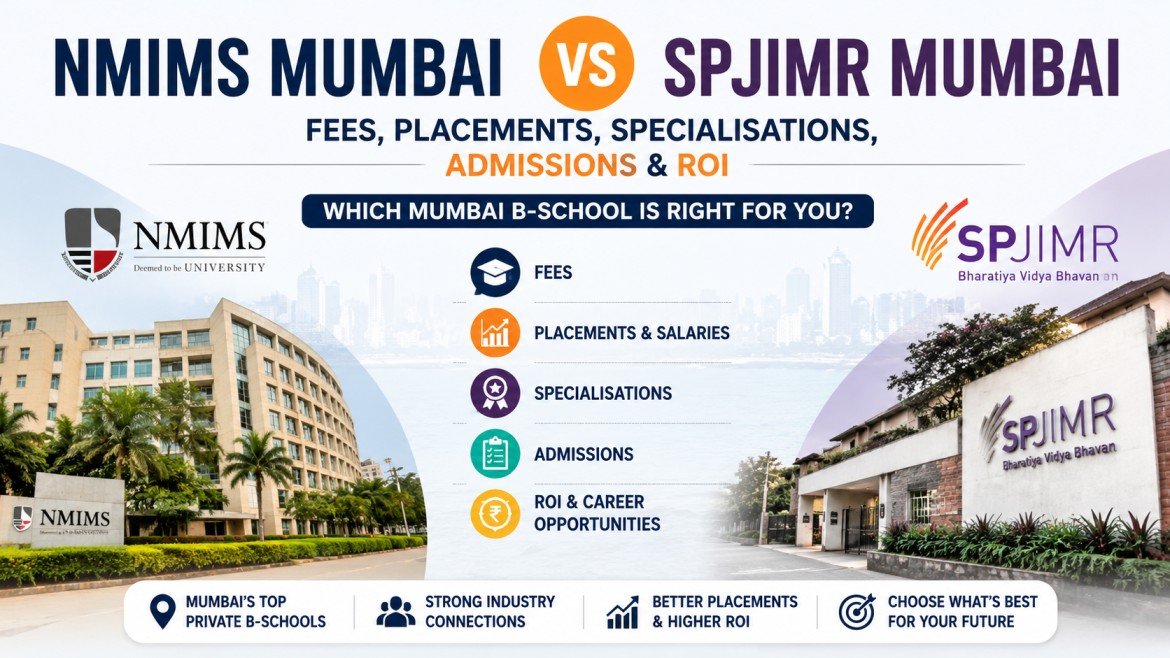
Quick Summary
- SPJIMR currently shows stronger reported placement outcomes, while NMIMS offers a strong Mumbai-based MBA ecosystem. Compare programme costs, career goals, specialisations and admission routes before choosing your B-school.
Meta Title: NMIMS vs SPJIMR: Fees, Placements, Specialisations & ROI
Meta Description: NMIMS vs SPJIMR compared on MBA fees, placements, specialisations, admissions, salaries and ROI to help aspirants choose the right Mumbai B-school.
NMIMS Mumbai vs SPJIMR Mumbai: Fees, Placements, Specialisations, Admissions & ROI
Choosing between NMIMS Mumbai and SPJIMR Mumbai is one of the more difficult decisions for MBA aspirants targeting top private B-schools in Mumbai. Both institutions have strong corporate connections, experienced faculty, recognised management programmes and access to Mumbai's large financial and corporate ecosystem. However, the two schools differ meaningfully in their admission routes, programme structure, specialisation choices, fees, placement outcomes and the kind of career profile they may suit.
For students searching for NMIMS vs SPJIMR, the most important question is not simply which institute has the stronger brand. The better question is: which programme gives you the strongest combination of career fit, placement potential, cost and long-term ROI?
SPJIMR's flagship PGDM is a two-year, full-time residential programme with specialisations in Finance, Information Management, Marketing and Operations & Supply Chain. Its official placement information reports 100% placement for the programme and highlights strong compensation outcomes.
NMIMS School of Business Management, meanwhile, offers its flagship MBA Core programme in Mumbai and has a long-established management education presence. Its official placement page reports an average salary of ₹25.13 lakh for MBA Core and says that 190 leading companies recruited students in the referenced placement cycle.
This comparison looks at NMIMS vs SPJIMR fees, placements, specialisations, admission process, student profile, career opportunities and ROI, while distinguishing between the latest available placement information and figures that belong to earlier admission or placement cycles.
Important: Fees and placement numbers can change by intake and academic cycle. Where an institute has not yet published a complete 2026 placement figure, the latest officially available figure is identified rather than being presented as a 2026 result.
NMIMS vs SPJIMR at a Glance
| Parameter | NMIMS Mumbai | SPJIMR Mumbai |
|---|---|---|
| Institute | SVKM's NMIMS School of Business Management | S.P. Jain Institute of Management & Research |
| City | Mumbai | Mumbai |
| Flagship programme considered | MBA Core | PGDM |
| Programme duration | 2 years | 2 years |
| Programme type | Full-time MBA | Full-time PGDM |
| Major specialisation areas | Finance, Marketing, Operations & Data Sciences, General Management | Finance, Information Management, Marketing, Operations & Supply Chain |
| Entrance route | NMAT-based admission route for flagship MBA admissions | CAT/GMAT |
| Residential format | Mumbai campus programme | Residential |
| SPJIMR latest reported average CTC | — | ₹33.75 LPA for Class of 2026 |
| SPJIMR latest reported median CTC | — | ₹32.85 LPA for Class of 2026 |
| SPJIMR latest reported highest CTC | — | ₹75 LPA for Class of 2026 |
| NMIMS official average salary figure available on placement page | ₹25.13 LPA for MBA Core | — |
| Overall positioning | Strong Mumbai-based MBA with broad corporate reach | Highly selective, residential management programme with strong consulting, finance and general-management outcomes |
SPJIMR's Class of 2026 final placement announcement reported 100% placements for the combined PGDM and PGDM(BM) batch, with an average CTC of ₹33.75 lakh, median CTC of ₹32.85 lakh and highest CTC of ₹75 lakh. The same announcement said 46% of the batch received pre-placement offers.
The comparison should therefore not be reduced to one salary number. NMIMS vs SPJIMR is fundamentally a comparison of programme positioning and career outcomes as much as it is a comparison of fees.
Why Compare NMIMS Mumbai and SPJIMR Mumbai?
Both institutions attract ambitious management aspirants, but their appeal is somewhat different.
NMIMS benefits from its Mumbai location, established alumni network, large student ecosystem and broad corporate exposure. Its School of Business Management has been operating since 1981 and describes itself as having more than 29,000 alumni and more than 250 recruiters across its wider ecosystem.
SPJIMR was also established in 1981 and operates from Bharatiya Vidya Bhavan's campus in Andheri West, Mumbai. Its PGDM is a two-year residential programme, and the institute highlights its EQUIS, AACSB and AMBA Triple Crown accreditation.
For an aspirant, that means both names can make sense on a shortlist. The difficult part begins when you have to decide which one deserves preference.
The answer depends on your:
CAT or NMAT performance and admission route
Desired specialisation
Career target
Work experience
Financial budget
Preference for residential versus city-based student life
Interest in consulting, finance, marketing, operations or technology
Expected salary after graduation
Risk tolerance around education cost
Long-term career goals
NMIMS vs SPJIMR: Which Is Better?
If the question is NMIMS vs SPJIMR, which is better for MBA?, there is no universal answer.
For candidates who prioritise a highly selective programme, strong consulting and finance opportunities, a residential learning environment and very strong reported placement outcomes, SPJIMR has a compelling advantage.
For candidates who prefer NMIMS's MBA ecosystem, want to enter through the NMAT route and value the broader Mumbai-based corporate environment, NMIMS Mumbai remains a strong option.
The salary data makes the distinction particularly interesting. SPJIMR's Class of 2026 reported an average CTC of ₹33.75 lakh and median CTC of ₹32.85 lakh. NMIMS's official placement page currently reports ₹25.13 lakh average salary for MBA Core.
However, these figures should not be treated as if they were generated under exactly the same reporting methodology or necessarily from identical batches. A responsible comparison therefore uses them as directional evidence rather than claiming a mathematically exact ROI difference.
NMIMS Mumbai MBA: Programme Overview
The School of Business Management at NMIMS Mumbai offers a flagship MBA Core programme alongside other management programmes.
The school describes its MBA programmes as designed to cater to different career interests, and its placement page reports participation from a large group of corporate recruiters.
One of NMIMS's major attractions is the breadth of its management ecosystem. Students interested in finance, marketing, operations, data-oriented roles and general management can find career pathways across multiple industries.
This is particularly relevant for students who do not want to lock themselves into a very narrow career path immediately after joining business school.
NMIMS MBA specialisation options
NMIMS's MBA Core ecosystem has historically included areas such as:
Finance
Marketing
Operations and Data Sciences
General Management
The exact curriculum, elective structure and available tracks can change by academic year, so applicants should verify the programme curriculum for their specific intake before making a final decision.
For students interested in analytics and technology-driven business roles, the presence of data-oriented coursework and career opportunities can be attractive.
For students focused on traditional finance, marketing or general management careers, the larger Mumbai corporate environment is another advantage.
SPJIMR PGDM: Programme Overview
SPJIMR's flagship PGDM is a two-year, full-time residential programme.
The institute states that the PGDM offers specialisation options in:
Finance
Information Management
Marketing
Operations & Supply Chain
The programme has a stated batch size of 240 on the current admissions page, although placement reporting can involve the combined PGDM and PGDM(BM) process and therefore should be interpreted carefully.
SPJIMR also emphasises experiential learning through live projects, industry engagement, simulations, internships, corporate competitions and international exposure.
That structure is useful for students who prefer a more immersive business-school experience rather than a programme focused primarily on classroom learning.
NMIMS vs SPJIMR Specialisations
Specialisation can matter more than the institute name for some students.
A candidate planning a career in investment banking, consulting, marketing, supply chain, product management or business analytics should evaluate the curriculum and recruiter mix associated with that career rather than selecting a school solely because of its overall ranking.
| Career interest | NMIMS Mumbai | SPJIMR Mumbai |
|---|---|---|
| Finance | Strong option | Strong option |
| Marketing | Strong option | Strong option |
| Operations | Strong option | Strong option |
| Data/analytics | Strong relevance through Operations & Data Sciences | Strong relevance through Information Management |
| Supply Chain | Relevant | Explicit Operations & Supply Chain specialisation |
| General Management | Available | Strong general-management exposure |
| Consulting | Strong corporate opportunities | Particularly strong recent placement presence |
| Technology/business roles | Strong potential | Strong Information Management pathway |
SPJIMR's Class of 2026 placement announcement reported that consulting accounted for 40% of all offers, with recruiters including Accenture Strategy, BCG, Deloitte, EY-Parthenon, Kearney, KPMG, McKinsey and PwC among others.
This makes SPJIMR particularly interesting for candidates targeting consulting.
NMIMS vs SPJIMR Fees
Fees are one of the most important parts of the NMIMS vs SPJIMR decision because both programmes require a substantial investment.
SPJIMR's official PGDM fee page currently lists ₹24.86 lakh for Indian participants and states that the amount includes tuition and basic hostel/accommodation. The institute also says that the fee is indicative and subject to revision.
The figure should therefore be checked against the admission offer and applicable intake-specific fee schedule before payment.
For NMIMS Mumbai, candidates should similarly verify the fee communicated for the relevant MBA Core admission cycle because fee schedules can change and different programme components can have different charges.
Third-party comparison pages currently place the tuition range for the relevant NMIMS and SPJIMR management programmes in broadly similar territory, but applicants should rely on the respective institute's official fee communication when calculating their actual cost.
What should be included in your fee calculation?
Do not compare only the headline tuition fee.
Your actual MBA investment may include:
Tuition
Hostel or accommodation
Mess expenses
Books and study materials
Laptop or technology costs
Travel
Personal expenses
Student activities
International exchange expenses, if applicable
Summer internship relocation expenses
Loan interest
Opportunity cost of two years without a full-time salary
SPJIMR specifically notes that its standard PGDM fee includes tuition and basic hostel/accommodation, while optional Global Fast Track and International Exchange expenses are separate.
That distinction matters when calculating ROI.
NMIMS vs SPJIMR Placements
Placements are probably the most searched part of the comparison.
And there is a clear reason.
An MBA is a major financial and opportunity-cost decision. Students want to know whether the institute can translate the degree into a strong first job.
SPJIMR placement performance
SPJIMR's latest Class of 2026 placement announcement is particularly strong.
According to the institute's December 2025 announcement:
100% of the 356 participants were placed
Average CTC was ₹33.75 lakh
Median CTC was ₹32.85 lakh
Highest CTC was ₹75 lakh
46% of the batch received PPOs
Top 50% average CTC was ₹39 lakh
Top 25% average CTC was ₹43.75 lakh
80 companies participated
31 were new recruiters
68% of offers were at or above ₹30 lakh
94% of offers were at or above ₹25 lakh
The institute's placement page also presents the PGDM 2024–26 placement highlights as ₹33.6 lakh average CTC, ₹75 lakh highest CTC and ₹32.85 lakh median CTC.
The small difference between figures displayed on different official pages illustrates why aspirants should always check the latest placement report for the precise batch being compared.
NMIMS placement performance
NMIMS's School of Business Management placement page currently states that 190 leading companies recruited students and reports an average salary of ₹25.13 lakh for MBA Core.
This is a strong figure in absolute terms, but when comparing it with SPJIMR's Class of 2026 outcome, SPJIMR's reported average and median compensation are higher.
That does not automatically mean every SPJIMR student will earn more than every NMIMS graduate.
Placement distributions matter.
The median is particularly useful because it gives a better indication of the middle of the graduating class than the highest package.
Average Salary vs Median Salary: Why It Matters
MBA aspirants often focus on the highest package.
That can be misleading.
Suppose one student receives a very high offer. That single offer can make the highest package look impressive without telling you what a typical graduate earns.
The average is more informative, but it can still be influenced by a small number of very high salaries.
The median is often more useful for understanding the central outcome.
SPJIMR's Class of 2026 reported:
Average CTC: ₹33.75 lakh
Median CTC: ₹32.85 lakh
Highest CTC: ₹75 lakh
The relatively small gap between the average and median is noteworthy because it indicates that compensation was not driven solely by a handful of extreme offers.
For NMIMS, the official placement page currently gives an average MBA Core salary of ₹25.13 lakh.
Students should seek the latest NMIMS placement report for the exact median, highest CTC, batch size and offer distribution before making a final investment decision.
NMIMS vs SPJIMR: Placement Comparison
| Placement factor | NMIMS Mumbai | SPJIMR Mumbai |
|---|---|---|
| Official average salary currently highlighted | ₹25.13 LPA for MBA Core | ₹33.75 LPA for Class of 2026 |
| Median salary | Verify against latest MBA Core report | ₹32.85 LPA |
| Highest salary | Verify against latest MBA Core report | ₹75 LPA |
| Placement record | Strong corporate recruitment history | 100% placement reported |
| PPO emphasis | Available | 46% of Class of 2026 batch received PPOs |
| Consulting | Strong opportunity set | 40% of Class of 2026 offers |
| Recruiter breadth | Broad | 80 companies in Class of 2026 final placement |
| Best interpretation | Strong Mumbai corporate ecosystem | Particularly strong recent compensation and consulting outcomes |
The available official data gives SPJIMR an advantage on the most recent published placement metrics, but candidates should not treat the difference as a guarantee of individual salary outcomes.
Which Has Better ROI: NMIMS or SPJIMR?
ROI is not simply:
Average salary ÷ tuition fee
A better MBA ROI calculation considers:
Total education cost + living expenses + loan interest + two-year opportunity cost
against:
Expected post-MBA compensation + career progression + role quality + long-term earning potential
For example, two programmes could have similar fees but different placement distributions. If one programme has a significantly higher median compensation, its financial payback can be faster.
SPJIMR's recent Class of 2026 outcomes make its ROI proposition particularly attractive. The official fee page lists ₹24.86 lakh for Indian PGDM participants, while the latest placement announcement reports ₹33.75 lakh average CTC and ₹32.85 lakh median CTC.
However, CTC is not the same as take-home salary.
A ₹33 lakh CTC package does not mean the graduate receives ₹33 lakh in their bank account during the year.
The package can contain:
Fixed salary
Variable compensation
Performance bonus
Joining bonus
Retirement benefits
Other components
Therefore, students should calculate ROI using expected fixed compensation and realistic living expenses rather than using the headline CTC alone.
NMIMS vs SPJIMR for Consulting
If consulting is your primary goal, SPJIMR deserves serious consideration.
The Class of 2026 placement announcement said consulting represented 40% of all offers and listed several major consulting firms among recruiters.
This is a substantial proportion of offers.
Consulting aspirants should still evaluate:
Previous academic performance
Case interview preparation
Communication skills
Problem-solving ability
Internship experience
Leadership experience
Academic diversity
Recruiter-specific eligibility
An MBA brand can open doors, but it does not replace preparation.
NMIMS also provides access to major corporate recruiters and can be a strong platform for consulting and strategy-oriented careers, but the currently available official placement information does not provide the same recent consulting-offer breakdown as SPJIMR's Class of 2026 announcement.
NMIMS vs SPJIMR for Finance
Both institutes can make sense for finance aspirants.
Mumbai itself is an advantage because the city hosts a large concentration of:
Banks
Investment firms
Asset managers
Insurance companies
Fintech companies
Consulting firms
Corporate headquarters
Financial services companies
SPJIMR offers Finance as one of its four PGDM specialisations.
NMIMS also has a strong finance ecosystem and a long-standing management presence in Mumbai.
For finance candidates, the decision should therefore go beyond the institute name. Compare:
Finance curriculum
Summer internship opportunities
Investment banking recruitment
Corporate finance roles
Wealth management opportunities
Equity research roles
Alumni presence
Certification support
Live projects
Final placement distribution
A student targeting high-end finance roles should also investigate the exact companies and job profiles offered to the most recent graduating batch.
NMIMS vs SPJIMR for Marketing
Marketing is another area where both institutions can be considered.
SPJIMR explicitly offers Marketing as a PGDM specialisation.
NMIMS also has a significant marketing and consumer-business ecosystem.
For marketing aspirants, the ideal choice can depend on whether the student is interested in:
Brand management
Sales
Product marketing
Digital marketing
Consumer insights
Market research
E-commerce
Advertising
Category management
Business development
Marketing roles can also have significantly different compensation structures, so comparing only average CTC can hide meaningful differences in job function.
NMIMS vs SPJIMR for Operations and Supply Chain
Students interested in operations should pay close attention to the curriculum.
SPJIMR explicitly lists Operations & Supply Chain as a PGDM specialisation.
NMIMS has historically provided an Operations and Data Sciences pathway within its MBA ecosystem.
This makes the comparison particularly relevant for students who want careers in:
Supply chain management
Procurement
Logistics
Operations strategy
Business analytics
Process improvement
Manufacturing
E-commerce operations
Technology operations
If you want a traditional supply-chain career, SPJIMR's explicitly named Operations & Supply Chain specialisation may be attractive.
If you want to combine operations with data-oriented business roles, NMIMS's Operations and Data Sciences positioning may deserve closer examination.
NMIMS vs SPJIMR for Data and Technology Careers
The modern MBA market increasingly overlaps with technology.
Students are no longer restricted to traditional finance, sales and operations roles.
Business schools now feed talent into:
Product management
Business analytics
Data-driven strategy
Digital transformation
Technology consulting
Fintech
E-commerce
Product marketing
Business intelligence
SPJIMR's Information Management specialisation is particularly relevant to students interested in the intersection of business and technology.
NMIMS also has a Data Sciences orientation within its management curriculum and a large corporate ecosystem.
For technology-oriented candidates, the final decision should therefore include the actual course list, electives, technology recruiters and roles offered in the latest placement season.
NMIMS vs SPJIMR: Admission Process
The admission process is one of the biggest differences.
NMIMS admission route
NMIMS's flagship MBA admission ecosystem is closely associated with NMAT, making it an important option for students who are preparing for or have taken the NMAT route.
This can be strategically useful.
A student who is not pursuing CAT exclusively can keep NMIMS as a major target through a different entrance strategy.
However, applicants must check the current official admission notification for the exact programme, test requirements, application dates, cut-offs and selection criteria for their intake.
SPJIMR admission route
SPJIMR accepts CAT and GMAT scores for its PGDM admission process.
The institute states that applicants need a bachelor's degree with at least 50% marks or equivalent CGPA, and both fresh graduates and candidates with up to five years of work experience can apply.
The current admissions information also states that applicants are shortlisted based on their profiles and qualifying entrance-exam scores.
This means profile quality can matter substantially.
SPJIMR Profile-Based Selection: What Does It Mean?
One of the reasons students frequently compare NMIMS vs SPJIMR is that SPJIMR's selection philosophy can be different from a simple percentile-only process.
A candidate's:
Academic record
Work experience
Leadership
Achievements
Extracurricular activities
Entrance score
Career clarity
Overall profile
can contribute to the selection process.
This can be especially valuable for candidates who have a strong profile but may not have an extraordinarily high test score.
At the same time, profile-based selection does not mean the entrance examination becomes irrelevant.
Applicants still need to satisfy the institute's qualifying criteria.
Eligibility Comparison
| Eligibility factor | NMIMS Mumbai MBA | SPJIMR PGDM |
|---|---|---|
| Bachelor's degree | Required | Required |
| Academic threshold | Check current programme notification | Minimum 50% or equivalent CGPA |
| Entrance exam | NMAT route | CAT/GMAT |
| Freshers | Eligible subject to programme criteria | Eligible |
| Work experience | Not necessarily mandatory for flagship full-time route | Not mandatory; up to five years accepted |
| Interview | Selection process includes institute evaluation | Profile-based shortlisting and interview process |
SPJIMR's official admission page explicitly states that fresh graduates and candidates with a maximum of five years of work experience can apply.
NMIMS vs SPJIMR for Freshers
Freshers often ask which school is better if they have no work experience.
The answer is that neither school should automatically be eliminated simply because you are a fresher.
SPJIMR explicitly says work experience is not mandatory for PGDM applicants.
For a fresher, the following can strengthen the application and eventual placement profile:
Strong academic record
Competitive entrance score
Internships
Relevant certifications
Leadership positions
College projects
Case competitions
Entrepreneurship
Extracurricular achievements
Clear career goals
The absence of full-time work experience can be compensated partly through evidence of initiative and responsibility.
NMIMS vs SPJIMR for Working Professionals
Candidates with one to five years of work experience may find both institutions relevant.
The value of work experience depends on the quality and relevance of the experience rather than simply the number of months.
A candidate with two years of strong technology, consulting, finance or product experience may enter an MBA with a clearer career objective than someone with two years of unrelated work.
SPJIMR explicitly permits candidates with up to five years of work experience for its PGDM, according to its admissions information.
Working professionals should therefore compare:
Current salary
Expected post-MBA salary
Career switch potential
Opportunity cost
Loan burden
Previous work relevance
Alumni career progression
Residential Experience: NMIMS vs SPJIMR
Campus experience is another difference worth considering.
SPJIMR's PGDM is explicitly described as a two-year full-time residential programme, with students residing on campus.
This creates an immersive environment where students spend substantial time with their classmates, faculty and industry ecosystem.
Residential education can help develop:
Peer networks
Leadership skills
Communication
Teamwork
Alumni relationships
Informal learning
Case discussion culture
NMIMS's Mumbai campus offers a different experience within a major metropolitan business environment.
For some students, being in Mumbai itself is an advantage.
The city gives students access to a large corporate ecosystem and a major professional network.
Therefore, the question is not whether one campus is universally better.
It is whether you prefer an immersive residential B-school environment or a larger metropolitan university ecosystem.
NMIMS vs SPJIMR: Campus and Location Advantage
Both schools are located in Mumbai, which is a major advantage for management students.
Mumbai is home to significant activity in:
Banking
Financial services
Consulting
FMCG
Media
Technology
E-commerce
Startups
Private equity
Venture capital
Insurance
Entertainment
This can create networking opportunities beyond classroom teaching.
SPJIMR is located in Andheri West, while NMIMS's School of Business Management operates in Mumbai's V.L. Mehta Road area.
The geographical proximity to Mumbai's business ecosystem can make internships, corporate events and professional networking more accessible.
NMIMS vs SPJIMR: Brand Value
Brand perception is difficult to quantify.
Different recruiters may value different institutions differently, and students often have different opinions based on their own experiences.
Instead of asking whether one brand is universally stronger, consider the brand in the context of your target career.
For example:
Consulting: SPJIMR's recent placement data is particularly strong.
Finance: Both have established Mumbai-based ecosystems.
Marketing: Both offer meaningful corporate exposure.
Operations: Both can be considered, with SPJIMR offering an explicit Operations & Supply Chain specialisation.
Technology/business roles: Both offer relevant pathways, although the curriculum should be examined closely.
General management: Both provide broad management exposure.
NMIMS vs SPJIMR: Alumni Network
Alumni can influence an MBA's long-term value.
A strong alumni network can support:
Referrals
Career changes
Entrepreneurship
Mentoring
Industry introductions
Job opportunities
Geographic mobility
NMIMS's School of Business Management states that its broader ecosystem has more than 29,000 alumni.
SPJIMR also has a substantial alumni community developed over decades of management education.
For an aspirant, the more useful question is not simply "How many alumni does the institute have?"
Ask:
How many alumni are working in the exact industry and role I want?
A smaller network with a high concentration in your desired field can sometimes be more useful than a very large general network.
NMIMS vs SPJIMR: Recruiter Quality
Recruiter quantity can be misleading.
One institute may have hundreds of companies while another has fewer companies but a larger proportion of high-paying consulting, finance or strategy roles.
SPJIMR's Class of 2026 reported 80 participating companies and 31 new recruiters.
The same placement announcement highlighted recruiters from consulting, financial services, FMCG and other sectors.
NMIMS's placement page states that 190 leading companies recruited students in its reported placement ecosystem.
These figures should not be directly compared as if the institutes use identical definitions of recruiter participation.
What matters is:
Number of offers
Number of unique recruiters
Number of repeat recruiters
Role quality
Fixed compensation
Variable compensation
Location
Industry
Career progression
NMIMS vs SPJIMR: Highest Package
Highest salary is one of the most visible placement metrics.
SPJIMR's Class of 2026 reported a highest CTC of ₹75 lakh.
But candidates should avoid making the decision based on the highest package alone.
The highest package represents the top outcome, not the typical outcome.
A better order of importance is:
Median → Average → Placement rate → Role quality → Highest package
That sequence gives a more realistic view of career outcomes.
NMIMS vs SPJIMR: 100% Placement
SPJIMR has reported a long-standing 100% placement record for its PGDM programme. Its official placement page says the programme has consistently achieved 100% placement for more than two decades.
The Class of 2026 announcement also reported 100% final placement for the combined PGDM and PGDM(BM) batch.
Candidates should understand that "100% placement" does not mean every graduate receives the same salary or gets their preferred role.
It means the institute reports placement for the eligible graduating participants under its placement process.
Career outcomes can still vary considerably according to:
Academic performance
Specialisation
Prior experience
Interview performance
Internship
Skill set
Preferred industry
Job location
SPJIMR's PPO Advantage
Pre-placement offers can make a meaningful difference.
SPJIMR reported that 46% of the Class of 2026 received PPOs.
This is important because a significant proportion of students can secure employment before the final placement cycle.
SPJIMR's placement process also explains that PPOs can come through internships and corporate competitions.
For students, this means the summer internship should not be treated as merely a temporary job.
It can become an important part of the final placement journey.
Internship Opportunities
Internships are especially important for MBA students because they allow companies to evaluate candidates before final hiring.
SPJIMR describes its summer internship as a mandatory credit component of the PGDM.
The institute's placement information says that its placement process involves separate internship and final placement cycles.
This structure makes internship performance an important component of the student's career journey.
NMIMS students also receive access to corporate internship and placement opportunities through its large recruiter ecosystem.
For students deciding between the two schools, ask:
Which companies recruit for my specialisation?
What percentage of students receive PPOs?
What are the typical internship roles?
What is the median internship stipend?
Which companies convert interns into full-time employees?
NMIMS vs SPJIMR: Student Profile
A business school becomes more valuable when your classmates bring different experiences.
SPJIMR's profile-based selection can create a classroom with students from varied academic and professional backgrounds.
NMIMS also attracts students from different academic disciplines and professional ambitions.
Diversity can improve:
Case discussions
Group projects
Leadership development
Peer learning
Industry understanding
For this reason, students should look beyond entrance scores when evaluating the student community.
NMIMS vs SPJIMR: Academic Pressure
Neither programme should be considered easy.
An MBA at this level requires:
Case preparation
Group projects
Presentations
Exams
Internships
Competitions
Networking
Placement preparation
Students who expect two years of classroom learning followed by automatic placement may find the experience very different from their expectations.
The most successful students usually treat the MBA as a full-time career-building project.
NMIMS vs SPJIMR: Faculty and Learning Style
The right school should also match your preferred learning style.
SPJIMR highlights live projects, simulations, industry engagement, corporate competitions and immersive experiences as part of its pedagogy.
This can suit students who prefer practical business problems.
NMIMS also combines academic learning with corporate exposure through its broader management ecosystem.
Before joining either institution, aspirants should review:
Faculty profiles
Current course curriculum
Electives
Live projects
Corporate speakers
Case competitions
Exchange programmes
Student clubs
Industry projects
NMIMS vs SPJIMR: International Exposure
International exposure can add value when it directly supports your career goal.
SPJIMR offers Global Fast Track and International Exchange opportunities. The institute notes that these are optional components and that associated expenses are not included in the standard PGDM fee.
International programmes can provide:
Global classroom exposure
Cross-cultural experience
International business understanding
Networking
Exposure to foreign markets
But students should not choose a business school simply because it offers an overseas exchange.
The question is whether the experience improves your career profile enough to justify its additional cost.
NMIMS vs SPJIMR: Scholarships and Financial Assistance
Financing an MBA requires planning.
SPJIMR states that it provides financial assistance and scholarships for deserving students. Its fee page says assistance can consider factors such as financial need, academic performance, extracurricular activities and conduct.
Students should investigate:
Merit scholarships
Need-based assistance
Education loans
Interest rates
Loan moratorium
Repayment period
Processing fees
Collateral requirements
Do not assume that a higher MBA fee automatically means worse ROI.
A student receiving financial assistance and securing a strong role may have better ROI than someone paying a lower effective fee but receiving a weaker placement outcome.
How to Calculate Your NMIMS vs SPJIMR ROI
A simple framework can help.
Step 1: Calculate total cost
Add:
Tuition + accommodation + living expenses + travel + loan interest + opportunity cost
Step 2: Estimate realistic first-year income
Do not use the highest package.
Use:
Expected fixed compensation or median placement compensation
where reliable data is available.
Step 3: Calculate annual post-tax savings
Your salary is not your disposable income.
Subtract:
Income tax
Rent
Food
Transport
Lifestyle expenses
Loan EMI
Step 4: Estimate payback period
If your total education investment is ₹30 lakh and your realistic annual post-tax savings are ₹10 lakh, the simple payback period is roughly three years.
This is only an illustrative calculation, not a prediction.
Step 5: Add career growth
A good MBA should not be judged only by your first-year salary.
Look at the possibility of:
Salary increases
Promotions
Role changes
International opportunities
Career switches
Leadership positions
This is where long-term ROI becomes more meaningful.
Is SPJIMR Worth the Higher Investment?
For many aspirants, yes.
SPJIMR's recent placement results provide a strong argument for its value proposition. The Class of 2026 reported a ₹33.75 lakh average CTC and ₹32.85 lakh median CTC against a published indicative Indian participant fee of ₹24.86 lakh for the PGDM.
But "worth it" depends on admission cost and individual outcome.
If you have to take a large loan and your alternative is a lower-cost programme with a similar career outcome, the financial calculation changes.
ROI should always be personal.
Is NMIMS Mumbai Worth the Investment?
NMIMS can be worth the investment for candidates who value:
Mumbai location
Established brand
Large alumni ecosystem
Broad corporate recruiter base
MBA Core structure
NMAT-based admission route
Multiple career pathways
Strong finance and marketing ecosystem
Its official placement page reports ₹25.13 lakh average salary for MBA Core and recruitment from 190 leading companies in the referenced cycle.
The most important step is to obtain the latest intake-specific fee and placement report before making the final financial decision.
NMIMS vs SPJIMR: Which Is Better for MBA in Mumbai?
If you want a direct answer:
SPJIMR is generally the stronger choice on the latest publicly available placement outcomes, particularly for candidates targeting consulting, finance and high-paying management roles.
NMIMS Mumbai remains a strong choice for candidates who value its MBA ecosystem, Mumbai corporate exposure, broad management opportunities and NMAT-based admission route.
The decision becomes clearer when matched to your profile.
Choose SPJIMR if:
You have a competitive CAT/GMAT profile.
Your profile fits SPJIMR's selection philosophy.
Consulting is one of your main targets.
You want a residential B-school experience.
You value strong recent median and average compensation.
You want specialisation options such as Finance, Marketing, Information Management or Operations & Supply Chain.
You are comfortable with the programme's financial investment.
Choose NMIMS Mumbai if:
You are targeting the NMAT route.
You want the NMIMS MBA ecosystem.
You value studying in Mumbai.
You want broad career options.
You are interested in finance, marketing, operations/data or general management.
The NMIMS admission outcome is stronger for your particular profile.
Your financial calculations make NMIMS the more sensible option.
NMIMS vs SPJIMR: Decision Matrix
| Your priority | Better fit |
|---|---|
| Latest reported placement outcomes | SPJIMR |
| Consulting | SPJIMR |
| Residential MBA experience | SPJIMR |
| Finance | Both |
| Marketing | Both |
| Operations | Both |
| Supply Chain | SPJIMR |
| Information Management | SPJIMR |
| NMAT route | NMIMS |
| Large Mumbai university ecosystem | NMIMS |
| Broad management pathways | NMIMS |
| Recent median compensation | SPJIMR |
| Profile-based admission appeal | SPJIMR |
| Mumbai corporate ecosystem | Both |
This table should be used as a decision framework rather than a universal ranking.
NMIMS vs SPJIMR: What If You Get Both?
This is the most useful scenario.
Suppose you receive offers from both.
Do not decide immediately based on reputation.
Ask yourself five questions.
What career do you want?
If you want consulting and SPJIMR is available, its recent placement profile is compelling.
If you want a broader career path and prefer the NMIMS ecosystem, NMIMS can still make sense.
How much debt will you take?
A ₹5–10 lakh difference in total debt can materially affect your early career.
Calculate the EMI before accepting the offer.
Which programme fits your learning style?
Do you want residential immersion?
SPJIMR may suit you.
Do you prefer a larger metropolitan university environment?
NMIMS may suit you.
Which recruiters do you want?
Look at the actual recruiter list and job descriptions.
Do not rely on brand reputation alone.
What is your fallback plan?
This is often ignored.
If your preferred career does not work out immediately, which institute gives you better alternatives?
A strong general-management platform can reduce career risk.
Common Mistakes Students Make While Comparing NMIMS vs SPJIMR
Comparing only the highest package
The highest package is not representative of the average student.
Comparing different placement years
A placement figure from one batch should not be casually compared with a different year's result.
Treating CTC as take-home salary
CTC includes components that may not appear directly in monthly salary.
Ignoring the median
Median salary can provide a better indication of the middle outcome.
Ignoring fees beyond tuition
Accommodation, living expenses and loan interest matter.
Choosing based only on ranking
Rankings use different methodologies.
Ignoring career fit
A marketing aspirant and an investment-banking aspirant may value different aspects of the same B-school.
Assuming placement is automatic
Even at top B-schools, students need to compete for internships and final roles.
How to Prepare for NMIMS MBA Admission
If NMIMS is your target, your preparation should include:
NMAT preparation
Quantitative ability
Language skills
Logical reasoning
Speed and accuracy
Application preparation
Interview preparation
Current affairs
Business awareness
Career clarity
Do not wait until after the entrance exam to think about your career story.
Interviewers can ask why you want an MBA, why NMIMS, what career you want and how your previous academic or professional experience connects to that goal.
How to Prepare for SPJIMR Admission
SPJIMR applicants should focus on more than the entrance examination.
Build a coherent profile.
That can include:
CAT/GMAT preparation
Academic consistency
Work experience
Internships
Leadership
Extracurricular activities
Certifications
Entrepreneurship
Social initiatives
Case competitions
Strong application answers
Interview preparation
SPJIMR's official admissions information says candidates are shortlisted based on their profiles as well as qualifying entrance scores.
Therefore, your application should explain what you have done and why it matters.
Which Exam Should You Prepare For: CAT or NMAT?
This depends on your target-school strategy.
If NMIMS is one of your primary targets, NMAT preparation becomes important.
If SPJIMR is your target, CAT or GMAT is relevant according to the applicable admission cycle.
Many aspirants should not think of this as an either-or decision.
A broader B-school strategy may involve preparing for multiple exams and then selecting among actual converts.
However, preparing for too many exams without a coherent strategy can also dilute your preparation.
Choose your exam portfolio based on your target schools.
NMIMS vs SPJIMR: Career Growth After MBA
The value of a B-school continues after the first job.
An MBA can support:
Career acceleration
Management transitions
Industry switches
Functional changes
Leadership roles
Entrepreneurship
International careers
But the degree itself does not guarantee these outcomes.
Your long-term career depends on:
Skills
Performance
Network
Industry
Role
Leadership
Learning ability
A graduate who enters a slightly lower-paying role but gets rapid responsibility can potentially outperform someone who starts with a higher package but remains in a stagnant role.
What Recruiters Look For
Across major MBA recruiters, several qualities repeatedly matter:
Analytical ability: Can you understand a business problem?
Communication: Can you explain an idea clearly?
Structured thinking: Can you break an ambiguous problem into manageable pieces?
Commercial awareness: Do you understand how businesses make money?
Leadership: Can you influence people?
Teamwork: Can you work with people who disagree with you?
Technical skills: Can you use spreadsheets, presentations, analytics tools or other role-specific systems?
Domain knowledge: Do you understand the industry you are entering?
This is why your MBA experience should be used to build skills, not simply collect a degree.
Frequently Asked Questions
Is NMIMS or SPJIMR better for MBA?
SPJIMR has the stronger recent published placement outcomes, with its Class of 2026 reporting ₹33.75 lakh average CTC and ₹32.85 lakh median CTC. NMIMS remains a strong MBA option with an established Mumbai ecosystem and an officially reported ₹25.13 lakh average salary for MBA Core.
Which has better placements, NMIMS or SPJIMR?
Based on the latest comparable official information available, SPJIMR has stronger reported compensation outcomes. Its Class of 2026 reported 100% placement, ₹33.75 lakh average CTC, ₹32.85 lakh median CTC and ₹75 lakh highest CTC.
What is the SPJIMR PGDM fee?
SPJIMR's official fee page currently lists ₹24.86 lakh for Indian PGDM participants, including tuition and basic hostel/accommodation. The institute notes that the fee is indicative and subject to revision.
What is the average salary at SPJIMR?
For the Class of 2026, SPJIMR reported an average CTC of ₹33.75 lakh and median CTC of ₹32.85 lakh.
What is the average salary at NMIMS Mumbai?
NMIMS's School of Business Management placement page currently reports an average salary of ₹25.13 lakh for MBA Core.
Does SPJIMR have 100% placement?
SPJIMR reports a long-standing 100% placement record for its PGDM programme. Its Class of 2026 announcement also reported 100% final placements for the combined PGDM and PGDM(BM) batch.
Which is better for consulting: NMIMS or SPJIMR?
SPJIMR has a particularly strong recent consulting outcome. Consulting represented 40% of all offers in its Class of 2026 placement announcement.
Which is better for finance: NMIMS or SPJIMR?
Both are strong options. SPJIMR offers Finance as a formal PGDM specialisation, while NMIMS has a long-established finance ecosystem in Mumbai. Your final decision should depend on the specific recruiters, roles and curriculum available in your admission year.
Which is better for marketing?
Both NMIMS and SPJIMR are relevant choices for marketing. SPJIMR explicitly offers Marketing as a PGDM specialisation.
Which is better for operations?
Both offer relevant opportunities. SPJIMR explicitly offers Operations & Supply Chain, while NMIMS has an Operations and Data Sciences pathway within its MBA ecosystem.
Can freshers apply to SPJIMR?
Yes. SPJIMR states that work experience is not mandatory and that fresh graduates can apply.
Does SPJIMR accept CAT?
Yes. SPJIMR accepts valid CAT and GMAT scores for its PGDM admission process.
Is SPJIMR residential?
Yes. SPJIMR describes its PGDM as a two-year, full-time residential programme, with students residing on campus.
Does SPJIMR offer international exposure?
Yes. Its PGDM includes opportunities such as Global Fast Track and International Exchange. These are optional and associated expenses are not included in the standard fee.
Is NMIMS good for an MBA?
Yes. NMIMS Mumbai is an established management school with a large alumni ecosystem and significant corporate recruitment. Its official placement page reports ₹25.13 lakh average salary for MBA Core and recruitment from 190 leading companies in the referenced cycle.
Is SPJIMR worth the fee?
For many candidates, the recent placement outcomes make the programme financially attractive. However, the answer depends on your actual fee, financing method, expected salary and career target.
Should I choose NMIMS or SPJIMR for ROI?
If you compare the latest published outcomes, SPJIMR currently has a stronger reported salary-to-programme-cost proposition. But calculate ROI using your actual cost, loan interest and expected fixed salary rather than headline CTC alone.
Which has a better brand, NMIMS or SPJIMR?
Both are respected private management institutions. Brand strength varies by industry and recruiter, so candidates should compare the schools according to their intended career rather than relying on a single overall ranking.
Is the highest package important?
It is useful but should not be the main decision factor. Median salary, average salary, placement rate, role quality and recruiter mix provide a more useful picture of expected outcomes.
Final Verdict: NMIMS vs SPJIMR
The NMIMS vs SPJIMR decision is not simply about choosing between two famous Mumbai B-schools.
It is about choosing the environment that gives you the strongest combination of career fit, admission probability, financial affordability and long-term ROI.
SPJIMR currently has the stronger case if your priority is recent placement performance. Its Class of 2026 reported 100% placements, ₹33.75 lakh average CTC, ₹32.85 lakh median CTC and ₹75 lakh highest CTC. Consulting alone represented 40% of offers, while 46% of participants received PPOs.
NMIMS Mumbai remains a strong alternative, particularly for candidates who value the NMIMS MBA ecosystem, Mumbai location, broad management opportunities and NMAT-based admission route. Its official placement information currently reports ₹25.13 lakh average salary for MBA Core and recruitment from 190 leading companies in the referenced cycle.
If both colleges are available to you, look beyond the name on the offer letter.
Compare the exact programme.
Compare the fee.
Compare your expected loan.
Compare the specialisation.
Compare the recruiter list.
Compare median compensation.
Compare the roles rather than only the packages.
And most importantly, compare the career you are likely to build after graduation.
For a student targeting consulting, finance, high-paying general management or a highly immersive residential B-school experience, SPJIMR may have the edge.
For a student who values NMIMS's established Mumbai ecosystem, NMAT pathway, broad career options and strong corporate presence, NMIMS Mumbai can be the better personal choice.
There is no single MBA that is best for every aspirant.
The right choice is the one where the programme, cost and career opportunity align with your profile.
Sources
SPJIMR official PGDM programme and admissions information.
SPJIMR official PGDM fee and scholarship information.
SPJIMR official placement and career-services information.
SPJIMR Class of 2026 placement announcement.
NMIMS School of Business Management official placement information.
NMIMS School of Business Management official programme information.
Third-party comparison reference for NMIMS Mumbai and SPJIMR.
Search Keywords
nmims vs spjimr, nmims vs spjimr fees, nmims vs spjimr placements, nmims vs spjimr roi, nmims vs spjimr mba, nmims vs spjimr which is better, nmims mumbai vs spjimr mumbai, nmims vs spjimr comparison, nmims spjimr comparison, nmims mba vs spjimr pgdm, nmims mba fees, nmims mumbai fees, nmims mba placement, nmims mumbai placement, nmims average package, nmims highest package, nmims median salary, nmims mba salary, nmims mba roi, nmims specialisations, nmims mba core, nmims school of business management, nmims mumbai mba, nmims mumbai mba fees, nmims mumbai mba placements, nmims mba admission, nmims mba eligibility, nmims mba entrance exam, nmims nmat, nmims nmat cutoff, nmims mba selection process, nmims mba finance, nmims mba marketing, nmims mba operations, nmims data science mba, nmims general management, spjimr fees, spjimr mba fees, spjimr pgdm fees, spjimr placement, spjimr placements 2026, spjimr average package, spjimr highest package, spjimr median salary, spjimr roi, spjimr specialisations, spjimr pgdm, spjimr mumbai, spjimr mba, spjimr admission, spjimr eligibility, spjimr cat cutoff, spjimr cat admission, spjimr gmat admission, spjimr profile based selection, spjimr finance, spjimr marketing, spjimr information management, spjimr operations supply chain, spjimr consulting placements, spjimr finance placements, spjimr marketing placements, spjimr 100 percent placement, spjimr ppo, spjimr summer internship, spjimr residential mba, mba colleges in mumbai, best mba colleges in mumbai, top b schools in mumbai, private mba colleges in mumbai, best private mba colleges in india, top private b schools india, mba fees mumbai, mba placements mumbai, mba roi india, best mba roi, mba college comparison, mba college fees comparison, mba placement comparison, mba salary comparison, nmims or spjimr, nmims or spjain, should i choose nmims or spjimr, nmims vs spjain, spjain vs nmims, nmims vs spjimr for finance, nmims vs spjimr for marketing, nmims vs spjimr for consulting, nmims vs spjimr for operations, nmims vs spjimr for freshers, nmims vs spjimr for work experience, nmims vs spjimr for mba, nmims vs spjimr for pgdm, nmims vs spjimr admission, nmims vs spjimr cutoff, nmims vs spjimr salary, nmims vs spjimr highest package, nmims vs spjimr average salary, nmims vs spjimr median salary, nmims vs spjimr placement rate, nmims vs spjimr recruiter, nmims vs spjimr campus, nmims vs spjimr hostel, nmims vs spjimr curriculum, nmims vs spjimr specialization, nmims vs spjimr career, nmims vs spjimr job opportunities, nmims vs spjimr alumni, nmims vs spjimr brand value, nmims vs spjimr reputation, nmims vs spjimr entrance exam, nmims vs spjimr cat, nmims vs spjimr nmat, nmims vs spjimr gmAT, nmims vs spjimr admission criteria, nmims vs spjimr fees and placements, nmims vs spjimr placements and fees, nmims vs spjimr roi comparison, nmims vs spjimr salary roi, nmims vs spjimr 2026, nmims mumbai 2026, spjimr 2026, mba admission 2026, mba fees 2026, mba placements 2026, best mba colleges 2026, top b schools 2026, mumbai mba colleges 2026
Long-Tail & Short-Tail Searches
which is better nmims or spjimr, nmims vs spjimr which one should i choose, is spjimr better than nmims, is nmims better than spjimr, nmims vs spjimr for mba aspirants, nmims vs spjimr fees and placement comparison, nmims vs spjimr complete comparison, nmims vs spjimr roi after mba, nmims vs spjimr average salary comparison, nmims vs spjimr placement salary comparison, nmims vs spjimr total fees comparison, nmims vs spjimr specialisation comparison, nmims vs spjimr for consulting career, nmims vs spjimr for finance career, nmims vs spjimr for marketing career, nmims vs spjimr for operations career, nmims vs spjimr for data analytics, nmims vs spjimr for freshers, nmims vs spjimr for experienced candidates, nmims vs spjimr for working professionals, should i join nmims mumbai, should i join spjimr mumbai, is nmims worth the fees, is spjimr worth the fees, is nmims mba worth it, is spjimr pgdm worth it, what is nmims mba fee, what is spjimr pgdm fee, what is nmims average salary, what is spjimr average salary, what is nmims highest package, what is spjimr highest package, what is nmims median package, what is spjimr median package, does spjimr have 100 percent placement, does nmims have good placements, which mba college has better roi nmims or spjimr, which is better for consulting nmims or spjimr, which is better for finance nmims or spjimr, which is better for marketing nmims or spjimr, which is better for operations nmims or spjimr, which accepts cat nmims or spjimr, does nmims accept nmat, does spjimr accept cat, does spjimr accept gmat, can freshers apply to spjimr, can freshers apply to nmims mba, nmims mba admission process, spjimr pgdm admission process, nmims mba eligibility criteria, spjimr pgdm eligibility criteria, nmims mba specialisations, spjimr pgdm specialisations, nmims finance placement, spjimr finance placement, nmims marketing placement, spjimr marketing placement, nmims consulting placement, spjimr consulting placement, nmims operations placement, spjimr operations placement, nmims mba campus life, spjimr campus life, nmims hostel fees, spjimr hostel fees, nmims mba residential, spjimr residential programme, nmims vs spjimr for career growth, nmims vs spjimr long term roi, nmims vs spjimr salary after mba, nmims vs spjimr loan repayment, nmims vs spjimr investment decision, best private mba college in mumbai for placements, best private mba college in mumbai for roi, top mba college in mumbai for consulting, top mba college in mumbai for finance, top mba college in mumbai for marketing, top mba college in mumbai for operations, best mba college between nmims and spjimr, nmims spjimr final decision.
Key Takeaways
SPJIMR has stronger recent reported average and median placement outcomes.
NMIMS Mumbai offers a well-established MBA ecosystem with broad corporate exposure.
SPJIMR offers specialisations including Finance, Marketing, Information Management and Operations & Supply Chain.
NMIMS provides career pathways across Finance, Marketing, Operations, Data Sciences and General Management.
SPJIMR's recent placement results make its ROI particularly attractive.
NMIMS is an important option for candidates targeting the NMAT admission route.
Placement outcomes should be evaluated using average and median salaries, not only the highest package.
MBA ROI should include tuition, living expenses, loan interest and opportunity cost.
Career goals should determine the choice more than brand name alone.
Candidates targeting consulting should give particular attention to SPJIMR's recent recruiter and placement profile.
Ask a question
Still confused? Leave your question and our team will help you.