
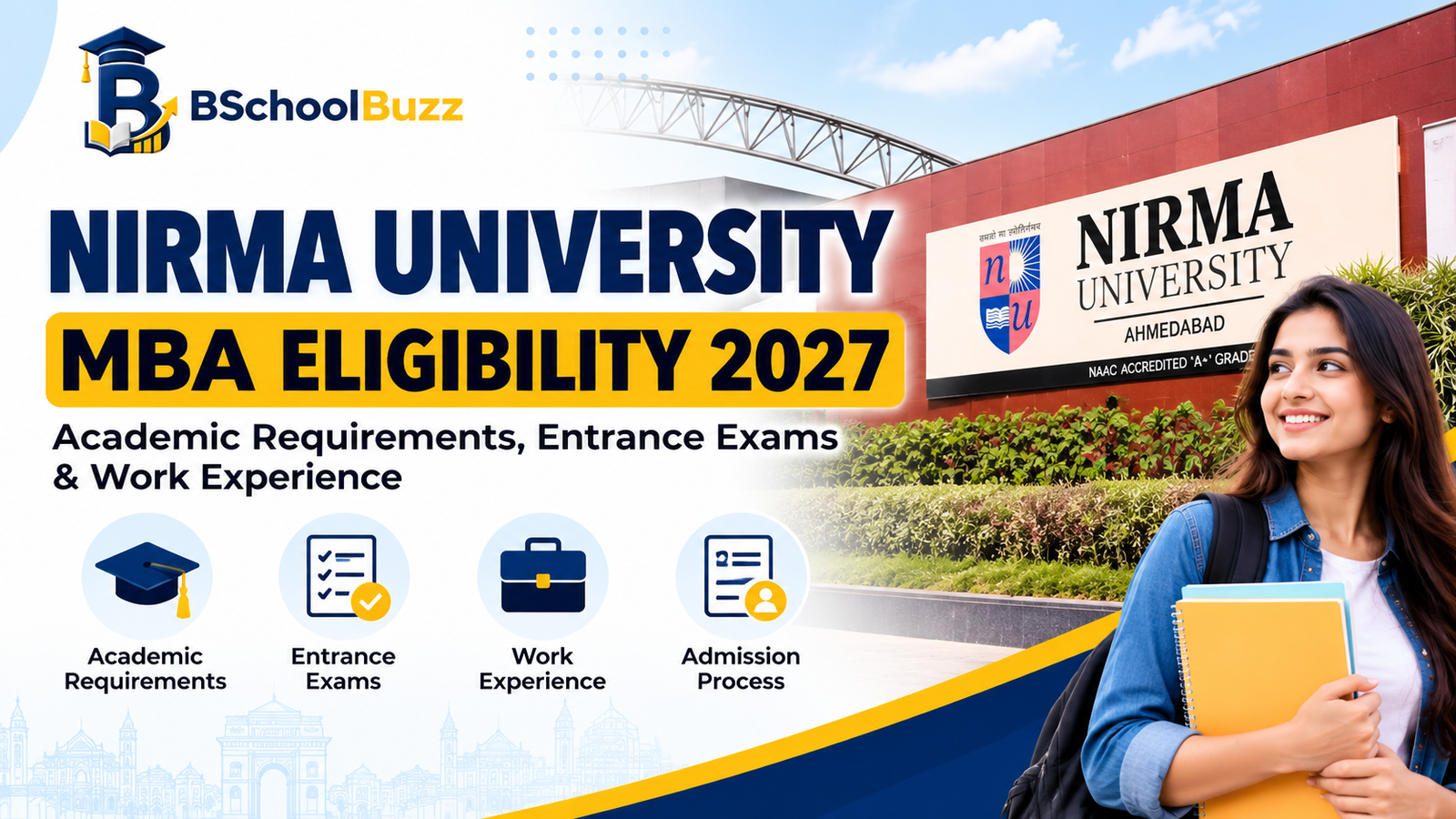
Quick Summary
- Nirma University offers a two-year, full-time regular MBA programme.
- Candidates need a recognised bachelor's degree in any discipline.
- The published minimum graduation requirement is 50% aggregate marks.
- Final-year undergraduate students can apply, subject to the applicable admission conditions.
- CAT is the entrance examination identified for the general MBA admission route.
- GMAT may be considered for specified international and overseas applicant categories.
- Candidates must submit a separate application to Nirma University.
- The selection process includes Theme Development and Presentation (TDP) and a Personal Interview (PI).
- Work experience is considered during selection but is not a universal mandatory requirement under the published general MBA eligibility criteria.
- The CAT cutoff published for the 2026 admission cycle was 81 percentile; this should not be treated as the confirmed 2027–28 cutoff.
- Meeting the minimum eligibility criteria does not guarantee admission.
- Candidates should verify the latest eligibility conditions, examination requirements, deadlines and selection criteria on the official university website.
NIRMA University MBA Eligibility 2027: Academic Requirements, Entrance Exams & Work Experience
Introduction to NIRMA University MBA Eligibility 2027
Understanding the eligibility criteria is an important first step for students planning to pursue an MBA at the Institute of Management, Nirma University, Ahmedabad. For the 2027–28 admission cycle, applicants should check their graduation marks, accepted entrance examination, final-year degree conditions and the institute's selection process before submitting an application.
Nirma University's official MBA admissions information states that candidates applying to the regular MBA programme must hold a bachelor's degree in any discipline from a recognised university, with at least 50% aggregate marks. Final-year undergraduate students can also apply, provided they meet the minimum academic requirement at the time of admission.
For the general-category admission route, the university identifies the Common Admission Test (CAT) as the entrance examination. Candidates must also submit a separate application to the Institute of Management and participate in the prescribed selection process if shortlisted. The process includes Theme Development and Presentation (TDP) and a Personal Interview (PI).
This article explains NIRMA University MBA eligibility 2027, including academic requirements, CAT scores, final-year student eligibility, work experience, application procedures, documents and frequently asked questions. It focuses on the regular two-year MBA programme and distinguishes its admission requirements from those of other management programmes offered by the university.
Official references: Nirma University MBA Admissions 2027–28 and Institute of Management – MBA Admissions.
Table of Contents
NIRMA University MBA Eligibility 2027: Overview
Academic Qualification Required for MBA Admission
Minimum Graduation Marks Required
Eligibility for Final-Year Students
Entrance Exam Requirements: CAT and GMAT
CAT Cutoff and Shortlisting Criteria
Is Work Experience Mandatory?
Eligibility for Different MBA Programmes
Nirma University MBA Admission Process
Documents Required for Admission
Important Eligibility Rules and Conditions
Common Eligibility Mistakes to Avoid
How to Check Your Eligibility
Official Admission Resources
Conclusion
1. NIRMA University MBA Eligibility 2027: Overview
NIRMA University MBA eligibility 2027 refers to the academic qualifications, entrance examination requirements and selection conditions candidates must satisfy to be considered for admission to the regular MBA programme for the 2027–28 academic year.
The Institute of Management at Nirma University offers a two-year, full-time MBA programme. The official admissions portal provides the principal academic requirement and outlines the entrance examination and selection stages.
Eligibility criteria at a glance
| Eligibility Parameter | Requirement |
|---|---|
| Institution | Institute of Management, Nirma University |
| Location | Ahmedabad |
| Programme | MBA |
| Programme duration | Two years |
| Minimum qualification | Bachelor's degree in any discipline |
| Minimum graduation marks | 50% aggregate marks |
| University recognition | Degree from a recognised university |
| Final-year students | Eligible to apply, subject to the prescribed conditions |
| General-category entrance exam | CAT |
| International and specified overseas categories | GMAT may be accepted under applicable category rules |
| Selection stages | Shortlisting, Theme Development and Presentation, Personal Interview |
| Separate institute application | Required |
| Work experience | Considered during selection; not a universal mandatory requirement in the published general MBA eligibility criteria |
Source: Official Nirma University MBA Admissions Portal.
The table summarises the main requirements, but applicants must also review the current admission notice for category-specific conditions, deadlines and score requirements.
A candidate who meets the minimum academic requirement is eligible to be considered for admission, but this does not guarantee shortlisting or a final offer. Entrance examination performance and the institute's selection process remain important.
2. Academic Qualification Required for MBA Admission
The academic qualification is the foundation of NIRMA University MBA eligibility 2027. Applicants must hold a bachelor's degree in any discipline from a recognised university and satisfy the minimum aggregate marks requirement.
Which bachelor's degrees are accepted?
The official MBA admissions information does not restrict eligibility to one undergraduate stream. Candidates from different recognised academic backgrounds can therefore assess their eligibility against the same published minimum requirements.
Examples of undergraduate qualifications include:
Bachelor of Commerce (BCom)
Bachelor of Business Administration (BBA)
Bachelor of Arts (BA)
Bachelor of Science (BSc)
Bachelor of Technology (BTech)
Other recognised bachelor's degrees
These examples are illustrative, not a separate list of officially approved degrees. The relevant question is whether the candidate's qualification is recognised and meets the university's admission conditions.
Students should not assume that only business or commerce graduates can pursue an MBA. Management programmes commonly attract applicants from science, engineering, humanities and other disciplines because their undergraduate studies may provide different perspectives on business problems.
Is a three-year graduation degree acceptable?
The university's published MBA eligibility information has specified a three-year bachelor's degree or equivalent qualification. Candidates with a conventional three-year degree should check that their university and qualification satisfy the applicable recognition requirements.
Students with integrated degrees, foreign qualifications or an unusual academic structure should seek clarification from the admissions office if their eligibility is uncertain.
Does the undergraduate subject affect admission?
The published minimum eligibility requirement is based on the bachelor's degree and aggregate marks, rather than a single mandatory undergraduate subject.
However, academic background may influence how comfortably a student approaches certain MBA subjects. Candidates should review the curriculum, programme structure and specialisations before deciding whether the MBA fits their educational preparation and career objectives.
What if the degree is from a private university?
Candidates should confirm that their awarding university and qualification meet the recognition requirements applicable to Nirma University admissions.
If the degree was awarded by a foreign institution, an institution with a special legal status or a university whose recognition is unclear, applicants should obtain confirmation before submitting their application.
3. Minimum Graduation Marks Required
The published academic eligibility requirement for Nirma University's regular MBA programme is at least 50% aggregate marks in a bachelor's degree from a recognised university.
| Academic Requirement | Published Condition |
|---|---|
| Undergraduate qualification | Bachelor's degree |
| Eligible academic stream | Any discipline |
| Minimum aggregate marks | 50% |
| Recognition | Recognised university |
| Final-year applicants | Permitted, subject to applicable conditions |
| Admission guarantee | No; minimum eligibility does not guarantee selection |
Source: Nirma University MBA Admissions 2027–28.
Can a candidate with exactly 50% marks apply?
A candidate whose recognised bachelor's degree meets the published 50% minimum may satisfy the basic academic eligibility requirement.
However, meeting the minimum percentage does not guarantee that the candidate will receive an invitation to the next stage. The institute also evaluates entrance examination performance and other selection components.
Applicants with exactly 50% should pay particular attention to their CAT preparation, application accuracy and interview readiness.
What if the graduation percentage is below 50%?
Candidates below the stated minimum generally do not meet the published academic requirement for the regular MBA programme.
If a candidate believes that an error in the marksheet, a university-approved conversion method or a revised result changes the calculation, they should obtain official documentation and contact the admissions office.
A strong CAT score should not be assumed to replace the minimum graduation requirement.
How should CGPA be converted into a percentage?
Candidates whose universities report CGPA or grade points should follow the conversion method officially prescribed by their university.
Do not use an unofficial conversion formula unless it is consistent with the awarding institution's rules. If the university does not issue a percentage automatically, ask the relevant academic authority how to document equivalence for admission purposes.
Is there a relaxation in the minimum marks requirement?
Applicants should follow the current programme-specific rules rather than assuming that a category-based relaxation applies. The general MBA admissions information specifies 50% aggregate marks, and candidates should obtain official clarification if they believe a different condition applies to their category.
4. Eligibility for Final-Year Students
Final-year undergraduate students can apply for the Nirma University MBA programme, subject to the university's stated conditions.
This is useful for students who want to move directly from undergraduate education to postgraduate management studies rather than waiting until all final-semester results have been declared.
Conditions for final-year applicants
The university's MBA admissions information allows final-year undergraduate students to apply, provided they meet the minimum marks requirement at the time of admission.
Earlier official MBA programme information has also specified that final-year candidates must furnish proof of meeting the eligibility criteria within three months of the programme's commencement. Candidates applying for 2027–28 should confirm the precise deadline and supporting-document rules in the current admission instructions.
| Requirement | What Candidates Should Do |
|---|---|
| Academic status | Be enrolled in the final year of a bachelor's degree or equivalent qualification |
| Graduation requirement | Meet the applicable minimum marks requirement |
| Academic documentation | Keep available marksheets and any requested institutional certificate |
| Final result | Submit the required proof within the official deadline |
| Backlogs or pending examinations | Check the current admission rules and clarify any issue with the institute |
| Provisional admission | Follow all conditions stated in the offer letter |
Can final-year students apply without a final marksheet?
Yes. The university permits final-year students to apply even when the final marksheet is not yet available, subject to the prescribed admission conditions.
However, applicants should distinguish between applying while awaiting results and completing the degree requirements. A provisional offer does not automatically remove the obligation to satisfy the minimum academic criteria.
What happens if the final marks are below 50%?
If a candidate fails to meet the applicable academic eligibility requirement by the required deadline, provisional admission may be affected.
Applicants should read their offer letter and current admission instructions carefully. If results are delayed, contact the admissions office early rather than waiting until the document-submission deadline.
Practical advice for final-year applicants
Before applying, candidates should:
Keep their available undergraduate marksheets ready.
Confirm their university's official percentage or CGPA conversion method.
Check the current deadline for submitting final results.
Resolve questions about backlogs or pending examinations with the admissions office.
Retain copies of submitted documents and official communications.
These steps help candidates manage provisional admission requirements and avoid preventable administrative issues.
5. Entrance Exam Requirements: CAT and GMAT
Entrance examination performance is an important component of NIRMA University MBA eligibility 2027 and the subsequent selection process.
For the regular MBA programme, the official admissions portal identifies CAT as the entrance examination for the general admission route. GMAT may be considered for specified international and overseas applicant categories under the applicable rules.
| Entrance Examination | Applicant Route | Important Condition |
|---|---|---|
| CAT | General admission route | Follow the CAT year and score requirements specified for the 2027–28 intake |
| GMAT | Eligible NRI, PIO, foreign national, OCI or other specified categories | Confirm the category-specific rules and score-validity requirements |
| Other examinations | Not established as general MBA entrance routes on the current official information | Do not assume acceptance without confirmation from Nirma University |
Source: Official MBA Admissions Portal.
Is CAT compulsory for Nirma University MBA?
For the general admission route to the regular MBA programme, the university identifies CAT as the entrance examination.
Candidates should follow the current admission instructions for the relevant year, including examination registration, result submission and the institute's separate application procedure.
Does Nirma University accept GMAT?
The university's admissions information identifies GMAT for specified international and overseas applicant categories. This should not be interpreted as a blanket replacement for CAT for all Indian applicants.
Candidates must verify which category applies to them and whether their score meets the current validity and submission conditions.
Does Nirma University accept CMAT, MAT or XAT?
The current official regular MBA admissions information identifies CAT for the general admission route and GMAT for specified categories. Applicants should not assume that CMAT, MAT or XAT is accepted for this programme unless the university explicitly confirms a change in the current admission rules.
Is registering for CAT enough?
No. CAT registration and Nirma University's MBA application are separate steps.
Candidates must complete the examination process and separately apply to the university. They should keep their registration details, score information and application confirmation available for reference.
6. CAT Cutoff and Shortlisting Criteria
Candidates often search for a fixed CAT cutoff when researching Nirma University MBA eligibility 2027. However, the academic eligibility threshold and the entrance score used for shortlisting are different requirements.
The official MBA admissions portal has published an 81 percentile CAT cutoff for the 2026 admission cycle. This is a historical, cycle-specific figure, not a confirmed cutoff for MBA admission in 2027–28.
Applicants should verify the current cutoff directly with the university as the 2027–28 selection process progresses.
Eligibility versus cutoff
| Term | Meaning |
|---|---|
| Academic eligibility | Minimum qualification and marks needed to be considered |
| CAT cutoff | Entrance-score threshold used for shortlisting, as specified for a particular cycle |
| Shortlisting | Selection of candidates for the next admission stage |
| Final selection | Decision based on the institute's applicable composite evaluation |
A candidate may meet the academic requirement but fail to meet the applicable CAT shortlisting threshold. Similarly, meeting a published cutoff does not guarantee a final admission offer.
How are candidates shortlisted?
Nirma University's official admissions information describes preliminary shortlisting based on CAT scores for the general MBA route. Academic performance, work experience and extracurricular achievements may also be considered as part of the candidate profile.
Candidates should review the latest selection criteria to understand the role of each component.
What happens after shortlisting?
Shortlisted candidates proceed to the institute's selection stages, which include Theme Development and Presentation (TDP) and a Personal Interview (PI).
The university describes these stages as a way to assess candidates' ability to analyse a topic, present ideas, communicate effectively and demonstrate suitability for management education.
How should candidates prepare?
Applicants should work on three areas:
Entrance examination: Build a strong CAT score through regular practice and review.
Academic record: Ensure that all academic details in the application are accurate.
Selection rounds: Practise structured presentations, clear communication and interview responses about career goals and programme choice.
The best preparation strategy is to address all selection components rather than focusing exclusively on the cutoff.
7. Is Work Experience Mandatory for Nirma University MBA?
Work experience is relevant to the selection process, but the published general MBA eligibility criteria do not establish prior full-time employment as a universal mandatory requirement.
This means fresh graduates can apply if they meet the academic and entrance examination requirements.
Can freshers apply?
Yes. Candidates can apply directly after completing their bachelor's degree, subject to the applicable admission rules.
Freshers should prepare to explain their academic interests, internships, projects, extracurricular activities and reasons for pursuing management education.
The absence of full-time employment should not automatically be treated as a disqualification when the published eligibility criteria do not require it.
Does work experience improve admission chances?
Work experience may strengthen a candidate's overall profile, but it does not guarantee admission.
Nirma University's published selection information identifies work experience among the factors that may be considered. The final outcome also depends on entrance examination performance, academic history and performance in the selection stages.
Candidates with employment experience should explain their responsibilities and achievements clearly, using accurate dates and job details.
Do internships count as work experience?
Applicants should follow the university's instructions about how work experience must be reported. They should not automatically treat internships, freelance projects or short-term assignments as equivalent to full-time employment.
If the application form distinguishes between internships and employment, provide the information in the appropriate fields.
How should working candidates prepare their employment details?
Candidates with work experience should maintain a clear record of:
Employer name and job title.
Employment start and end dates.
Main responsibilities.
Relevant professional achievements.
Supporting documents, if requested.
Accurate reporting helps ensure consistency between the application and the supporting evidence.
8. Eligibility for Different MBA Programmes
Nirma University offers multiple management programmes. Applicants should make sure they are reviewing the correct eligibility requirements for their intended course rather than combining information from different admission routes.
The regular MBA programme should be distinguished from MBA in Human Resource Management, MBA in Family Business & Entrepreneurship and the five-year integrated BBA–MBA programme.
| Programme | General Academic Eligibility Reference | Entrance Route |
|---|---|---|
| Regular MBA | Bachelor's degree with at least 50% aggregate marks | CAT for the general admission route; category-specific GMAT rules may apply |
| MBA in Human Resource Management | Check the programme-specific admission page | CAT for the general admission route, subject to current rules |
| MBA in Family Business & Entrepreneurship | Check the separate programme eligibility requirements | Separate programme-specific selection procedure |
| Integrated BBA–MBA | Undergraduate-entry eligibility based on Class 12 requirements | IPMAT and other category-specific criteria, as applicable |
Sources: Regular MBA, MBA–HRM, MBA–Family Business & Entrepreneurship and Integrated BBA–MBA.
Regular MBA
The regular MBA is a two-year postgraduate management programme. Candidates should check the current curriculum and officially listed specialisations before applying.
The principal academic requirement is a recognised bachelor's degree with at least 50% aggregate marks, together with the applicable entrance examination and selection requirements.
MBA in Human Resource Management
This programme has a distinct management focus and its own programme information. Applicants should consult the official MBA–HRM admissions page for current eligibility, entrance examination and selection conditions.
Although some requirements may be similar to those of the regular MBA, candidates should not automatically assume that every deadline, seat allocation or selection detail is identical.
MBA in Family Business & Entrepreneurship
The MBA in Family Business & Entrepreneurship is a separate programme with its own admission process. Its entrance and selection requirements should be checked independently.
Applicants interested in entrepreneurship or family-business management should use the programme-specific official page rather than applying the regular MBA rules without verification.
Integrated BBA–MBA
The integrated BBA–MBA programme is designed for students entering management education after Class 12. It is not the same as the two-year MBA for graduates.
Its eligibility criteria, entrance examination and admission process differ from those of the regular postgraduate programme. Applicants should review the official integrated programme page before applying.
9. Nirma University MBA Admission Process
Meeting the NIRMA University MBA eligibility criteria is the first stage of admission. Candidates must also complete the application and selection procedures established for the relevant admission year.
Step 1: Check academic eligibility
Confirm that your bachelor's degree is recognised and that your graduation marks meet the minimum requirement.
Final-year candidates should read the conditions for provisional applications and subsequent result submission.
Step 2: Register for CAT
Candidates applying through the general route should register for the relevant CAT examination through the official examination authority.
Keep registration details and result information available for the university application.
Step 3: Submit the Nirma University application
Complete the separate MBA application through the official admissions portal. Enter personal details, academic records and entrance examination information accurately.
Step 4: Pay the application fee
Follow the amount and payment instructions displayed in the current application form. Do not rely on an older brochure for the current application fee.
Step 5: Wait for shortlisting
The university reviews the entrance examination score and other applicable profile details before identifying candidates for the next stage.
Step 6: Attend Theme Development and Presentation
Shortlisted candidates participate in the TDP stage. This evaluates their ability to understand a theme, organise ideas and present their analysis.
Candidates should practise expressing their views logically, supporting arguments with relevant examples and communicating within the prescribed time.
Step 7: Attend the Personal Interview
The Personal Interview assesses the candidate's background, motivation, communication and suitability for management education.
Applicants should be prepared to discuss their academic history, career plans, reasons for choosing Nirma University and understanding of business issues.
Step 8: Final selection and admission offer
The university determines final selection using the applicable evaluation criteria. Candidates receiving offers should read all conditions carefully and complete the admission formalities within the prescribed deadlines.
10. Documents Required for Admission
The precise document list depends on the instructions for the relevant admission cycle and the applicant's academic status. Candidates should use the official application form and admission communications as the final authority.
| Document | Purpose |
|---|---|
| Class 10 marksheet or certificate | Academic history verification, if requested |
| Class 12 marksheet or certificate | Academic history verification, if requested |
| Undergraduate marksheets | Verification of graduation performance |
| Degree or provisional certificate | Evidence of completed qualification, where available |
| Final-year certificate or available results | Supporting documentation for candidates awaiting final results |
| CAT score details | Entrance examination verification |
| Identity document | Identity verification, if requested |
| Photograph and signature | Application requirements, where specified |
| Work experience documents | Verification of declared employment, if applicable |
| Additional certificates | Any further documents required by the university |
Document preparation tips
Keep readable copies of your academic records and check that the information matches the details entered in the application form.
If your university reports CGPA, use the official conversion method. If your name or personal information differs between documents, prepare the appropriate supporting evidence and ask the admissions office whether any additional document is required.
Final-year applicants should pay particular attention to the final-result submission deadline.
11. Important Eligibility Rules and Conditions
Applicants should understand several conditions before submitting an application.
Minimum eligibility does not guarantee admission
The minimum academic requirement establishes whether a candidate may be considered. It does not guarantee a shortlist or final offer.
CAT and the institute application are separate
Candidates must complete the relevant entrance examination process and separately apply to Nirma University.
Final-year applications are conditional
Students awaiting their results must meet the minimum academic requirement and submit the required documents within the applicable deadline.
Work experience must be reported accurately
Work experience may be considered during selection. Applicants should not exaggerate employment duration or misclassify internships.
Programme-specific rules must be checked
The regular MBA, MBA–HRM, MBA–Family Business & Entrepreneurship and integrated BBA–MBA have different programme structures and may have different admission requirements.
Deadlines can change
Applicants should verify application dates, selection schedules, score validity and document-submission conditions on the current official portal.
12. Common Eligibility Mistakes to Avoid
Mistake 1: Confusing eligibility with selection. Meeting the 50% graduation requirement does not guarantee admission.
Mistake 2: Assuming all entrance examinations are accepted. Check the official examination requirements for the exact programme and admission year.
Mistake 3: Completing CAT registration but not the institute application. Both processes must be completed separately.
Mistake 4: Ignoring final-year conditions. Candidates awaiting results must satisfy the academic and document requirements within the prescribed timeframe.
Mistake 5: Assuming work experience is compulsory. The general MBA eligibility criteria do not establish it as a universal requirement.
Mistake 6: Using an old cutoff as the 2027 cutoff. A cutoff published for a previous admission cycle should not be presented as confirmed for 2027–28.
Mistake 7: Applying rules from another programme. Integrated BBA–MBA and other management programmes may have different entrance examinations and eligibility conditions.
Mistake 8: Using an unofficial CGPA conversion formula. Follow the method prescribed by the awarding university.
Mistake 9: Entering incorrect application details. Verify academic percentages, examination information and personal details before submission.
Mistake 10: Waiting until the last day. Complete the application early enough to resolve document or payment issues.
13. How to Check Your Eligibility
Use this checklist to review your position before applying.
I hold a recognised bachelor's degree or an eligible equivalent qualification.
My graduation marks meet the published minimum of 50% aggregate marks.
I have checked the official CAT requirements for the 2027–28 admission cycle.
If I am a final-year student, I understand the provisional eligibility conditions.
I have checked the current admission deadlines.
I understand that a separate Nirma University application is required.
My academic details and entrance examination information are accurate.
I have prepared the documents requested in the application form.
I understand the TDP and Personal Interview stages.
I have reviewed the programme-specific rules for my intended MBA course.
If any condition is unclear, contact the university's admissions office before submitting the application.
14. Official Admission Resources
The following official resources are the preferred sources for verifying the requirements discussed in this article.
1. Nirma University MBA Admissions 2027–28
https://admissions.nirmauni.ac.in/mba.html
Use this page for the regular MBA programme's eligibility criteria, entrance examination requirements, admission timeline and selection information.
2. Institute of Management – MBA and MBA–HRM Admissions
https://management.nirmauni.ac.in/admission-aid/postgraduate/mba-and-mba-hrm/
Consult this page for the institute's programme information, seat-intake details and admission notices.
3. MBA–Human Resource Management
https://admissions.nirmauni.ac.in/mbahrm.html
Use this resource for programme-specific eligibility and admission information.
4. MBA–Family Business & Entrepreneurship
https://admissions.nirmauni.ac.in/mbafbe.html
Review the separate programme requirements if applying to this course.
5. Integrated BBA–MBA
https://management.nirmauni.ac.in/admission-aid/undergraduate/bba-mba-five-year-integrated/
Use this page for the undergraduate-entry programme rather than applying the regular MBA eligibility rules.
6. CAT official website
Use the official CAT website for examination registration, examination instructions and result-related information.
Candidates should check the latest official admission notice before applying. Where a current notice differs from older programme information, follow the current applicable instructions or seek written clarification from the university.
15. Conclusion
NIRMA University MBA eligibility 2027 requires candidates for the regular MBA programme to hold a recognised bachelor's degree with at least 50% aggregate marks. Final-year undergraduate students may also apply, subject to the applicable academic and document-submission conditions. CAT is the entrance examination identified for the general admission route, while GMAT may apply to specified overseas categories.
Eligibility is only the beginning of the admission process. Candidates must submit a separate application, meet the relevant entrance examination requirements and participate in the selection stages, including Theme Development and Presentation and the Personal Interview.
Before applying, review the current admission portal, verify the relevant cutoff and deadlines, and ensure that the requirements relate to the regular MBA programme rather than another course offered by Nirma University. Careful preparation will help you assess your eligibility accurately and approach the admission process with confidence.
Key Takeaways
Academic qualification: A recognised bachelor's degree in any discipline is required.
Minimum graduation marks: Candidates must meet the published requirement of 50% aggregate marks.
Final-year students: Applicants awaiting their graduation results may apply, subject to the university's conditions.
Entrance examination: CAT is the stated examination for the general admission route.
GMAT eligibility: GMAT may be accepted for specified overseas applicant categories under applicable rules.
Work experience: Freshers can apply if they meet the eligibility requirements. Work experience may contribute to the selection assessment.
Selection process: Shortlisted candidates participate in Theme Development and Presentation and a Personal Interview.
Previous cutoff: The 81-percentile figure relates to the 2026 admission cycle and is not confirmation of the 2027–28 cutoff.
Separate application: CAT registration does not replace the Nirma University MBA application.
Programme differences: Regular MBA, MBA–HRM, MBA–Family Business & Entrepreneurship and integrated BBA–MBA have distinct admission requirements.
Official verification: Check the university's current admissions portal before submitting an application or paying any fees.
Frequently Asked Questions
What is the eligibility criteria for NIRMA University MBA admission in 2027?
Candidates must hold a bachelor's degree in any discipline from a recognised university with at least 50% aggregate marks. They must also satisfy the applicable entrance examination and selection requirements.
What is the minimum percentage required for an MBA at Nirma University?
The published minimum graduation requirement for the regular MBA programme is 50% aggregate marks. Meeting this requirement does not guarantee shortlisting or final admission.
Which entrance exam is accepted by Nirma University for MBA admission?
CAT is the entrance examination identified for the general MBA admission route. GMAT may be considered for specified international and overseas applicant categories, subject to the applicable rules.
Can final-year students apply for Nirma University MBA admission?
Yes, final-year undergraduate students can apply, subject to the university's conditions. They must meet the minimum academic requirement and submit the necessary documents within the prescribed deadline.
Is work experience compulsory for Nirma University MBA admission?
Work experience is not established as a universal mandatory requirement under the published general MBA eligibility criteria. Freshers can apply if they meet the academic and entrance examination requirements.
What is the CAT cutoff for Nirma University MBA 2027?
The university's admissions information published an 81-percentile CAT cutoff for the 2026 admission cycle. Candidates should check the official admissions portal for the applicable 2027–28 cutoff rather than assuming the previous figure will remain unchanged.
Does Nirma University accept CMAT, MAT or XAT for its regular MBA programme?
The official admissions information identifies CAT for the general admission route. Candidates should not assume that CMAT, MAT or XAT is accepted unless the university confirms it in the current official admission rules.
What is the selection process for Nirma University MBA admission?
The process includes entrance examination-based shortlisting, Theme Development and Presentation, and a Personal Interview. Final selection follows the university's applicable evaluation criteria.
Can students from arts, science or engineering backgrounds apply for an MBA at Nirma University?
Yes, the published eligibility criteria allow applicants with a bachelor's degree in any discipline. Candidates must satisfy the minimum marks requirement and the other applicable admission conditions.
Where can I check the official Nirma University MBA eligibility criteria for 2027?
Visit https://admissions.nirmauni.ac.in/mba.html for the official MBA admission information. You can also consult https://management.nirmauni.ac.in/admission-aid/postgraduate/mba-and-mba-hrm/ for programme and admission updates.
Ask a question
Still confused? Leave your question and our team will help you.