
Quick Summary
- MDI offers a premium residential experience, while FMS delivers exceptional ROI through low fees and strong placements. Your final choice depends on finances, career goals and campus preferences.
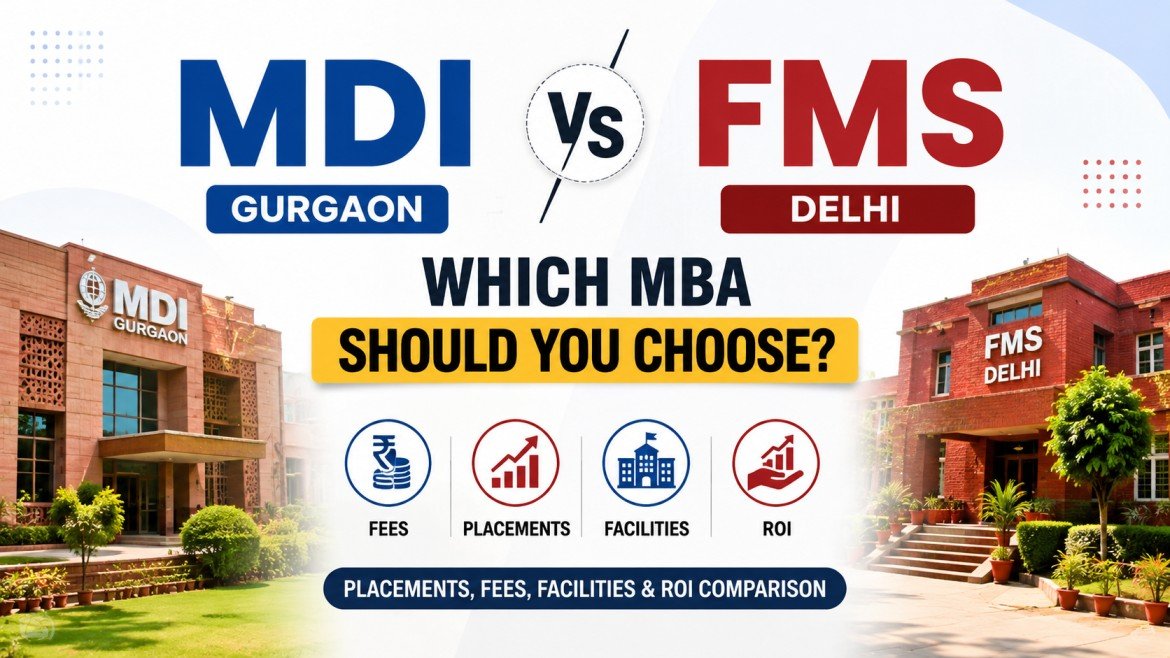
Choosing between MDI Gurgaon and FMS Delhi is one of the most difficult decisions for MBA aspirants who have both institutes on their shortlist. Both are highly regarded management schools, both attract strong recruiters, and both can lead to careers in consulting, finance, marketing, product management, general management and analytics.
However, the economics of the two choices are very different.
FMS Delhi has a dramatically lower MBA fee, while MDI Gurgaon offers a fully residential campus experience with substantial hostel and campus infrastructure. At the same time, the latest 2026 placement data shows that FMS Delhi reported an average CTC of ₹32.27 lakh and a median CTC of ₹29.59 lakh for its 2024–26 MBA batch, while MDI Gurgaon's flagship PGDM reported an average CTC of ₹29.5 lakh and median CTC of ₹29 lakh.
That makes the MDI vs FMS decision less about simply asking which college has the higher package and more about understanding fees, ROI, placements, campus experience, location, career goals and the kind of MBA experience you want.
For a student primarily focused on financial return, FMS can be exceptionally attractive. For someone who values a residential B-school environment, a broader campus ecosystem and MDI's strong corporate presence in Gurugram, MDI can be a compelling alternative.
This detailed MDI vs FMS comparison breaks down the differences so you can make the decision based on your own priorities.
MDI vs FMS: Quick Comparison
Before getting into the details, here is the comparison at a glance.
| Factor | MDI Gurgaon | FMS Delhi |
|---|---|---|
| Institute | Management Development Institute, Gurgaon | Faculty of Management Studies, University of Delhi |
| Flagship programme | PGDM | MBA |
| Programme duration | 2 years | 2 years |
| Admission exam | CAT | CAT |
| Location | Gurugram, Haryana | North Campus, Delhi |
| 2026 flagship programme fee | About ₹26.55 lakh including listed boarding/lodging and other components | Approximately ₹60,818 per semester for MBA, as stated in the 2026 admission information |
| Latest placement batch | 2024–26 | 2024–26 |
| Average CTC | ₹29.5 LPA | ₹32.27 LPA |
| Median CTC | ₹29 LPA | ₹29.59 LPA |
| Highest CTC | ₹97.5 LPA | ₹1.10 crore |
| Placement companies | 157 recruiters across the broader 2024–26 process | 119 companies participated; 103 rolled out offers |
| Campus experience | Residential, dedicated B-school campus | University-based, urban Delhi campus |
| Strong advantage | Campus, corporate ecosystem, residential experience | Extremely strong ROI |
| Best suited for | Students wanting a residential B-school experience | Students prioritising ROI and low cost |
The figures above need to be read carefully because the institutions report placement and fee data differently. MDI's fee figure includes several residential and academic components, while FMS publishes its MBA semester fee separately.
What Is the Main Difference Between MDI Gurgaon and FMS Delhi?
The biggest difference in the MDI vs FMS comparison is the relationship between cost and placement outcomes.
MDI Gurgaon is a private management institute with a dedicated residential campus in Gurugram. Its flagship PGDM programme for the 2026–28 intake has a listed two-year total of ₹26,55,310, including tuition, boarding, lodging, learning materials, student activities, library, alumni fee and security deposit.
FMS Delhi is part of the University of Delhi and operates with a radically different fee structure. Its 2026 MBA information document states that the semester fee is currently approximately ₹60,818 per semester, subject to revision.
This difference is enormous.
At the same time, the latest placement reports show that FMS is not sacrificing salary outcomes simply because its fee is low. FMS reported an average CTC of ₹32.27 lakh and median CTC of ₹29.59 lakh for its 2024–26 batch.
MDI's latest 2024–26 placement report reported a ₹29.5 lakh average CTC and ₹29 lakh median CTC for its flagship PGDM.
This is why MDI vs FMS for ROI is such an interesting comparison.
MDI Gurgaon: An Overview
Management Development Institute Gurgaon, commonly known as MDI Gurgaon, is located in Gurugram's corporate ecosystem.
The institute describes its campus as being in the heart of the corporate hub of Gurugram and highlights its focus on management education, research, leadership and industry interaction.
MDI offers several postgraduate management programmes, including:
- PGDM
- PGDM-HRM
- PGDM-International Business
- PGDM-Business Analytics
- PGDM-Business Management
- PGDM-Banking and Financial Services
For the 2026–28 admissions cycle, MDI's flagship PGDM, PGDM-HRM, PGDM-IB and PGDM-Business Analytics programmes use CAT 2025 for Indian candidates. The selection process includes shortlisting followed by WAT/GD/PI-related evaluation and other factors such as academics, work experience and diversity.
The MDI campus provides the traditional residential B-school experience. Students live, study and interact within a dedicated management-school environment.
That can matter more than it initially appears.
A residential programme creates more opportunities for:
- Peer learning
- Group projects
- Student clubs
- Case competitions
- Alumni interaction
- Informal networking
- Corporate events
- Campus activities
- Leadership opportunities
For students who want a classic two-year residential MBA/PGDM experience, MDI has a clear advantage in this aspect.
FMS Delhi: An Overview
Faculty of Management Studies, or FMS Delhi, is part of the University of Delhi and is one of the most sought-after management schools in India.
Its MBA programme is particularly known for the combination of low tuition cost and strong placement outcomes.
The 2026–28 MBA admission information lists 251 sanctioned seats, along with supernumerary seats under applicable categories.
FMS has a different campus model from MDI.
Instead of being a standalone residential B-school environment, it operates within the larger University of Delhi ecosystem. That gives students access to the academic and cultural environment of one of India's most prominent universities while also placing them in the middle of Delhi's business and professional ecosystem.
For an MBA aspirant, that creates a different kind of experience.
The FMS advantage is particularly obvious when the comparison is framed around fees versus salary.
MDI vs FMS Fees
Fees are probably the single biggest reason why many students compare these two institutes.
MDI Gurgaon Fees
For the 2026–28 PGDM programme, MDI lists the following two-year total:
₹26,55,310
The amount includes:
- Tuition fees
- Boarding charges
- Lodging charges
- Learning material fees
- Student activity fees
- Library fees
- Alumni fee
- Security deposit
MDI's official admission information lists first-year total fees of ₹13,48,905 and second-year total fees of ₹13,06,405, producing the two-year total of ₹26,55,310.
MDI also notes that fees and charges may be revised with prior notice.
FMS Delhi Fees
The FMS 2026 admission document states that the fee for the MBA programme is currently approximately:
₹60,818 per semester
The document also makes clear that fees can be revised by the University of Delhi.
Assuming four semesters at the currently stated amount, the academic fee comes to approximately ₹2.43 lakh over two years.
That calculation is simply four times the published semester fee and should not be interpreted as a guarantee of the final amount because the institute explicitly states that fees may be revised.
MDI vs FMS Fees Comparison
| Expense | MDI Gurgaon | FMS Delhi |
|---|---|---|
| Programme | PGDM | MBA |
| Published 2026 fee basis | Two-year total | Semester fee |
| Approx. academic/programme cost | ₹26.55 lakh | ₹60,818 per semester |
| Residential charges | Included in MDI's listed total | Not included in the semester figure |
| Programme duration | 2 years | 2 years |
The difference is substantial.
This is the strongest argument in favour of FMS ROI.
However, students should avoid comparing the figures as if they represent exactly the same expense basket. MDI's published total explicitly incorporates boarding and lodging, whereas FMS's published semester figure is an academic fee and does not represent a complete two-year living-cost calculation.
Why FMS Has Such a Strong ROI Advantage
ROI is not simply:
Salary ÷ Fees
A more practical MBA ROI assessment should consider:
Total education cost + living expenses + opportunity cost + expected salary + career progression
Even after considering these variables, FMS has an unusually strong financial proposition because its academic fee is very low relative to the salaries reported in its placement report.
FMS's 2024–26 placement report recorded:
- Average CTC: ₹32.27 lakh
- Median CTC: ₹29.59 lakh
- Top 100 average CTC: ₹45.196 lakh
- Highest CTC: ₹1.10 crore
- 74.9% of the batch received offers above ₹25 lakh
These figures are from FMS's official final placement report.
That combination of low programme fee and high placement outcomes is difficult for most B-schools to match.
It is the central reason why MDI vs FMS ROI generally favours FMS.
MDI vs FMS Placements
Placements are where the comparison becomes more nuanced.
FMS Delhi Placement 2026
FMS's official Final Placement Report for the 2024–26 batch provides detailed placement information.
The placement process involved both lateral and final placements. Students with more than 18 months of prior work experience participated in the lateral placement process in December 2025, followed by the final placement process for the remaining students in January 2026.
The institute reported:
- 307 students in the batch
- 304 students appearing for placements
- 287 students placed
- 3 students taking placement holiday
- 119 companies participating
- 103 companies rolling out offers
The compensation numbers were:
Average CTC: ₹32.27 lakh
Median CTC: ₹29.59 lakh
Top 100 average CTC: ₹45.19 lakh
Highest CTC: ₹1.10 crore
FMS also reported that 74.9% of the batch received offers above ₹25 lakh.
This is particularly useful because the median gives a better indication of the centre of the placement distribution than the highest package alone.
MDI Gurgaon Placement 2026
MDI's final placement report for the 2024–26 batch shows strong growth in compensation.
For the flagship PGDM programme, the reported figures were:
Average CTC: ₹29.5 lakh
Median CTC: ₹29 lakh
Highest CTC: ₹97.5 lakh
The 2024–26 report covered multiple programmes, and the broader placement process involved 157 recruiters and 189 pre-placement offers.
Programme-wise placement figures reported for the 2024–26 batch include:
| MDI Programme | Average CTC | Median CTC | Highest CTC |
|---|---|---|---|
| PGDM | ₹29.5 LPA | ₹29.0 LPA | ₹97.5 LPA |
| PGDM-HRM | ₹24.8 LPA | ₹23.0 LPA | ₹41.1 LPA |
| PGDM-IB | ₹26.3 LPA | ₹25.0 LPA | ₹63.5 LPA |
| PGDM-Business Analytics | ₹26.2 LPA | ₹25.7 LPA | ₹40.3 LPA |
The programme-specific figures are based on the latest reported 2024–26 placement data.
MDI vs FMS: Placement Comparison
If we compare the flagship programmes:
| Placement Metric | MDI Gurgaon PGDM | FMS Delhi MBA |
|---|---|---|
| Average CTC | ₹29.5 LPA | ₹32.27 LPA |
| Median CTC | ₹29 LPA | ₹29.59 LPA |
| Highest CTC | ₹97.5 LPA | ₹1.10 crore |
| Placement batch | 2024–26 | 2024–26 |
| Recruiter participation | 157 across MDI's broader placement process | 119 |
| Strong domains | Consulting, BFSI, FMCG/FMCD, technology, e-commerce, general management | Consulting, finance, marketing, product/IT/analytics, general management |
The important observation is that FMS has the higher average CTC, while the median numbers are much closer.
That means the answer to MDI vs FMS placements is not simply "FMS wins" or "MDI wins."
FMS currently has a stronger flagship average.
MDI remains highly competitive and has demonstrated a substantial increase in its highest CTC.
Understanding the Highest Package
MBA aspirants frequently make the mistake of using the highest package as the primary basis for choosing a college.
That is risky.
A highest CTC represents an exceptional offer made to one or a small number of students. It does not represent the salary that an average student should expect.
For example, MDI's flagship PGDM reported a highest CTC of ₹97.5 lakh, while its average was ₹29.5 lakh and median was ₹29 lakh.
FMS reported a highest CTC of ₹1.10 crore, but its average was ₹32.27 lakh and median was ₹29.59 lakh.
For career planning, the median and average are generally more useful indicators than the highest package.
MDI vs FMS: Which Has Better ROI?
If ROI means financial return relative to the cost of the programme, FMS has a clear advantage.
The reason is straightforward.
FMS's programme fee is extremely low compared with its reported placement outcomes.
MDI requires a much larger financial investment, although that cost includes residential infrastructure and related charges.
Suppose a student compares only the published programme fee with the reported average CTC:
- MDI PGDM: approximately ₹26.55 lakh listed programme cost versus ₹29.5 lakh average CTC
- FMS MBA: approximately ₹2.43 lakh across four semesters at the currently stated semester fee versus ₹32.27 lakh average CTC
These are not direct "profit" calculations because CTC is not take-home salary, and students also incur living, travel, personal and opportunity costs.
Still, the difference demonstrates why FMS is often regarded as one of India's strongest MBA options from an ROI perspective.
Is MDI Worth the Higher Fee?
Yes, it can be.
But whether it is worth paying the additional cost depends on what you value.
MDI offers a residential management-school environment, a dedicated campus, corporate proximity in Gurugram and a broad recruiter ecosystem.
The institute's official website highlights more than 90 faculty members and more than 2,200 research publications, alongside its location in Gurugram's corporate hub.
Its placement ecosystem also spans consulting, BFSI, e-commerce, FMCG/FMCD, healthcare, media and telecom, automobile, conglomerates, energy and logistics.
For some students, that environment is worth paying for.
For others, especially students who are comfortable with a university-based campus and care primarily about financial efficiency, FMS may make much more sense.
MDI vs FMS: Facilities and Campus
MDI Gurgaon Facilities
MDI has a dedicated residential campus.
That is an important distinction.
Students can expect the typical infrastructure associated with a residential management institute, including academic spaces, accommodation, student activity areas, library resources and facilities designed around a full-time campus experience.
MDI's published fee structure itself includes boarding and lodging charges, confirming that the flagship PGDM is structured as a residential programme.
The campus model can make student life highly immersive.
Students spend much of their two years surrounded by peers from different academic, professional and geographic backgrounds.
That environment is particularly useful for:
- Case discussions
- Group assignments
- Club activities
- Competitions
- Student-led events
- Peer networking
- Alumni interactions
- Corporate sessions
FMS Delhi Facilities
FMS has a different advantage: its location and University of Delhi ecosystem.
The institute is located in Delhi's North Campus environment, giving students exposure to a large university ecosystem and the wider Delhi-NCR professional market.
FMS's placement report also highlights substantial corporate interaction. The institute reported hosting 150+ leadership sessions over the preceding year through its Arthashastra leadership talk series.
FMS also has a strong student-driven culture.
Because the programme is located within a major university environment, the student experience is different from a standalone residential B-school.
Facilities Winner
If you want:
Dedicated residential B-school infrastructure → MDI
If you want:
University ecosystem + central Delhi exposure + extremely low academic fee → FMS
MDI vs FMS: Location Advantage
Location can have an indirect impact on your MBA experience.
MDI is in Gurugram, one of India's major corporate hubs.
That gives students access to a dense concentration of companies in:
- Consulting
- Financial services
- Technology
- Consumer businesses
- Startups
- E-commerce
- Media
- Telecommunications
FMS, meanwhile, is located in Delhi and benefits from the wider Delhi-NCR ecosystem.
For internships, networking and industry events, both locations are strong.
The difference is more about the style of exposure.
MDI offers the classic corporate-hub-plus-residential-campus combination.
FMS combines a university campus with access to Delhi's professional ecosystem.
MDI vs FMS: Admission and CAT
Both institutes use CAT for their flagship full-time management programmes.
MDI Admission
For the 2026–28 cycle, MDI required CAT 2025 for Indian candidates applying to its main two-year programmes. The institute states that shortlisted candidates are evaluated through a selection process that considers CAT performance alongside WAT/GD/PI and other factors.
MDI's selection criteria can include:
- CAT score
- Academic performance
- Work experience
- Academic diversity
- Social diversity
- Performance in the selection process
- Behavioural assessment
FMS Admission
FMS also uses CAT as the primary entrance examination for its MBA programme.
The 2026–28 admission information sets out the programme details, seat structure and applicable reservation rules.
Because both institutes are extremely competitive, candidates should not approach the comparison as an alternative to CAT preparation.
The first objective is to obtain a sufficiently competitive CAT score and then understand the institute-specific selection process.
MDI vs FMS: Which Has Better Placement Diversity?
Both have broad placement ecosystems.
FMS's 2026 placement report categorises recruitment across:
- Consulting and General Management
- Finance
- Marketing
- Product/IT/Analytics
- Operations
The consulting and general management category accounted for more than 33% of total recruitment according to the report.
FMS also reported increasing opportunities in product, IT, operations and analytics, including AI-focused roles.
MDI's placement ecosystem similarly covers:
- Consulting
- BFSI
- FMCG/FMCD
- E-commerce
- Healthcare and pharmaceuticals
- Media and telecom
- Automobile
- Conglomerates
- Energy and logistics
Therefore, both schools offer broad career options.
The better choice depends more on the role you want than on whether one institution has a single additional sector.
MDI vs FMS for Consulting
Consulting is one of the strongest career choices available at both schools.
FMS's 2026 placement report shows strong consulting recruitment, including companies such as:
- Accenture Strategy
- Alvarez & Marsal
- Bain & Company
- BCG
- Deloitte
- EY-Parthenon
- Kearney
- KPMG
- McKinsey & Company
- PwC
MDI also attracts major consulting recruiters and has a long-standing presence in management consulting and general management recruitment. Its placement information lists consulting among its major recruitment areas.
If consulting is your target, both should remain on your shortlist.
MDI vs FMS for Finance
Finance is another area where both institutes have strong opportunities.
FMS's 2026 placement report lists recruiters such as:
- Goldman Sachs
- HSBC
- Citi
- ICICI Bank
- Kotak Mahindra
- Motilal Oswal
- Standard Chartered
- Tata Play
- Vedanta
The report states that roles included corporate finance, wholesale credit risk, front-end investment banking and equity research.
MDI similarly attracts BFSI recruiters and has a strong financial-services presence.
Students interested in finance should therefore evaluate the exact role profile, prior work experience expectations and recruiting firms rather than selecting a school purely from a generic "finance placement" label.
MDI vs FMS for Marketing
Marketing is a major career path at both institutions.
FMS's placement report includes recruiters from consumer goods, retail, technology, media and e-commerce sectors, with roles covering sales, brand management, category management and sales and marketing.
MDI's recruiter ecosystem also includes major FMCG/FMCD, consumer and retail organisations.
For a student targeting brand management, category management or sales and marketing, both schools can provide strong opportunities.
The decision should therefore consider the individual recruitment mix in the year you graduate.
MDI vs FMS for Product Management and Analytics
This is an increasingly relevant area for MBA aspirants.
FMS's latest placement report specifically notes increased opportunities in IT, Product, Operations and Analytics, covering areas such as strategy analytics, product management, product design, operations and growth. The report also notes an increase in AI-focused roles.
MDI also has a dedicated PGDM-Business Analytics programme and attracts technology and analytics recruiters.
If your goal is product management, analytics or technology strategy, your choice should not be based solely on average salary.
Look at:
- Role quality
- Job function
- Company type
- Product exposure
- Internship opportunities
- Prior work experience
- Your undergraduate background
- Your technical and analytical skills
MDI vs FMS: Student Profile
The peer group is one of the most valuable parts of a top MBA.
FMS's 2024–26 batch included students from different academic backgrounds. The official placement report shows representation from engineering, sciences, BBA/BMS/BCOM/economics and other backgrounds.
The batch also included a significant number of freshers, with the placement report showing 54% freshers in its profile.
MDI similarly attracts students from diverse academic and professional backgrounds.
For both schools, peer learning can be as valuable as classroom teaching.
You are likely to work with people who have backgrounds in engineering, commerce, economics, science, humanities and professional careers.
That diversity matters when learning subjects such as:
- Strategy
- Marketing
- Finance
- Operations
- Economics
- Organisational behaviour
- Data analysis
MDI vs FMS: Alumni Network
A strong alumni network can help with:
- Mentorship
- Career transitions
- Internships
- Job referrals
- Industry knowledge
- Entrepreneurship
- Long-term networking
MDI states that it has more than 10,000 alumni working across 54 countries.
FMS's alumni ecosystem is also one of its major strengths, particularly because of its long history within the University of Delhi and the breadth of industries represented by its alumni.
For a prospective student, the more useful question is not simply "Which has more alumni?"
Instead, ask:
Where are the alumni working in the career path I want?
For example, a candidate targeting consulting should examine consulting alumni.
A candidate targeting investment banking should examine finance alumni.
A candidate interested in entrepreneurship should look at founder and startup networks.
MDI vs FMS: Brand Value
Both institutions have strong brand recognition in India's management education ecosystem.
The nature of that brand is somewhat different.
MDI is strongly associated with management education and its dedicated B-school environment.
FMS benefits from its association with the University of Delhi and its unusually strong placement outcomes relative to its fee.
Neither is a "bad brand" choice.
The decision becomes more interesting because the two institutions offer different value propositions.
MDI vs FMS: Which Is Better for a Fresher?
For a fresher, both can be excellent.
FMS may have a particularly attractive proposition because its latest placement report shows that 54% of its 2024–26 batch were freshers.
That demonstrates that prior work experience is not the only route to strong placement opportunities at FMS.
MDI also admits fresh graduates and has a diverse cohort.
For a fresher, the more important factors are:
- CAT performance
- Academic record
- Interview performance
- Communication skills
- Internships
- Extracurricular activities
- Leadership experience
- Career clarity
A fresher should not reject either school simply because they do not have full-time work experience.
MDI vs FMS for Work Experience Candidates
Work experience can become particularly relevant for candidates targeting consulting, product management, finance and general management.
FMS's placement process explicitly distinguishes candidates based on prior work experience. Students with more than 18 months of work experience participated in lateral placements in December 2025.
That shows how work experience can influence the placement process.
At MDI too, work experience is one of the factors considered in admission selection.
If you have two or more years of experience, compare the institutes based on:
- Lateral hiring
- Role quality
- Pre-placement offers
- Industry preference
- Career switching opportunities
rather than only looking at average CTC.
MDI vs FMS: Campus Life
Campus life is where the comparison becomes subjective.
MDI Gurgaon Campus Life
MDI offers the more conventional residential B-school experience.
Students live on campus, attend classes, participate in student clubs and interact continuously with their batch.
This creates an immersive environment.
FMS Delhi Campus Life
FMS offers a different experience.
The institute is part of the University of Delhi ecosystem, and students experience a larger university environment and the culture of Delhi.
For some students, this is an advantage.
For others, the dedicated residential model of MDI may be more attractive.
There is no universal winner here.
MDI vs FMS: Academic Experience
The academic experience at both institutions is rigorous.
An MBA or PGDM at this level is not simply about attending lectures.
Students typically spend substantial time on:
- Case studies
- Group projects
- Presentations
- Assignments
- Exams
- Simulations
- Competitions
- Internships
- Industry interactions
FMS's placement report notes more than 150 leadership sessions over the preceding year, demonstrating significant corporate interaction outside conventional classroom teaching.
MDI similarly emphasises research-based education, industry interaction and management learning.
MDI vs FMS: Which Has Better Corporate Exposure?
Both are strong.
MDI's location in Gurugram gives it proximity to a major corporate hub.
FMS's Delhi location provides access to Delhi-NCR's corporate, consulting, financial and public-sector ecosystem.
FMS's placement report also demonstrates significant corporate engagement, including 150+ leadership sessions and participation from 119 companies in the 2024–26 placement process.
MDI's 2024–26 placement process involved 157 recruiters across its programmes.
So the answer is not simply that one school has corporate exposure and the other does not.
Both do.
MDI vs FMS: The Importance of Median Salary
Students often focus on average salary.
Median salary can sometimes provide a more useful perspective.
If 50% of students earn above the median and 50% earn below it, the median gives an indication of the centre of the distribution.
For the latest flagship data:
MDI PGDM median: ₹29 lakh
FMS MBA median: ₹29.59 lakh
The difference is much smaller than the difference in average CTC.
That is worth noticing.
FMS's average is higher, but the two median figures are relatively close.
This suggests that the decision should not be made by looking at average CTC alone.
MDI vs FMS: What Does the Placement Data Actually Tell You?
The latest numbers tell us several things.
First, both schools have strong placement outcomes.
Second, FMS has a higher flagship average CTC.
Third, the median CTC at the two schools is close.
Fourth, FMS has a much lower programme fee.
Fifth, MDI offers a substantially more expensive residential education model.
Sixth, both have broad recruiter ecosystems.
Seventh, the highest package at either school should not be treated as the expected salary of a typical student.
These observations make the ROI difference much clearer.
Is FMS Better Than MDI Gurgaon?
If the question is:
"Which offers better financial ROI?"
FMS is the stronger choice.
If the question is:
"Which has a stronger residential B-school experience?"
MDI has the advantage.
If the question is:
"Which has the higher latest average CTC?"
FMS, based on the 2026 placement reports.
If the question is:
"Which has a strong corporate ecosystem?"
Both.
If the question is:
"Which is cheaper?"
FMS, by a very large margin on published programme fees.
If the question is:
"Which should I choose if I value campus life and a residential MBA experience?"
MDI becomes much more attractive.
When Should You Choose FMS Delhi?
FMS is likely the better fit if you:
- Want exceptional financial ROI
- Want to minimise MBA debt
- Are comfortable with a university-based campus
- Want strong consulting opportunities
- Want strong finance opportunities
- Want access to Delhi's professional ecosystem
- Prefer a low-cost MBA with strong placement outcomes
- Are comfortable building your own campus experience
- Want to preserve more capital after graduation
The biggest FMS advantage is simple:
You do not need to spend ₹25+ lakh on tuition and residential charges to access a top-tier management education and strong placement outcomes.
When Should You Choose MDI Gurgaon?
MDI may be the better fit if you:
- Want a residential B-school experience
- Value dedicated campus infrastructure
- Prefer living and studying with your cohort
- Want Gurugram corporate exposure
- Are interested in MDI's broader programme ecosystem
- Value the MDI alumni network
- Prefer a traditional B-school environment
- Are comfortable making the larger financial investment
The biggest reason to choose MDI is not simply the highest package.
It is the overall residential management-school experience combined with strong placements and corporate exposure.
MDI vs FMS: ROI After Graduation
A major advantage of FMS is the lower financial burden after graduation.
Imagine two students receiving similar employment outcomes.
Student A leaves college with a very large education expense.
Student B leaves with a much smaller academic fee burden.
Even if their starting salaries are close, Student B can potentially:
- Save more
- Invest earlier
- Repay family contributions faster
- Build an emergency fund
- Start investing
- Consider entrepreneurship
- Take career risks
- Fund additional education
This is why ROI should be evaluated beyond the first-year salary.
The financial impact of the MBA continues for years.
Should You Take a Loan for MDI Instead of FMS?
This is one of the most practical questions in the MDI vs FMS decision.
If you have both options and FMS is available to you, taking a large loan to attend MDI requires a strong personal reason.
The reason could be:
- You strongly prefer the residential campus
- You want MDI's specific programme
- You value the campus ecosystem
- You have a career objective where you believe MDI offers a particular advantage
- Family finances make the difference manageable
But if your only argument is:
"MDI has a good placement package,"
then the latest numbers do not make that argument especially strong.
FMS currently reports a higher average CTC while charging dramatically less in programme fees.
MDI vs FMS: Placement Consistency Matters
One year of placement data should never be treated as a permanent guarantee.
Economic conditions change.
Recruitment cycles change.
Industries change.
The number of recruiters changes.
Salary structures change.
Students therefore need to look at multiple years of placement reports rather than treating one highest package as a promise.
FMS's placement report itself presents compensation statistics across 2024, 2025 and 2026, showing the average moving from ₹29.2 lakh to ₹30.1 lakh and then ₹32.27 lakh.
MDI also publishes historical placement reports alongside its latest 2024–26 report.
Looking at trends provides a more realistic picture than looking at a single headline number.
MDI vs FMS: What About International Opportunities?
MDI's latest placement data includes international compensation figures, with the highest international CTC reported at ₹80.2 lakh for the relevant placement cycle.
FMS's placement report also includes a broad range of recruiters, including global companies and multinational organisations.
However, students should not choose an institute solely because of an international package.
International offers are typically limited and can vary significantly by year.
The more useful questions are:
- How many international offers were made?
- Which countries?
- Which roles?
- Which companies?
- How many candidates received them?
- What was the compensation structure?
MDI vs FMS: Which Is Better for a Career in Consulting?
Both are strong.
FMS has a particularly strong consulting presence in its latest placement report, with consulting and general management accounting for more than one-third of recruitment.
MDI also has a long-standing consulting recruitment ecosystem.
If consulting is your primary target, the difference between the two should be evaluated through:
- Consulting recruiter list
- Number of offers
- Role type
- Compensation
- Alumni in consulting
- Internship opportunities
- Your own interview performance
Do not assume that simply attending one of these schools guarantees a consulting role.
MDI vs FMS: Which Is Better for Finance?
FMS has a strong finance recruiter base in the latest placement report.
The report lists Goldman Sachs, Citi, HSBC, ICICI Bank, Kotak Mahindra, Motilal Oswal and Standard Chartered among finance recruiters.
MDI also has substantial BFSI recruitment.
For finance aspirants, FMS's ROI advantage can be especially appealing because finance roles can be competitive and the lower education cost leaves the student with significantly less financial pressure.
MDI vs FMS: Which Is Better for Marketing?
Both have excellent marketing ecosystems.
FMS has recruiters across consumer goods, retail, technology, media and e-commerce.
MDI also attracts major FMCG/FMCD and consumer-sector employers.
If your career goal is brand management or marketing, consider:
- Marketing recruiter list
- Brand roles versus sales roles
- Internship conversion
- Alumni profiles
- Sector preference
- Location
The school name is only one component of the final outcome.
MDI vs FMS: Which Is Better for Product Management?
Product management has become increasingly popular among MBA aspirants with technology or engineering backgrounds.
FMS's 2026 placement report specifically reports growth in product, IT, analytics and operations roles and mentions AI-focused positions.
MDI's Business Analytics programme and broader technology recruitment also make it relevant for candidates targeting technology careers.
If product management is your goal, evaluate the actual role descriptions rather than just searching for "product management placements."
A company offering a business analyst position and a company offering a product manager position are not equivalent simply because both belong to the technology sector.
MDI vs FMS: What Students Should Not Compare
There are some comparisons that can be misleading.
Do not compare only highest packages
The highest package is an outlier.
Do not compare fee without understanding inclusions
MDI's published fee includes boarding and lodging components. FMS's semester fee is a different cost category.
Do not compare average salary without programme definitions
MDI has multiple PGDM programmes, while FMS's placement report is for its MBA batch.
Do not assume 100% placement means every student gets the same quality of role
Placement rates do not describe role quality, function, location or compensation distribution.
Do not assume a college guarantees a career
Your profile, skills, internships, interview performance and career decisions remain critical.
MDI vs FMS: The Best Choice by Student Priority
| Your Priority | Better Choice |
|---|---|
| Best financial ROI | FMS Delhi |
| Lowest programme fee | FMS Delhi |
| Higher latest average CTC | FMS Delhi |
| Residential campus | MDI Gurgaon |
| Dedicated B-school environment | MDI Gurgaon |
| Gurugram corporate ecosystem | MDI Gurgaon |
| Delhi university ecosystem | FMS Delhi |
| Consulting | Both |
| Finance | Both |
| Marketing | Both |
| Product/Analytics | Both |
| Minimal education debt | FMS Delhi |
| Traditional residential MBA experience | MDI Gurgaon |
MDI vs FMS: Final Verdict
There is no single answer to the MDI vs FMS question because the two institutions optimise for different things.
If you are looking for the best ROI, FMS Delhi is difficult to beat.
Its published MBA fee is exceptionally low, while the latest placement report shows an average CTC of ₹32.27 lakh, median CTC of ₹29.59 lakh and highest CTC of ₹1.10 crore.
MDI Gurgaon, on the other hand, offers a premium residential B-school experience. Its 2026–28 PGDM fee is substantially higher, but that fee includes residential components and the institute provides a dedicated campus environment in Gurugram.
Its latest flagship PGDM placement figures are also strong, with a ₹29.5 lakh average CTC, ₹29 lakh median CTC and ₹97.5 lakh highest CTC for the 2024–26 batch.
So the simplest decision rule is:
Choose FMS Delhi if ROI and financial efficiency are your top priorities.
Choose MDI Gurgaon if you place a high value on residential campus life, dedicated B-school infrastructure and the Gurugram corporate ecosystem and are comfortable with the additional cost.
If you have both admits and there is no major personal constraint, FMS is generally the stronger financial decision.
If your preference is strongly in favour of a residential management-school experience and the additional cost is manageable, MDI remains an excellent choice.
Ultimately, the best MDI vs FMS decision is the one that fits your career target, financial situation and preferred learning environment—not simply the college with the highest package.
Frequently Asked Questions
Which is better, MDI Gurgaon or FMS Delhi?
For pure ROI, FMS Delhi has the stronger proposition because its MBA fee is dramatically lower while its latest average CTC is higher than MDI's flagship PGDM average. MDI may be preferable for students who value a residential campus and dedicated B-school environment.
Is FMS cheaper than MDI Gurgaon?
Yes. FMS's 2026 admission document lists an MBA semester fee of approximately ₹60,818, while MDI's 2026–28 PGDM fee is listed at ₹26.55 lakh for two years including the specified residential and academic components.
Which has better placements, MDI or FMS?
The latest flagship figures favour FMS on average CTC: FMS reported ₹32.27 lakh, compared with ₹29.5 lakh for MDI's PGDM. Their median CTC figures are much closer: ₹29.59 lakh at FMS and ₹29 lakh at MDI.
What is the average package at FMS Delhi?
The FMS 2024–26 final placement report records an average CTC of ₹32.27 lakh.
What is the average package at MDI Gurgaon?
For the flagship PGDM programme, MDI's latest 2024–26 placement data reports an average CTC of ₹29.5 lakh.
What is the median salary at FMS Delhi?
FMS reported a median CTC of ₹29.59 lakh for its 2024–26 MBA placement batch.
What is the median salary at MDI Gurgaon?
MDI reported a median CTC of ₹29 lakh for its flagship PGDM 2024–26 batch.
Which has better ROI, MDI or FMS?
FMS generally has the stronger ROI because the programme fee is much lower while placement outcomes remain very strong.
Is MDI Gurgaon worth the higher fees?
It can be, particularly for students who value residential campus life, dedicated infrastructure, the Gurugram location and MDI's broader management-school ecosystem. Whether it is worth the additional cost depends on your financial circumstances and priorities.
Does MDI Gurgaon have a residential campus?
Yes. MDI's published PGDM fee structure includes boarding and lodging charges, reflecting its residential programme structure.
Is FMS Delhi a residential college?
FMS and MDI have different campus models. FMS operates within the University of Delhi ecosystem, while MDI is structured as a dedicated residential management institute.
Which is better for consulting, MDI or FMS?
Both are strong consulting destinations. FMS's latest placement report shows significant consulting and general management recruitment, while MDI also has a strong consulting recruiter base.
Which is better for finance, MDI or FMS?
Both offer strong finance opportunities. FMS's latest placement report includes recruiters such as Goldman Sachs, Citi, HSBC, ICICI Bank, Kotak Mahindra and Standard Chartered.
Which is better for marketing, MDI or FMS?
Both are strong options. Your decision should depend on the type of marketing role you want, the companies recruiting in that year and your career goals.
Which is better for a fresher?
Both can be excellent for freshers. FMS's 2024–26 placement report shows that 54% of its batch were freshers.
Does work experience matter for FMS?
Work experience can influence placement opportunities, especially for lateral roles. FMS's 2024–26 placement process included a separate lateral process for students with more than 18 months of prior work experience.
Does work experience matter for MDI admission?
Yes. MDI lists work experience among the factors considered during its selection process, along with CAT performance, academics, diversity and the selection-stage assessment.
Which should I choose if I have admits from both?
If your priority is ROI and minimising education cost, choose FMS.
If your priority is residential campus experience and MDI's broader B-school environment, choose MDI.
Are the highest packages at MDI and FMS guaranteed?
No. Highest CTC figures represent the top end of placement outcomes and should never be treated as expected salaries for every student.
Is FMS better than MDI only because it is cheaper?
No. FMS is not attractive only because of its fee. Its latest placement report also shows a strong average and median compensation profile, extensive recruiter participation and opportunities across consulting, finance, marketing, product, IT and analytics.
Conclusion
The MDI vs FMS comparison ultimately comes down to the balance between cost, career outcomes and campus experience.
MDI Gurgaon asks students to make a much larger financial investment, but provides a residential management-school environment in Gurugram and strong access to corporate recruiters.
FMS Delhi offers an unusually powerful combination: a very low published academic fee and excellent placement outcomes. The latest 2026 placement report puts its average CTC at ₹32.27 lakh and median at ₹29.59 lakh.
MDI's flagship PGDM remains highly competitive, with a ₹29.5 lakh average CTC and ₹29 lakh median CTC in its latest 2024–26 placement data.
For most students who receive comparable options from both institutes, FMS is the more compelling ROI decision.
For students who specifically want a residential B-school experience and are willing to pay the premium for it, MDI Gurgaon can still be an excellent choice.
The smartest approach is therefore not to ask only, "Which college is better?"
Ask instead:
Which college gives me the right combination of career opportunities, financial burden, campus experience and long-term value?
That is the question that makes the MDI vs FMS decision much easier.
Sources
- MDI Gurgaon official admissions and fee information
- MDI Gurgaon official placement reports
- FMS Delhi MBA 2026 admission information
- FMS Delhi official placement reports
Search Keywords
mdi vs fms, MDI vs FMS, MDI Gurgaon vs FMS Delhi, MDI vs FMS fees, MDI vs FMS placements, MDI vs FMS ROI, MDI Gurgaon fees, FMS Delhi fees, MDI Gurgaon placements, FMS Delhi placements, MDI average package, FMS average package, MDI median package, FMS median package, MDI highest package, FMS highest package, MDI Gurgaon ROI, FMS Delhi ROI, MDI vs FMS salary, MDI vs FMS package, MDI vs FMS comparison, MDI Gurgaon MBA, FMS Delhi MBA, MDI Gurgaon PGDM, FMS MBA, MDI Gurgaon admission, FMS Delhi admission, MDI CAT cutoff, FMS CAT cutoff, MDI Gurgaon CAT, FMS Delhi CAT, MDI vs FMS CAT, MDI Gurgaon placement 2026, FMS placement 2026, MDI Gurgaon placement report 2026, FMS placement report 2026, MDI 2026 fees, FMS 2026 fees, MDI 2026 admission, FMS 2026 admission, MDI Gurgaon 2026, FMS Delhi 2026, MDI PGDM fees, FMS MBA fees, MDI PGDM placement, FMS MBA placement, MDI vs FMS for consulting, MDI vs FMS for finance, MDI vs FMS for marketing, MDI vs FMS for product management, MDI vs FMS for analytics, MDI vs FMS for freshers, MDI vs FMS for working professionals, MDI vs FMS campus, MDI vs FMS facilities, MDI vs FMS hostel, MDI vs FMS campus life, MDI vs FMS alumni, MDI vs FMS brand value, MDI vs FMS career opportunities, MDI vs FMS job opportunities, MDI vs FMS salary comparison, MDI vs FMS average salary, MDI vs FMS median salary, MDI vs FMS highest salary, MDI vs FMS placement statistics, MDI vs FMS recruiter comparison, MDI vs FMS recruiter list, MDI vs FMS corporate exposure, MDI vs FMS location, MDI Gurgaon vs FMS, FMS Delhi vs MDI Gurgaon, MDI or FMS, FMS or MDI, choose MDI or FMS, should I choose MDI or FMS, MDI vs FMS which is better, MDI vs FMS which is best, MDI vs FMS better ROI, MDI vs FMS better placement, MDI vs FMS better salary, MDI vs FMS better college, MDI vs FMS MBA comparison, MDI vs FMS PGDM comparison, MDI vs FMS admission comparison, MDI vs FMS fee comparison, MDI vs FMS placement comparison, MDI vs FMS career comparison, MDI vs FMS student life, MDI vs FMS residential campus, MDI vs FMS Delhi NCR, MDI Gurgaon vs FMS Delhi ROI, MDI Gurgaon vs FMS Delhi fees, MDI Gurgaon vs FMS Delhi placements, MDI Gurgaon vs FMS Delhi package, MDI Gurgaon vs FMS Delhi average salary, MDI Gurgaon vs FMS Delhi median salary, MDI Gurgaon vs FMS Delhi campus, MDI Gurgaon vs FMS Delhi facilities, MDI Gurgaon vs FMS Delhi admission, MDI Gurgaon vs FMS Delhi CAT, MDI Gurgaon vs FMS Delhi 2026, MDI FMS comparison 2026, MDI FMS fees 2026, MDI FMS placements 2026, MDI FMS ROI 2026, best MBA ROI India, best MBA colleges ROI India, top MBA colleges Delhi NCR, best MBA college Delhi NCR, best MBA college Gurgaon, best MBA college Delhi, low fee MBA high placement, MBA low fees high salary, FMS ROI, MDI ROI, FMS Delhi ROI 2026, MDI Gurgaon ROI 2026
Long-Tail & Short-Tail Searches
MDI vs FMS which is better, MDI Gurgaon or FMS Delhi which is better, should I choose FMS or MDI, MDI vs FMS which has better ROI, MDI vs FMS which has better placements, MDI vs FMS which has lower fees, MDI vs FMS average package comparison, MDI vs FMS median salary comparison, MDI vs FMS highest package comparison, MDI vs FMS complete comparison, MDI vs FMS 2026 comparison, MDI vs FMS fees and placements, MDI vs FMS placements and ROI, MDI vs FMS campus and facilities, MDI vs FMS for MBA aspirants, MDI vs FMS for CAT students, MDI vs FMS for freshers, MDI vs FMS for finance career, MDI vs FMS for consulting career, MDI vs FMS for marketing career, MDI vs FMS for analytics career, MDI vs FMS for product management, MDI vs FMS for working professionals, is FMS worth choosing over MDI, is MDI worth the higher fee than FMS, why is FMS ROI so high, how much does MDI Gurgaon cost, how much does FMS Delhi cost, what is MDI Gurgaon average package, what is FMS Delhi average package, what is MDI Gurgaon median package, what is FMS Delhi median package, what is MDI Gurgaon highest package, what is FMS Delhi highest package, which has better campus MDI or FMS, which has better facilities MDI or FMS, which has better placements MDI or FMS, which has better ROI MDI or FMS, which is cheaper MDI or FMS, which is better for consulting MDI or FMS, which is better for finance MDI or FMS, which is better for marketing MDI or FMS, which is better for product management MDI or FMS, which is better for analytics MDI or FMS, MDI Gurgaon vs FMS Delhi placement statistics, MDI Gurgaon vs FMS Delhi fee structure, MDI Gurgaon vs FMS Delhi average CTC, MDI Gurgaon vs FMS Delhi median CTC, MDI Gurgaon vs FMS Delhi highest CTC, MDI Gurgaon vs FMS Delhi campus life, MDI Gurgaon vs FMS Delhi hostel facilities, MDI Gurgaon vs FMS Delhi student life, MDI Gurgaon vs FMS Delhi corporate exposure, MDI Gurgaon vs FMS Delhi alumni network, MDI Gurgaon vs FMS Delhi CAT admission, MDI Gurgaon vs FMS Delhi 2026 fees, MDI Gurgaon vs FMS Delhi 2026 placements, MDI Gurgaon vs FMS Delhi 2026 ROI, MDI vs FMS MBA fees 2026, MDI vs FMS MBA placements 2026, MDI vs FMS MBA ROI 2026, MDI vs FMS CAT 2026, MDI vs FMS admission 2026, MDI vs FMS salary 2026, MDI vs FMS package 2026, MDI vs FMS placement report 2026, MDI vs FMS residential campus, MDI vs FMS low fee MBA, MDI vs FMS education cost, MDI vs FMS loan burden, MDI vs FMS financial decision, MDI vs FMS career decision, MDI vs FMS after CAT, MDI vs FMS college selection, MDI vs FMS MBA college choice, MDI vs FMS top MBA comparison, MDI vs FMS Delhi NCR MBA, MDI vs FMS best college for ROI.
Key Takeaways
FMS Delhi offers significantly better ROI because of its exceptionally low MBA fee.
MDI Gurgaon provides a premium residential B-school experience with dedicated campus facilities.
FMS reported a higher average CTC than MDI's flagship PGDM in the latest comparable placement data.
MDI benefits from its location in Gurugram's major corporate ecosystem.
Both institutes offer strong opportunities in consulting, finance, marketing, technology and analytics.
FMS is particularly attractive for students who want to minimise education costs.
MDI can be worth the higher investment for students who prioritise residential campus life.
Average and median CTC are more useful for comparison than the highest package alone.
Both colleges use CAT as an important component of their MBA/PGDM admission process.
For pure financial ROI, FMS Delhi is generally the stronger choice.
Ask a question
Still confused? Leave your question and our team will help you.