
Quick Summary
- IIM Calcutta leads strongly in finance and broad MBA opportunities, while XLRI stands out for HR, consulting and leadership. Both offer excellent placements, alumni networks and corporate exposure.
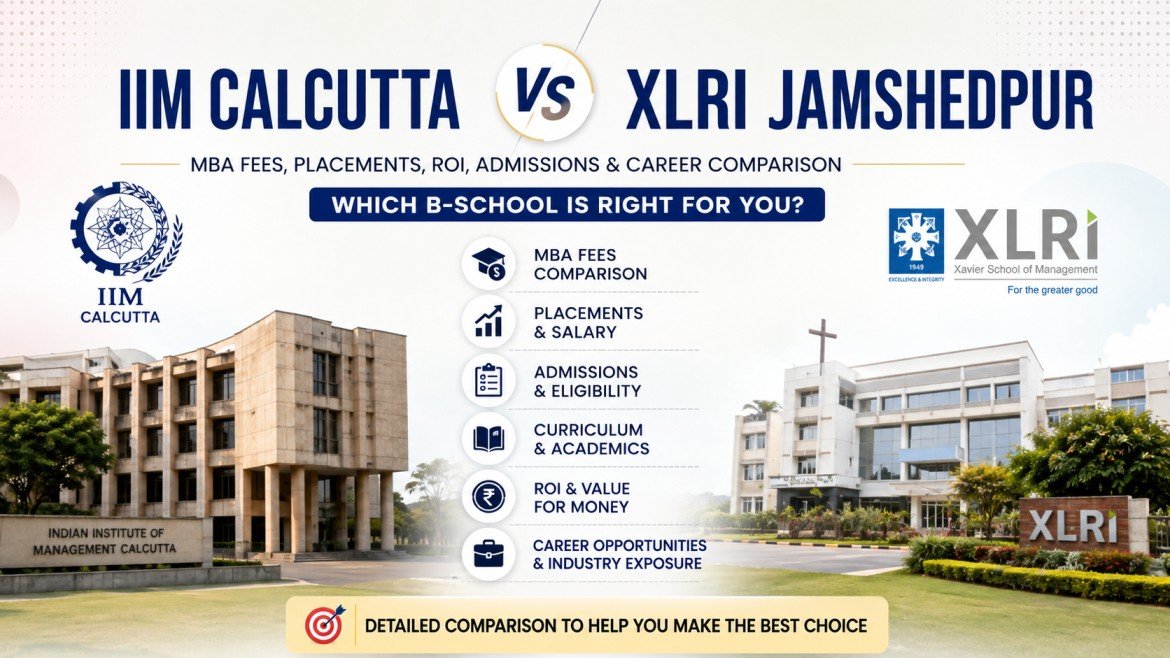
Choosing between two of India’s most respected management institutes is rarely a simple decision. For many MBA aspirants, the question eventually becomes IIM Calcutta vs XLRI Jamshedpur.
Both institutes have decades of academic legacy, strong alumni networks, demanding selection processes and excellent relationships with recruiters. Yet the two schools are not identical. Their admission routes, programme structures, academic strengths, campus environments, brand positioning and career opportunities differ in meaningful ways.
IIM Calcutta vs XLRI is therefore not simply a question of which institute has the higher package. The better choice depends on the candidate’s career goal, entrance-exam profile, preferred specialisation, tolerance for fees, desired location, work experience, and long-term plans.
IIM Calcutta's flagship MBA is a two-year, full-time postgraduate degree. For the 2026–28 batch, the institute's admission policy states that the programme includes a core curriculum, a compulsory summer internship between the first and second years, and second-year electives across multiple functional areas.
XLRI's flagship PGDM in Business Management is also a two-year full-time management programme. Its curriculum covers areas including economics, finance, information systems, marketing, production and operations, decision sciences and strategic management, with ethics, sustainability and values integrated into the programme.
This makes IIMC vs XLRI particularly interesting for students targeting consulting, finance, product management, marketing, general management, operations and other leadership careers.
The comparison below focuses on the full-time flagship management programmes and uses the latest information that could be verified from institutional sources. Where a 2026 figure is not yet publicly available, that limitation is stated instead of presenting an older number as a current figure.
IIM Calcutta vs XLRI: Quick Comparison
| Parameter | IIM Calcutta | XLRI Jamshedpur |
|---|---|---|
| Institute | Indian Institute of Management Calcutta | XLRI – Xavier School of Management |
| Location | Kolkata, West Bengal | Jamshedpur, Jharkhand |
| Flagship full-time programme | MBA | PGDM in Business Management |
| Duration | 2 years | 2 years |
| Entrance examination | CAT | XAT |
| Programme type | Full-time residential MBA | Full-time PGDM |
| Major academic areas | Finance, economics, marketing, operations, strategy, systems, HR, public policy | Economics, finance, marketing, operations, strategy, information systems, decision sciences |
| Summer internship | Compulsory | Part of the two-year programme structure |
| Major career areas | Consulting, finance, investment banking, product, marketing, general management and more | Consulting, BFSI, sales & marketing, general management, product, operations, HR and more |
| Brand strength | IIM brand with particularly strong finance and consulting positioning | XLRI brand with especially strong management, HR and business leadership reputation |
| Primary exam advantage | CAT | XAT |
| Best known differentiation | Strong finance ecosystem and broad MBA career options | Strong management culture, alumni network and leadership/HR legacy |
The important point in an IIM Calcutta vs XLRI comparison is that both are elite institutions, but their strengths are shaped differently.
IIM Calcutta vs XLRI: Which Is Better?
For a student who wants a broad MBA experience with particularly strong opportunities in finance, consulting and other high-end corporate functions, IIM Calcutta may have the stronger overall fit.
For a student who values XLRI's management culture, wants to enter through XAT, is interested in business leadership or HR, or prefers the institute's particular academic and alumni ecosystem, XLRI can be an equally compelling choice.
There is no universal answer to the question, “IIM Calcutta vs XLRI — which is better?”
A better way to ask it is:
Which institute gives me the strongest combination of career opportunities, academic fit, cost, network and long-term value for my specific career goal?
That distinction matters because MBA decisions are not made only on average salary.
About IIM Calcutta
The Indian Institute of Management Calcutta, commonly known as IIM Calcutta or IIMC, was established in 1961 and is one of India's oldest management institutions.
Its flagship MBA is designed as a broad management programme with a strong analytical orientation. The official MBA structure for the 2026–28 batch includes compulsory courses in economics, finance, marketing, operations, systems, organisational behaviour, human resources, strategy and public policy during the first year, followed by a range of electives in the second year.
The programme also includes a compulsory summer internship between the first and second academic years. IIM Calcutta describes this internship as an opportunity for students to apply classroom learning to real organisational situations and gain exposure to professional work environments.
This broad curriculum is one reason IIM Calcutta attracts students with very different career ambitions.
A finance aspirant can build a finance-heavy academic profile. A consulting aspirant can select relevant strategy and analytics courses. A product-management aspirant can combine technology, analytics, marketing and strategy. Someone interested in general management can build a cross-functional profile.
That flexibility is a major strength when comparing IIM Calcutta vs XLRI.
What Makes IIM Calcutta Different?
IIM Calcutta has built a particularly strong reputation in finance and analytical management education.
Its location in Kolkata also provides students with access to a major metropolitan business ecosystem, while the institute's alumni network extends across banking, consulting, investment management, technology, consumer businesses, manufacturing and public institutions.
The school is also part of the IIM network, which has considerable recognition among Indian employers and international business schools.
For students targeting careers such as:
Investment banking
Private equity
Asset management
Consulting
Corporate finance
Product management
Strategy
Marketing
General management
Business analytics
IIM Calcutta can be an attractive choice.
About XLRI Jamshedpur
XLRI – Xavier School of Management is based in Jamshedpur, Jharkhand and has a long-standing reputation for management education and corporate leadership.
Its two-year PGDM in Business Management is one of India's best-known management programmes. XLRI states that the programme integrates management theory with practical business application and covers areas such as economics, finance, information systems, marketing, production, operations, decision sciences and strategic management.
XLRI's academic identity is also closely associated with ethics, values and responsible management.
For students comparing IIMC vs XLRI, this is important because XLRI's proposition is broader than salary statistics.
The institute has a strong alumni presence across:
Consulting
Finance
Banking
Consumer goods
Technology
Manufacturing
Human resources
General management
Sales and marketing
Operations
Entrepreneurship
XLRI is also particularly famous for its HR programme. However, students considering the IIM Calcutta vs XLRI decision should not assume that XLRI is primarily an HR school. Its Business Management programme has a broad management curriculum and attracts candidates targeting consulting, finance, marketing, operations, product and general management as well.
IIM Calcutta vs XLRI: MBA and PGDM Programme Structure
The programme structure is one of the first areas students should examine.
IIM Calcutta's MBA 2026–28 policy describes a two-year full-time postgraduate degree with core courses, a compulsory summer internship and second-year electives.
XLRI's PGDM-BM is similarly structured as a two-year full-time management programme, with broad coverage of functional and strategic management disciplines.
IIM Calcutta curriculum
The first year focuses heavily on management fundamentals.
Students encounter subjects across:
Economics
Finance
Marketing
Operations
Systems
Organisational behaviour
Human resources
Strategy
Public policy
The second year gives students considerably more flexibility through electives.
XLRI curriculum
XLRI's Business Management curriculum covers:
Economics
Finance
Information systems
Marketing
Production
Operations
Decision sciences
Strategic management
The programme also places emphasis on ethics, sustainability and values.
Which curriculum is better?
There is no objective winner.
If your priority is an analytically intensive MBA with a particularly strong finance ecosystem, IIM Calcutta may appeal more.
If you prefer a management education environment that explicitly integrates business competence with ethics, self-awareness and responsible leadership, XLRI may be a better fit.
IIM Calcutta vs XLRI: Admission Process
Admission is one of the biggest differences between the two institutes.
IIM Calcutta Admission
IIM Calcutta's MBA admission process for the 2026–28 batch uses CAT 2025.
The institute specifies minimum CAT percentile thresholds for consideration. For the open category, the minimum listed thresholds are:
VARC: 80 percentile
DILR: 80 percentile
QA: 75 percentile
Overall: 85 percentile
However, IIM Calcutta explicitly states that actual cut-offs can be significantly higher depending on the number of candidates shortlisted.
This distinction is important.
A candidate should not interpret an 85 percentile minimum as meaning that an 85 percentile CAT score is normally sufficient for admission.
The final selection process is much more competitive.
For the 2026–28 batch, IIM Calcutta's final selection weights include:
CAT 2025 score: 30%
Personal Interview: 48%
Writing Ability Test: 8%
Academic diversity: 6%
Work experience: 8%
The institute also considers academic performance and other factors during earlier stages of selection.
IIM Calcutta therefore evaluates candidates beyond their CAT score.
Basic academic eligibility at IIM Calcutta
For the 2026–28 MBA batch, the institute requires a bachelor's degree with at least 50% marks or equivalent CGPA for the general eligibility category, with the specified relaxation for SC, ST and PwD candidates. Final-year candidates can also apply subject to the institute's conditions.
XLRI Admission Process
XLRI's flagship Business Management programme uses XAT as its principal entrance route for Indian candidates.
The institute's admission information states that Indian candidates can apply through XAT, while NRI, foreign, PIO and OCI candidates may use XAT or GMAT depending on the applicable admission route.
For the 2026 cycle, XLRI listed:
XAT registration opening: July 10, 2025
Registration closing: December 5, 2025
XAT examination: January 4, 2026
Interview shortlisting: end of January
Interviews: mid-February to mid-March
Offers and waitlist: April 2026
Academic session: mid-June 2026
The institute notes that dates can be subject to change.
XLRI's selection process is not simply a matter of securing a particular XAT percentile. Academic performance, relevant work experience, extracurricular activities, interview performance and other factors can be considered.
That means students should prepare for the complete selection process rather than treating the entrance examination as the only hurdle.
CAT vs XAT: IIM Calcutta vs XLRI
The entrance examination difference is crucial.
IIM Calcutta
IIM Calcutta uses CAT for its flagship MBA admission.
XLRI
XLRI uses XAT for its flagship Business Management and Human Resource Management programmes.
This creates a practical decision point for aspirants.
If you are already preparing heavily for CAT, IIM Calcutta may naturally be one of your preferred targets.
If you perform particularly well in XAT, XLRI becomes a major option.
For students preparing for both examinations, applying to both institutions can make sense because the exams test overlapping but not identical skill sets.
XAT also has its own examination characteristics, including its decision-making component.
Therefore, IIM Calcutta vs XLRI is not only a college comparison. It can also be an exam-strategy decision.
IIM Calcutta vs XLRI: Fees
Fees are among the most searched factors in any MBA comparison.
However, fee comparisons need to be handled carefully because institutes update fees, and programme charges can include or exclude different components.
The official IIM Calcutta sources available for 2026 do not provide a clearly published 2026–28 flagship MBA total fee figure in the material reviewed here. Therefore, it would be misleading to present an unverified number as the current IIM Calcutta MBA fee.
This is an important distinction because many third-party websites continue to display historical fee figures.
For XLRI, the institute's current admission information gives a fee figure of ₹15.25 lakh per annum for its postgraduate programmes and notes that mess and hostel expenses are additional.
The exact amount payable by a student can therefore depend on the specific programme and additional campus expenses.
Why fee alone should not determine the decision
Suppose one programme costs slightly less but provides a weaker fit for your intended career.
That does not automatically make it better ROI.
Similarly, paying a higher fee can be financially rational if the programme significantly improves your probability of reaching your target role.
The better approach is to compare:
Total cost = tuition + accommodation + food + personal expenses + opportunity cost
against:
Expected career value = role quality + compensation + career mobility + network + long-term brand value
IIM Calcutta vs XLRI: Placement Comparison
Placements are often the most important part of an MBA decision.
Both IIM Calcutta and XLRI have strong recruiter relationships, but students should be careful when comparing published statistics.
Placement reports may differ in:
Batch size
Participating students
Number of offers
Domestic versus international offers
Average salary
Median salary
Highest salary
Salary reporting methodology
Programme coverage
Therefore, the highest package should never be the only basis for an IIM Calcutta vs XLRI decision.
IIM Calcutta placements
IIM Calcutta publishes placement information through its official Career Development and Placement pages. Its flagship MBA is described as a two-year residential programme designed to develop general management and decision-making capabilities.
The institute also maintains dedicated placement reports and brochures for its MBA batches.
For 2026, the latest official final placement page available for the MBA programme is the Final Placement Report for the 61st batch.
The important takeaway is that IIM Calcutta has a mature placement ecosystem covering multiple high-value sectors rather than relying on a single recruitment industry.
XLRI Placements
XLRI provides especially useful recent placement information through its official placement reports.
For the 2024–26 PGDM BM and HRM cohort across the Jamshedpur and Delhi-NCR campuses, XLRI reported 576 students placed through 145 recruiting organisations. The institute reported more than 576 domestic offers and two international offers. It also reported that 42.5% of students received Pre-Placement Offers.
The reported average salary was ₹31.40 lakh per annum, while the median salary was ₹29 lakh per annum.
The reported top-10 percentile average was ₹49.2 lakh, and the top-25 percentile average was ₹44.18 lakh. XLRI reported the highest domestic offer at ₹59 lakh and the highest international offer at ₹1.10 crore.
These figures provide strong evidence of XLRI's corporate demand.
They also show why a simple “IIM Calcutta vs XLRI package” comparison can be misleading.
Averages describe an entire placement cohort. Individual outcomes depend on academic performance, previous experience, role preferences, interview performance, internship outcomes and market conditions.
IIM Calcutta vs XLRI: Industry Exposure
Industry exposure is one of the areas where both institutes perform strongly.
IIM Calcutta industry exposure
IIM Calcutta's compulsory summer internship is explicitly designed to connect classroom concepts with real organisational situations. Students undertake time-bound projects and interact with workplace environments.
The combination of classroom education, internships, case discussions, projects and recruiter interaction gives students exposure to corporate decision-making.
For students targeting finance, consulting and strategy, the ecosystem can be particularly valuable.
XLRI industry exposure
XLRI has similarly strong corporate integration.
Its 2026 placement report demonstrates the breadth of its recruiter base, with 145 organisations participating in final recruitment for the 2024–26 BM and HRM cohort across the two campuses.
XLRI's summer internship placement process also demonstrates significant corporate engagement. For the 2025–27 cohort, the institute reported 584 offers from 114 organisations, with an average stipend of ₹1.6 lakh per month and a median stipend of ₹1.55 lakh per month.
The summer internship market is especially relevant because internships can influence PPO opportunities.
IIM Calcutta vs XLRI: Consulting Careers
Consulting is a major target for students entering both institutes.
IIM Calcutta for consulting
IIM Calcutta offers a combination of:
Strong analytical training
Strategy education
Quantitative skills
Diverse peer group
Corporate exposure
Alumni presence in consulting
Students interested in management consulting, strategy consulting and related roles can find strong opportunities.
XLRI for consulting
XLRI also has significant consulting recruitment.
Its recent placement report lists consulting among the major recruitment areas, alongside BFSI, sales and marketing and general management.
Verdict for consulting
For consulting, the difference is relatively small compared with the difference in individual student profiles.
If you have an offer from both, examine:
Specific roles
Recruiters
Location
Compensation structure
Joining timeline
Career progression
Alumni in your target consulting firm
Rather than choosing solely on the institution name.
IIM Calcutta vs XLRI: Finance Careers
Finance is one of the strongest differentiators in the comparison.
IIM Calcutta has a particularly strong reputation among finance-oriented MBA aspirants.
Students interested in:
Investment banking
Private equity
Asset management
Corporate finance
Financial services
Markets
Risk management
often place IIM Calcutta high on their preference list.
XLRI also offers finance opportunities and has a strong corporate ecosystem, but IIM Calcutta's historical positioning in finance is a major reason why finance aspirants frequently prefer it.
If finance is your number-one career objective, IIM Calcutta generally has the stronger fit.
That does not mean XLRI is weak for finance. It means that when finance is weighted heavily in the decision, IIM Calcutta's ecosystem becomes particularly attractive.
IIM Calcutta vs XLRI: Marketing Careers
Marketing is another field where both institutions offer strong opportunities.
Students can target:
Brand management
Sales
Digital marketing
Product marketing
Consumer insights
Category management
General management
XLRI's broad management curriculum and corporate network make it attractive for marketing aspirants.
IIM Calcutta also provides strong access to consumer-facing companies and general management roles.
For marketing, the choice can therefore depend more heavily on the actual offers available to the student than on a simple institutional ranking.
IIM Calcutta vs XLRI: Product Management
Product management has become increasingly attractive to MBA aspirants.
Both institutions can support a product career because product management requires a combination of:
Business understanding
Customer understanding
Analytics
Technology awareness
Communication
Strategy
Execution
IIM Calcutta may appeal to candidates who want to combine analytical and strategic training with technology-sector opportunities.
XLRI also provides exposure to information systems, strategy, operations and marketing, which can create a useful foundation for product roles.
However, students should remember that an MBA does not automatically qualify someone for product management.
Relevant internships, technology understanding, case preparation, product sense and prior experience can matter significantly.
IIM Calcutta vs XLRI: HR Careers
This is one category where the answer is clearer.
XLRI has an exceptional legacy in human resource management.
Its PGDM-HRM programme is one of the institute's flagship offerings and has contributed to XLRI's long-standing reputation in HR education.
Students targeting:
HR business partner roles
Talent management
Compensation and benefits
Organisation development
People analytics
Talent acquisition
HR consulting
CHRO-track careers
should give XLRI serious consideration.
IIM Calcutta can still offer HR-related courses and career paths, but XLRI has the more distinctive institutional identity in HR.
IIM Calcutta vs XLRI: General Management
General management is a broad category that includes leadership, business strategy, operations, cross-functional management and corporate development.
Both schools are strong here.
IIM Calcutta's MBA is explicitly designed around broad management education and high-level decision-making.
XLRI's Business Management programme similarly focuses on building managers who can work across functional areas.
The better choice may depend on the industries and companies you want to enter.
IIM Calcutta vs XLRI: Alumni Network
Alumni can have a significant impact on the value of an MBA.
An active alumni network can help with:
Career advice
Interview preparation
Referrals
Industry information
Entrepreneurship
Mentorship
Career transitions
International opportunities
Both IIM Calcutta and XLRI have extensive alumni communities.
IIM Calcutta benefits from the wider IIM ecosystem and a particularly deep presence across finance, consulting and corporate leadership.
XLRI has a strong alumni identity across management, HR, consulting, consumer businesses, technology and general management.
The difference is therefore less about whether one institute has an alumni network and more about which network is stronger for your desired industry.
IIM Calcutta vs XLRI: Campus Experience
Campus life is another area where the two institutions differ.
IIM Calcutta campus
IIM Calcutta's campus is located in Joka, Kolkata.
The residential MBA environment creates an immersive academic experience where students spend a significant portion of their two-year programme working with peers.
The campus environment includes:
Classes
Student clubs
Committees
Case competitions
Events
Alumni interactions
Recruiter sessions
Academic projects
XLRI Jamshedpur campus
XLRI's Jamshedpur campus is closely associated with its institutional identity.
Students experience a residential B-school environment with academic activities, clubs, events, competitions and corporate interactions.
The Jamshedpur location also creates a different lifestyle from metropolitan campuses such as those in Mumbai, Delhi or Bengaluru.
For some students, that quieter environment is a positive. Others may prefer the direct metropolitan exposure of a larger city.
IIM Calcutta vs XLRI: ROI
ROI is one of the most misunderstood concepts in MBA selection.
Students often calculate:
ROI = Average salary ÷ MBA fee
That is too simplistic.
A better framework considers:
Financial ROI = Career earnings increase – total MBA cost – opportunity cost
And then adds non-financial factors such as:
Career mobility
Alumni network
Brand
Job quality
International opportunities
Leadership opportunities
Learning
Network value
Why IIM Calcutta can offer strong ROI
IIM Calcutta has strong career outcomes across high-paying corporate sectors, particularly finance and consulting.
If a student uses the MBA to move from a modest pre-MBA salary into a high-growth role, the economic value of the degree can be substantial.
Why XLRI can offer strong ROI
XLRI's recent final placement figures show an average salary of ₹31.40 lakh and a median salary of ₹29 lakh for the 2024–26 BM and HRM cohort across the two campuses.
Its strong recruiter base and PPO conversion also contribute to the value proposition.
But students should not calculate ROI using the highest salary.
A median salary is generally more useful for understanding the centre of the placement distribution than an exceptional highest offer.
IIM Calcutta vs XLRI: Which Has Better Placements?
If the question is simply, “Which has better placements?”, the most responsible answer is:
Both have excellent placements, and the better choice depends on the role, sector and individual student outcome.
IIM Calcutta has a particularly strong reputation in finance, consulting and analytical business roles.
XLRI has a broad corporate placement ecosystem, with strong performance across consulting, BFSI, sales and marketing, general management, product management, operations, systems and HR.
XLRI's 2026 final placement report recorded an average salary of ₹31.40 lakh and a median of ₹29 lakh for the reported cohort.
Instead of asking only about average salary, compare:
| Placement factor | What to check |
|---|---|
| Average salary | Overall cohort compensation |
| Median salary | More representative middle outcome |
| Highest salary | Exceptional outcome, not typical |
| Recruiters | Which companies actually recruit |
| Roles | What jobs students receive |
| Sector mix | Finance, consulting, technology, FMCG, etc. |
| PPOs | Internship-to-job conversion |
| Batch size | Context for placement statistics |
| International offers | Global mobility |
| Location | Where jobs are concentrated |
IIM Calcutta vs XLRI: Which Is Better for Freshers?
Both institutes accept fresh graduates.
However, your profile matters more than simply being a fresher.
A fresher should evaluate:
Academic record
CAT/XAT score
Internship quality
Extracurricular activities
Leadership experience
Interview performance
Career clarity
IIM Calcutta's 2026 admission policy explicitly considers academic performance, CAT performance, gender diversity and work experience at different stages.
Therefore, a fresher should not assume that having no full-time work experience automatically puts them at a disadvantage.
Similarly, a candidate with work experience should not assume admission is guaranteed.
IIM Calcutta vs XLRI: Which Is Better for Engineers?
Engineers form a large part of India's MBA applicant pool.
For engineering graduates, the competition can be intense because many candidates have similar academic and entrance-test profiles.
IIM Calcutta's 2026 final selection policy awards academic diversity points to candidates from non-engineering backgrounds, meaning academic background can influence the composite score. Engineering degrees do not receive those academic-diversity points under the listed categories.
That does not make IIM Calcutta inaccessible to engineers.
It means engineers need to compensate through:
Strong CAT performance
Academic scores
Interview performance
Relevant work experience
Strong extracurriculars
A compelling overall profile
The same principle applies when considering XLRI: a high XAT score is important, but selection should be viewed holistically.
IIM Calcutta vs XLRI: Which Is Better for Candidates With Work Experience?
Work experience can strengthen an MBA profile, but its value depends on the quality and relevance of the experience.
Good work experience can demonstrate:
Leadership
Responsibility
Business exposure
Problem-solving
Career progression
Professional maturity
IIM Calcutta's 2026 MBA policy awards up to eight points for work experience based on completed months of eligible post-bachelor's employment as of January 31, 2026. The institute also requires supporting employment documentation.
For a working professional, the most important question is not simply whether one institute gives work-experience points.
Ask instead:
Will this MBA help me make the career transition I want?
For example, moving from IT into consulting is a different objective from moving from finance into investment banking.
IIM Calcutta vs XLRI: International Exposure
International exposure can come through:
Exchange programmes
International internships
Global companies
International alumni
Overseas career opportunities
Cross-cultural peer learning
Both institutions have international academic and corporate connections.
However, students should evaluate international exposure based on actual opportunities available to their specific batch and programme rather than relying on general claims.
The strength of an MBA is increasingly connected to global employability, but international career outcomes depend heavily on work authorisation, geography, prior experience, language, industry and employer requirements.
IIM Calcutta vs XLRI: Brand Value
Brand value is difficult to quantify but matters in early-career recruitment.
IIM Calcutta brand
The IIM name carries strong recognition across India.
IIM Calcutta's alumni occupy senior positions across many industries, and the institution has a long history in management education.
XLRI brand
XLRI also has an exceptionally strong management-school brand.
Its reputation is particularly distinctive in HR and responsible leadership, but its Business Management programme has broad recognition across the corporate sector.
Which brand is stronger?
For general management in India, both are powerful.
For finance-oriented careers, IIM Calcutta often has a stronger fit.
For HR, XLRI is the more obvious specialist choice.
For consulting, both can provide strong pathways.
For general corporate careers, the difference may be much smaller than aspirants expect.
IIM Calcutta vs XLRI: Student Culture
Student culture is sometimes overlooked during MBA selection.
At IIM Calcutta, the residential environment encourages students to work collaboratively while competing intensely for academic and career opportunities.
At XLRI, the institute's emphasis on values, ethics and responsible leadership forms an important part of its identity.
The right environment depends on your personality.
If you thrive in highly competitive analytical environments, IIM Calcutta may appeal strongly.
If you value a management culture that explicitly places emphasis on ethics, responsibility and leadership, XLRI may resonate more.
There is no objectively superior personality fit.
IIM Calcutta vs XLRI: Scholarships and Financial Planning
MBA aspirants should consider financing before accepting an offer.
Expenses can include:
Tuition
Hostel
Food
Books
Laptop
Travel
Personal expenses
Club and activity expenses
Loan interest
Lost salary during the MBA
Do not assume that the published tuition fee represents the complete financial commitment.
Students should also examine:
Education-loan interest rates
Moratorium period
Processing fees
Collateral requirements
Scholarship opportunities
Family contribution
Expected post-MBA salary
Expected monthly loan repayment
The financially best decision is the one you can sustain without putting unreasonable pressure on your post-MBA career.
IIM Calcutta vs XLRI: Career Opportunities by Specialisation
| Career Area | IIM Calcutta | XLRI |
|---|---|---|
| Finance | Excellent | Strong |
| Investment Banking | Excellent fit | Strong |
| Consulting | Excellent | Excellent |
| Strategy | Excellent | Strong |
| Marketing | Strong | Strong |
| Sales | Strong | Strong |
| Product Management | Strong | Strong |
| Operations | Strong | Strong |
| General Management | Excellent | Excellent |
| HR | Strong | Exceptional |
| Business Analytics | Strong | Strong |
| Entrepreneurship | Strong | Strong |
| Technology careers | Strong | Strong |
The table should be interpreted as a fit assessment rather than a ranking.
IIM Calcutta vs XLRI: Pros and Cons
IIM Calcutta advantages
Strong IIM brand
Excellent finance ecosystem
Strong consulting opportunities
Broad management curriculum
Powerful alumni network
Strong analytical orientation
Wide range of career options
Residential MBA experience
Strong corporate recognition
IIM Calcutta limitations
Extremely competitive CAT-based admission
Academic workload can be intense
High opportunity cost
Finance-oriented reputation may influence perceptions even though the programme is broad
Total cost goes beyond tuition
XLRI advantages
Highly respected management-school brand
Strong corporate relationships
Exceptional HR legacy
Strong Business Management programme
Excellent consulting and general management opportunities
Strong alumni network
Emphasis on responsible leadership
XAT provides an alternative route to an elite B-school
XLRI limitations
Jamshedpur may not appeal to every student
Total cost is significant
XAT preparation requires specific exam strategy
Career fit can vary considerably by sector and role
IIM Calcutta vs XLRI: Who Should Choose IIM Calcutta?
IIM Calcutta may be the better choice if:
You want a career in finance.
You are targeting investment banking.
You want strong consulting opportunities.
You prefer the IIM ecosystem.
You enjoy quantitative and analytical learning.
You want broad career flexibility.
You are comfortable with a highly competitive academic environment.
Your long-term goal involves senior corporate leadership.
For finance-focused aspirants, the IIM Calcutta option deserves particularly serious consideration.
Who Should Choose XLRI?
XLRI may be the better choice if:
You have a strong XAT profile.
You want HR as a primary career.
You value XLRI's leadership and ethics-oriented culture.
You are targeting consulting.
You want careers in marketing, general management or operations.
You value XLRI's alumni ecosystem.
You prefer the institute's academic environment.
Your career goals align strongly with the Business Management programme.
For HR aspirants, XLRI is particularly difficult to overlook.
IIM Calcutta vs XLRI: What If You Get Both Offers?
This is where the comparison becomes practical.
Suppose you receive an IIM Calcutta MBA offer and an XLRI Business Management offer.
Do not make the decision based only on the highest salary statistic.
Ask yourself five questions.
What career do I want?
Finance, consulting, marketing, HR, technology and general management can lead to different preferences.
Which programme gives me stronger access to that career?
Look at actual recruiters and roles.
What is the total financial burden?
Calculate the complete cost, not only tuition.
Which environment suits me?
An MBA is two intensive years. Campus culture matters.
What happens if my preferred career plan changes?
Choose a programme that preserves career flexibility if you are not completely certain about your target industry.
IIM Calcutta vs XLRI: ROI Beyond Salary
Imagine two students.
Student A joins an MBA programme, receives a ₹30 lakh package and dislikes the role.
Student B receives a ₹26 lakh package but enters a role that provides strong learning, excellent mentorship and rapid career progression.
Which student has better ROI?
There is no simple answer.
Salary is important, but career trajectory matters.
A strong MBA should ideally create:
better role → better skills → stronger network → greater responsibility → higher future compensation
This is why an MBA should be evaluated over five to ten years rather than only on the first post-MBA salary.
IIM Calcutta vs XLRI: Common Mistakes Students Make
Comparing only highest packages
The highest salary usually represents a small number of students.
Median and average figures provide more useful context.
Ignoring the role
₹30 lakh in one role is not automatically better than ₹28 lakh in another.
Role quality, learning and future mobility matter.
Treating minimum cut-offs as expected cut-offs
IIM Calcutta explicitly warns that actual CAT cut-offs may be much higher than the minimum thresholds used for consideration.
The same principle applies broadly to elite B-school admissions.
Ignoring opportunity cost
Two years without a full-time salary have an economic value.
Choosing based on social media rankings
Rankings can be useful as one input but should never replace programme-level research.
Ignoring personal career goals
A student interested in HR should not choose a programme simply because someone says another school has a better overall brand.
IIM Calcutta vs XLRI: How to Make the Final Decision
A useful way to compare the two is to assign weights to your priorities.
For example:
| Factor | Suggested Weight |
|---|---|
| Career opportunities | 25% |
| Placement quality | 20% |
| Programme fit | 15% |
| Brand/alumni network | 15% |
| Total cost and ROI | 10% |
| Campus and location | 5% |
| International exposure | 5% |
| Personal preference | 5% |
You can modify the weights.
A finance aspirant could increase finance-career fit.
An HR aspirant could increase HR-specific career value.
A candidate planning entrepreneurship could assign more weight to alumni and startup ecosystems.
This approach is much more useful than asking, “Which college is number one?”
IIM Calcutta vs XLRI: A Practical Decision Matrix
| If your priority is... | Better fit |
|---|---|
| Finance | IIM Calcutta |
| Investment banking | IIM Calcutta |
| Consulting | Both |
| Strategy | Both |
| HR | XLRI |
| Marketing | Both |
| General management | Both |
| Product management | Both |
| Strong IIM brand | IIM Calcutta |
| Strong HR legacy | XLRI |
| CAT route | IIM Calcutta |
| XAT route | XLRI |
| Broad career flexibility | IIM Calcutta |
| Responsible leadership orientation | XLRI |
This is not an absolute ranking. Individual offers and career targets can change the answer.
IIMC vs XLRI: The Role of Location
Location matters more than many students expect.
Kolkata
IIM Calcutta is located in Kolkata, one of India's major metropolitan cities.
The city offers:
Corporate exposure
Financial institutions
Cultural diversity
Large alumni ecosystem
Strong business history
Connectivity
Jamshedpur
XLRI is located in Jamshedpur, an important industrial city.
The city has a strong connection with manufacturing and corporate India.
The campus environment is relatively self-contained, which can be attractive to students who prefer an immersive residential experience.
Neither location is universally better.
The right question is which environment supports your learning and career goals.
IIM Calcutta vs XLRI: Placements and the Importance of Median Salary
A common mistake in MBA research is focusing on the highest package.
Consider three numbers:
Average salary: the arithmetic average across the relevant placement population.
Median salary: the middle point of the distribution.
Highest salary: the top reported offer.
If the highest salary is ₹1 crore but the median is ₹25 lakh, the ₹1 crore figure should not influence every applicant's expectations.
XLRI's latest final placement report is useful because it provides both average and median figures. The 2024–26 BM and HRM cohort recorded an average of ₹31.40 lakh and a median of ₹29 lakh.
Students should seek similarly detailed placement information for IIM Calcutta and compare cohorts on a like-for-like basis.
IIM Calcutta vs XLRI: Why PPOs Matter
Pre-Placement Offers can be an important component of MBA placement outcomes.
A PPO is generally offered to an intern based on internship performance and company requirements.
For students, a PPO can reduce final-placement uncertainty.
XLRI reported that 42.5% of the 2024–26 cohort received PPOs.
Its summer internship process for the 2025–27 cohort also produced 584 offers from 114 organisations, showing the scale of corporate engagement.
This is one reason internship preparation should begin early.
Students should treat the summer internship not simply as a mandatory academic requirement but as an extended interview for potential future employment.
IIM Calcutta vs XLRI: What Employers Look For
The institute name may open a door, but the candidate still has to perform.
Employers commonly evaluate:
Academic performance
Internship experience
Work experience
Leadership
Communication
Analytical ability
Problem-solving
Business awareness
Domain knowledge
Case-solving
Teamwork
Interview performance
This means that getting into IIM Calcutta or XLRI is not the end of the process.
It is the beginning of another competition.
IIM Calcutta vs XLRI: Is the IIM Tag Always Better?
No.
The IIM brand is powerful, but brand hierarchy should not be used mechanically.
For example, an aspirant targeting HR may reasonably prefer XLRI because of its deep HR legacy.
Likewise, a candidate targeting a specific XLRI recruiter may choose XLRI over another school with a higher general ranking.
The right MBA is the institution that maximises your expected career outcome.
IIM Calcutta vs XLRI: Is XLRI Worth the Cost?
For a student who can secure a strong post-MBA role, XLRI can provide substantial career value.
Its latest official placement report shows strong salary outcomes and a large recruiter base.
The more important question is whether the programme fits your career objective.
If your goal is HR, the value proposition becomes particularly compelling.
If your goal is consulting or general management, compare the actual roles and recruiters available to you.
If your goal is finance, compare the finance-specific opportunities carefully with IIM Calcutta.
IIM Calcutta vs XLRI: Is IIM Calcutta Worth the Cost?
IIM Calcutta can provide significant value for students who use its academic and recruiting ecosystem effectively.
Its MBA offers broad management education, compulsory industry exposure through the summer internship and extensive second-year elective choices.
The institute's placement infrastructure and alumni network can be especially useful for students targeting high-end corporate roles.
However, students should not assume that an IIM degree automatically guarantees a particular salary.
The outcome depends on the individual.
IIM Calcutta vs XLRI: Final Verdict
So, IIM Calcutta vs XLRI — which one should you choose?
If your primary goal is finance, investment banking or a broad MBA with particularly strong analytical and finance positioning, IIM Calcutta is usually the more natural choice.
If your primary goal is HR, responsible leadership or a career path strongly aligned with XLRI's management ecosystem, XLRI may be the better fit.
For consulting, marketing, general management, operations and many product-oriented roles, both can be excellent choices.
The decision should ultimately be based on the combination of:
Your career goal
Entrance-exam route
Academic profile
Work experience
Desired industry
Programme fit
Placement roles
Total cost
Alumni network
Campus preference
Long-term career plans
The biggest mistake is asking only, “Which college is better?”
The better question is:
Which institute gives me the strongest platform for the career I want to build?
For most aspirants, that is the real answer to IIM Calcutta vs XLRI.
Frequently Asked Questions
Is IIM Calcutta better than XLRI?
Neither institute is universally better. IIM Calcutta is particularly attractive for finance, investment banking, consulting and broad MBA career options, while XLRI has a particularly strong legacy in HR and excellent opportunities across consulting, general management, marketing and other corporate functions.
Which is better for finance, IIM Calcutta or XLRI?
IIM Calcutta is generally the stronger fit for students primarily targeting finance and investment banking because of its long-standing finance ecosystem and positioning.
Which is better for HR, IIM Calcutta or XLRI?
XLRI is generally the preferred choice for HR because of its long-established HR management programme and alumni network in the field.
Does IIM Calcutta accept XAT?
The flagship IIM Calcutta MBA admission process is based on CAT. For the 2026–28 batch, IIM Calcutta's official admission policy specifies CAT 2025 as the entrance-test basis.
Does XLRI accept CAT?
For the flagship PGDM-BM route, Indian candidates apply through XAT. XLRI's admission information specifies XAT as the principal route for Indian candidates.
What is the minimum CAT percentile for IIM Calcutta?
For the 2026–28 batch, IIM Calcutta lists a minimum overall CAT percentile of 85 for the open category, with sectional minimums of 80 in VARC, 80 in DILR and 75 in QA. The institute states that actual cut-offs can be substantially higher.
What is the IIM Calcutta MBA eligibility?
For the 2026–28 batch, candidates need a bachelor's degree with at least 50% marks or equivalent CGPA, subject to the applicable category relaxation. Final-year candidates may also apply under the conditions specified by the institute.
What is the XLRI Business Management programme?
XLRI's PGDM in Business Management is a two-year full-time programme covering economics, finance, information systems, marketing, production, operations, decision sciences and strategic management.
What was XLRI's latest reported average salary?
For the 2024–26 BM and HRM cohort across XLRI's Jamshedpur and Delhi-NCR campuses, the institute reported an average salary of ₹31.40 lakh per annum and a median salary of ₹29 lakh per annum.
What was XLRI's highest reported package?
XLRI reported the highest domestic offer at ₹59 lakh per annum and the highest international offer at ₹1.10 crore for the 2024–26 BM and HRM final placement process.
Is XLRI good for consulting?
Yes. Consulting is one of the major recruitment areas reported by XLRI, alongside BFSI, sales and marketing and general management.
Is IIM Calcutta good for consulting?
Yes. Consulting is an important career path for IIM Calcutta MBA students, supported by the institute's broad management curriculum and corporate placement ecosystem.
Which has better ROI, IIM Calcutta or XLRI?
Both can offer excellent ROI. The better financial decision depends on your total programme cost, opportunity cost, post-MBA role and long-term salary progression rather than the highest package alone.
Which is better for freshers?
Both institutions can be suitable for fresh graduates. Your academic record, entrance score, interview performance, internships and overall profile matter more than simply being a fresher.
Which is better for engineers?
Both can be excellent choices. Engineering candidates should pay particular attention to the admission methodology and academic-diversity components of each institution. IIM Calcutta's 2026 policy explicitly provides academic-diversity points to specified non-engineering backgrounds.
Is work experience mandatory for IIM Calcutta MBA?
No. Work experience is considered in the selection process, but the flagship MBA is not restricted to candidates with full-time work experience. IIM Calcutta's 2026 policy explicitly includes a work-experience component in final selection.
Which entrance exam should I prepare for: CAT or XAT?
If IIM Calcutta is your target, CAT preparation is essential. If XLRI is your target, XAT is essential for the standard Indian-candidate admission route. Students targeting both should prepare strategically for both examinations.
Should I choose IIM Calcutta over XLRI because it is an IIM?
Not automatically. The right choice depends on your career target. For finance, IIM Calcutta may have a stronger fit; for HR, XLRI can be the more logical choice.
Which is better for MBA overall?
Both are elite options. IIM Calcutta offers a highly respected broad MBA with particularly strong finance positioning, while XLRI offers an equally prestigious management ecosystem with a distinctive HR and leadership legacy.
Conclusion
The IIM Calcutta vs XLRI debate is ultimately less about finding a universal winner and more about finding the right match.
IIM Calcutta stands out for its IIM brand, analytical management education, finance ecosystem, consulting opportunities and broad career flexibility. Its 2026–28 MBA structure combines a common management foundation, compulsory summer internship and extensive second-year electives.
XLRI stands out for its strong corporate relationships, Business Management programme, leadership-oriented culture and exceptional HR legacy. Its latest official final placement report also demonstrates substantial recruiter participation and strong salary outcomes.
For finance and investment banking, IIM Calcutta generally deserves the edge.
For HR, XLRI is the natural standout.
For consulting, general management, marketing, operations and several product-oriented careers, both deserve serious consideration.
If you have offers from both, compare the actual roles, total cost, career trajectory and personal fit instead of choosing based on a single ranking or highest salary.
That is the most practical way to approach IIMC vs XLRI and make an MBA decision that remains valuable long after graduation.
Sources and Further Reading
The most reliable information for admissions, programmes and placements should come from the institutes themselves. IIM Calcutta publishes its MBA admission policy and placement information through its official website, while XLRI publishes programme, admission and placement information through its official channels.
The original brief supplied for this article specifies the topic, target keyword, 2026 requirement and requirement for a publication-ready long-form comparison.
Search Keywords
iim calcutta vs xlri, IIMC vs XLRI, IIM Calcutta vs XLRI, IIM Calcutta or XLRI, IIM Calcutta vs XLRI fees, IIM Calcutta vs XLRI placements, IIM Calcutta vs XLRI ROI, IIM Calcutta vs XLRI salary, IIM Calcutta vs XLRI MBA, IIM Calcutta vs XLRI PGDM, IIM Calcutta MBA, XLRI Jamshedpur MBA, XLRI Business Management, IIM Calcutta fees, XLRI fees, IIM Calcutta placements, XLRI placements, IIM Calcutta average package, XLRI average package, IIM Calcutta median salary, XLRI median salary, IIM Calcutta highest package, XLRI highest package, IIM Calcutta admission, XLRI admission, IIM Calcutta CAT, XLRI XAT, CAT vs XAT, IIM Calcutta eligibility, XLRI eligibility, IIM Calcutta cut off, XLRI cut off, IIM Calcutta CAT percentile, XLRI XAT percentile, IIM Calcutta placement report, XLRI placement report, IIM Calcutta placement 2026, XLRI placement 2026, IIM Calcutta MBA 2026, XLRI MBA 2026, IIM Calcutta 2026 admission, XLRI 2026 admission, IIM Calcutta vs XLRI 2026, IIMC vs XLRI 2026, IIM Calcutta ROI, XLRI ROI, IIM Calcutta career opportunities, XLRI career opportunities, IIM Calcutta finance, XLRI finance, IIM Calcutta consulting, XLRI consulting, IIM Calcutta HR, XLRI HR, IIM Calcutta marketing, XLRI marketing, IIM Calcutta product management, XLRI product management, IIM Calcutta general management, XLRI general management, IIM Calcutta alumni, XLRI alumni, IIM Calcutta campus, XLRI Jamshedpur campus, IIM Calcutta curriculum, XLRI curriculum, IIM Calcutta course structure, XLRI course structure, IIM Calcutta summer internship, XLRI summer internship, IIM Calcutta PPO, XLRI PPO, IIM Calcutta recruiters, XLRI recruiters, IIM Calcutta placement statistics, XLRI placement statistics, IIM Calcutta salary 2026, XLRI salary 2026, best MBA college India, best B school India, top MBA colleges India, top B schools India, IIM Calcutta or XLRI which is better, XLRI or IIM Calcutta which is better, IIM Calcutta vs XLRI which is better, IIMC vs XLRI which is better, IIM Calcutta vs XLRI for finance, IIM Calcutta vs XLRI for consulting, IIM Calcutta vs XLRI for HR, IIM Calcutta vs XLRI for marketing, IIM Calcutta vs XLRI for freshers, IIM Calcutta vs XLRI for engineers, IIM Calcutta vs XLRI for work experience, IIM Calcutta vs XLRI for MBA, IIM Calcutta vs XLRI salary comparison, IIM Calcutta vs XLRI fee comparison, IIM Calcutta vs XLRI placement comparison, IIM Calcutta vs XLRI career comparison, IIM Calcutta vs XLRI admission comparison, IIM Calcutta vs XLRI campus comparison, IIM Calcutta vs XLRI brand comparison, IIM Calcutta vs XLRI alumni comparison, IIM Calcutta vs XLRI ROI comparison, IIM Calcutta vs XLRI finance placement, IIM Calcutta vs XLRI consulting placement, IIM Calcutta vs XLRI HR placement, IIM Calcutta vs XLRI marketing placement, IIM Calcutta vs XLRI general management, IIM Calcutta MBA vs XLRI PGDM, IIM Calcutta MBA fee, XLRI PGDM fee, IIM Calcutta MBA placement, XLRI PGDM placement, IIM Calcutta MBA salary, XLRI PGDM salary, IIM Calcutta MBA admission process, XLRI PGDM admission process, IIM Calcutta CAT eligibility, XLRI XAT eligibility, IIM Calcutta CAT 2026, XLRI XAT 2026
Long-Tail & Short-Tail Searches
which is better IIM Calcutta or XLRI, IIM Calcutta vs XLRI which college should I choose, IIM Calcutta vs XLRI for MBA aspirants, IIM Calcutta vs XLRI for finance career, IIM Calcutta vs XLRI for investment banking, IIM Calcutta vs XLRI for consulting career, IIM Calcutta vs XLRI for HR career, IIM Calcutta vs XLRI for marketing career, IIM Calcutta vs XLRI for product management, IIM Calcutta vs XLRI for general management, IIM Calcutta vs XLRI for fresh graduates, IIM Calcutta vs XLRI for engineers, IIM Calcutta vs XLRI for commerce students, IIM Calcutta vs XLRI for working professionals, IIM Calcutta vs XLRI after CAT, IIM Calcutta vs XLRI after XAT, should I choose IIM Calcutta or XLRI, is IIM Calcutta better than XLRI, is XLRI better than IIM Calcutta, is IIM Calcutta worth the fees, is XLRI worth the fees, which has better ROI IIM Calcutta or XLRI, which has better placements IIM Calcutta or XLRI, which has higher salary IIM Calcutta or XLRI, which has better finance placements, which has better consulting placements, which has better HR placements, which has better marketing placements, which has better alumni network, which has better campus life, which has better brand value, CAT vs XAT for MBA, IIM Calcutta CAT cutoff 2026, XLRI XAT cutoff 2026, IIM Calcutta MBA eligibility 2026, XLRI BM eligibility 2026, IIM Calcutta MBA fees 2026, XLRI BM fees 2026, IIM Calcutta placement statistics 2026, XLRI placement statistics 2026, IIM Calcutta average salary 2026, XLRI average salary 2026, IIM Calcutta median salary 2026, XLRI median salary 2026, IIM Calcutta highest package 2026, XLRI highest package 2026, IIM Calcutta MBA admission process, XLRI Business Management admission process, IIM Calcutta summer internship placements, XLRI summer internship placements, IIM Calcutta PPO opportunities, XLRI PPO opportunities, IIM Calcutta finance career opportunities, XLRI HR career opportunities, IIM Calcutta consulting career, XLRI consulting career, IIM Calcutta MBA vs XLRI PGDM which is better, IIM Calcutta or XLRI for high salary, IIM Calcutta or XLRI for long term career, IIM Calcutta or XLRI for best ROI, IIM Calcutta or XLRI for corporate jobs, IIM Calcutta or XLRI for leadership careers, IIM Calcutta or XLRI for management consulting, IIM Calcutta or XLRI for investment banking, IIM Calcutta or XLRI for private equity, IIM Calcutta or XLRI for business analytics, IIM Calcutta or XLRI for technology jobs, IIM Calcutta or XLRI for FMCG careers, IIM Calcutta or XLRI for banking careers, IIM Calcutta or XLRI for startup careers.
Key Takeaways
IIM Calcutta is particularly strong for finance, investment banking, consulting and analytical careers.
XLRI is especially renowned for HR, while its Business Management programme offers broad corporate career opportunities.
IIM Calcutta's flagship MBA admits students through CAT, while XLRI primarily uses XAT for Indian candidates.
Both institutes offer two-year, full-time management programmes with significant corporate and internship exposure.
IIM Calcutta provides a broad curriculum with substantial second-year elective flexibility.
XLRI's Business Management curriculum covers finance, marketing, operations, strategy, information systems and decision sciences.
XLRI reported an average salary of ₹31.40 lakh and median salary of ₹29 lakh for its 2024–26 BM and HRM cohort.
IIM Calcutta's MBA includes an eight-week summer internship between the first and second years.
Both schools have strong consulting, general management, marketing and technology-related career opportunities.
The best choice depends on your target career, programme fit, total cost, placement roles and long-term goals.
Students should compare median salary and actual roles rather than relying only on the highest package.
For finance-focused aspirants, IIM Calcutta generally has the stronger fit.
For HR-focused aspirants, XLRI generally has the stronger fit.
For consulting and general management, both IIM Calcutta and XLRI are highly competitive options.
ROI should consider tuition, living expenses, opportunity cost, salary and long-term career progression—not just the average package.
Your final decision should be based on career goals rather than simply choosing the institute with the stronger overall brand.
Ask a question
Still confused? Leave your question and our team will help you.