
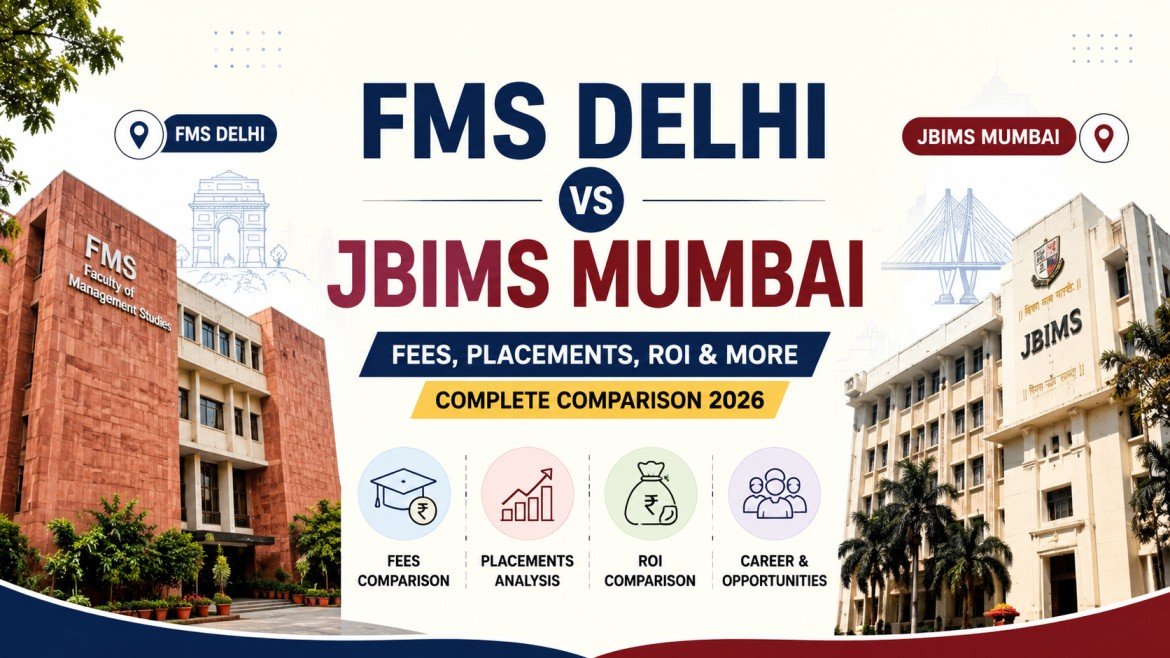
Quick Summary
- FMS Delhi offers exceptional ROI through low fees and strong placements, while JBIMS Mumbai provides powerful corporate exposure, particularly for finance-focused students seeking opportunities within Mumbai's business ecosystem.
When students compare FMS Delhi vs JBIMS Mumbai, the decision usually comes down to four questions: Which college has better placements? Which has lower fees? Which offers better ROI? And which campus is better for a particular career goal?
Both are among India's most respected management institutions, but they offer different advantages. FMS Delhi is known for its extremely low MBA fee relative to its strong national placement outcomes and broad recruiter base. JBIMS Mumbai, often associated with its strong corporate ecosystem and Mumbai location, has a particularly strong reputation among students interested in finance and corporate careers.
The latest available official information makes one point especially clear: the FMS vs JBIMS comparison should not be reduced to a single placement package. Fees, location, batch size, admission route, professional network, career preferences and the relevant placement year all matter.
For the 2026 admission cycle, FMS's official MBA information bulletin lists a semester fee of approximately ₹60,818, while JBIMS's official website shows that MMS admissions continue through the Maharashtra admission framework and qualifying examinations including MAH-CET, CMAT and CAT, depending on the applicable category and admission process.
This article compares FMS Delhi vs JBIMS Mumbai using the latest available verified information, while clearly identifying the year to which placement and fee figures apply.
Table of Contents
FMS Delhi vs JBIMS Mumbai at a glance
Understanding the programmes
FMS vs JBIMS fees comparison
FMS vs JBIMS placement comparison
Average, median and highest packages
ROI comparison
Admission process and entrance examinations
Batch size and peer group
Location advantage: Delhi vs Mumbai
Specialisations and career opportunities
Student outcomes beyond placement packages
Which college is better for finance?
Which college is better for consulting and general management?
Campus life and professional exposure
FMS vs JBIMS: who should choose which?
Frequently Asked Questions
Final verdict
FMS Delhi vs JBIMS Mumbai at a glance
| Factor | FMS Delhi | JBIMS Mumbai |
|---|---|---|
| Main full-time programme | MBA Full-Time | MMS |
| Location | Delhi | Mumbai |
| University association | University of Delhi | University of Mumbai ecosystem |
| 2026 programme fee information | Approximately ₹60,818 per semester for MBA | Fee depends on the applicable admission/category structure; official 2025-26 open-category MMS information listed ₹4,22,175 |
| Main admission route | CAT-based selection for MBA Full-Time | Maharashtra admission framework; qualifying examinations include MAH-CET, CMAT and CAT |
| Latest official final placement report available | Final Placement Report 2024-26 | Unified Final Placement Report 2024-26 listed on official website |
| Career environment | Strong national recruiter access across functions | Strong Mumbai corporate and financial ecosystem |
| Major strength in the comparison | Exceptional fee-to-placement value | Strong corporate network and Mumbai location advantage |
The most important caution in an FMS vs JBIMS comparison is that placement statistics must always be matched with the correct graduating batch and placement season. FMS has published a final placement report for the 2024-26 batch, while JBIMS currently lists a Unified Final Placement Report for the 2024-26 batch on its official placement reports page.
Understanding the difference between FMS Delhi and JBIMS Mumbai
FMS Delhi offers a two-year full-time MBA and is one of the most widely discussed public management institutions in India because of its combination of low academic fees and strong corporate outcomes. The MBA programme includes core management education, electives, corporate interaction and a summer internship component. FMS also states that candidates need a bachelor's degree meeting the applicable University of Delhi eligibility requirements, with final-year students eligible to apply subject to fulfilling the required conditions.
JBIMS Mumbai's flagship management offering is the MMS programme. Its official admissions information describes the programme as a two-year management course and states that admissions are conducted through the Maharashtra admission framework, with MAH-CET, CMAT and CAT among the qualifying examinations referenced by the institute.
Therefore, FMS vs JBIMS is not simply MBA versus MBA. Students are comparing two highly regarded management programmes with different university ecosystems, admission structures and regional advantages.
FMS vs JBIMS fees comparison
Fees are one of the biggest reasons students search for FMS vs JBIMS.
FMS Delhi MBA fees
For the MBA Full-Time 2026-28 programme, FMS's official information bulletin states that the semester fee is approximately ₹60,818 per semester. On a four-semester basis, this works out to approximately ₹2,43,272, before considering personal living expenses and other applicable costs. The institute also notes that fees may be revised according to University of Delhi instructions.
The low academic fee is one of FMS's most significant advantages. Even after considering accommodation, food, transport and personal expenses, the total financial burden can remain substantially lower than at many private management schools.
JBIMS Mumbai MMS fees
JBIMS fee structures can depend on the admission category and the applicable academic-year notification. The official JBIMS admission information for the 2025-26 CAP process listed an open-category fee of ₹4,22,175. This figure should not automatically be treated as the fee for every 2026 applicant because category structures and applicable charges may change. Students should verify the exact amount in the official admission notice applicable to their own category and admission cycle.
For the 2026-27 academic cycle, JBIMS has published admission announcements and CAP-related notices, so applicants should use the relevant official notification rather than relying on older third-party fee estimates.
FMS vs JBIMS fees: what the numbers mean
At the tuition level, FMS has a significant advantage because its officially stated 2026 semester fee produces an approximate two-year academic fee of ₹2.43 lakh. JBIMS has historically also been regarded as comparatively affordable, but students should check their specific 2026 category and admission notification before calculating the final cost.
For students focused heavily on affordability, FMS vs JBIMS often begins with an advantage for FMS.
However, tuition fee is only one part of total cost. Mumbai's living costs can be significantly different from Delhi's depending on housing choices, distance from campus and lifestyle. A student should calculate:
Academic fees
Hostel or rented accommodation
Food and daily expenses
Local transport
Laptop and study expenses
Professional travel and networking costs
Opportunity cost of the two-year programme
The better ROI is not always the college with the lowest fee alone. It is the institution that gives the student the strongest career outcome relative to the total cost incurred.
FMS vs JBIMS placements comparison
Placements are the second major part of the FMS vs JBIMS debate.
FMS has an official final placement report for the 2024-26 batch. According to that report, the final placement process took place in January 2026 for the main final-placement process, while lateral placements for eligible experienced candidates were conducted in December 2025. The report states that 119 companies participated in the recruitment process, with 103 companies rolling out offers.
The same report lists:
Batch size: 307 students
Students appearing for placements: 304
Students placed: 287
Students taking a placement holiday: 3
Companies participating: 119
Companies extending offers: 103
These figures provide important context. A placement package should not be read without understanding how many students participated, how many were placed and how the placement process was structured.
JBIMS's official website currently lists placement reports for multiple batches, including a Unified Final Placement Report 2024-26 and a Summer Placement Report 2024-26. Students comparing FMS and JBIMS should refer to the relevant official report for the same graduating period before comparing salary figures directly.
FMS Delhi placement outcomes for the 2024-26 batch
The latest published FMS final placement report for the 2024-26 batch provides a clear picture of the 2026 final placement season.
A recent summary based on the official FMS placement information reported the following figures for the 2026 placement outcome:
| FMS Delhi placement metric | Reported figure |
|---|---|
| Highest package | ₹110 LPA |
| Average package | ₹32.27 LPA |
| Median package | ₹29.59 LPA |
| Batch size | 307 |
| Students appearing | 304 |
| Students placed | 287 |
The figures above should be understood specifically as the reported outcome for the FMS 2024-26 graduating batch and the final placement process conducted in the 2026 placement season.
For students searching FMS vs JBIMS placements, the FMS data demonstrates why the institution continues to attract attention despite its relatively low programme fee.
Why direct placement-package comparisons can be misleading
Students often search:
FMS vs JBIMS average package
FMS vs JBIMS highest package
FMS vs JBIMS placement percentage
FMS vs JBIMS salary
But these comparisons require context.
An average package can change because of:
Batch composition
Work experience levels
Number of lateral placements
Economic conditions
Recruiter participation
Function-wise hiring
Domestic versus international compensation
Salary structure and variable pay
A higher highest package does not necessarily mean every student receives a proportionately better outcome. Similarly, an average package alone does not describe the entire salary distribution.
The median package can sometimes provide useful additional context because it represents the middle point in the salary distribution. Students should therefore compare the complete placement picture rather than selecting one headline number.
FMS vs JBIMS ROI comparison
ROI is where the FMS vs JBIMS comparison becomes especially interesting.
Why FMS is widely considered an exceptional ROI option
Using the officially stated 2026 semester fee of approximately ₹60,818, the approximate academic fee for the two-year FMS MBA is ₹2.43 lakh before living expenses. Against that fee, the reported 2026 placement outcome for the 2024-26 batch included an average package of ₹32.27 LPA and a median of ₹29.59 LPA.
This does not mean a student should simply divide salary by fee and treat the result as guaranteed financial return. Salary is pre-tax compensation, and students have personal expenses, accommodation costs and other financial considerations.
Nevertheless, the gap between programme cost and reported placement compensation explains why FMS is frequently considered one of India's strongest value propositions in management education.
JBIMS ROI
JBIMS also benefits from a public-institution positioning and comparatively affordable programme structure. Its Mumbai location can provide additional access to a dense corporate ecosystem.
The precise ROI calculation for a JBIMS applicant should use the fee applicable to that applicant's 2026 admission category and the latest official placement report for the corresponding graduating batch.
For many students, the decision is therefore not:
FMS has ROI and JBIMS does not.
The more accurate question is:
Which college offers the better ROI for my intended career, admission probability, location preference and total cost of attendance?
Which college is better for finance: FMS or JBIMS?
For students strongly focused on finance, the FMS vs JBIMS decision requires attention to location and professional ecosystem.
Mumbai is India's most prominent financial and commercial centre. The city provides proximity to banks, financial institutions, investment companies, consulting firms, corporate headquarters and a large professional network.
JBIMS has long been associated with strong corporate exposure in Mumbai. For students who want to build careers in finance, corporate banking, investment-related roles, financial markets or other Mumbai-centred opportunities, this ecosystem can be strategically valuable.
However, FMS should not be dismissed for finance. FMS has access to a national recruiter base and a large corporate ecosystem in Delhi NCR. Students should evaluate the latest recruiter participation, role mix and alumni network rather than assuming that one location automatically guarantees a particular role.
Choose JBIMS more seriously if:
You strongly prefer Mumbai as a long-term professional location.
Your career interest is heavily connected to the Mumbai corporate ecosystem.
You value the institute's historical network and alumni presence in business and finance.
You are comfortable with the relevant Maharashtra admission route.
Choose FMS more seriously if:
You want a broader national placement environment.
Extremely low academic fees are a major decision factor.
You are comfortable competing through the CAT-based FMS admission process.
You want flexibility across consulting, finance, marketing, general management and other corporate functions.
Which college is better for consulting and general management?
FMS is particularly attractive for students who want broad exposure to major corporate functions.
Its official corporate relations information highlights the presence of leading organisations across industries and describes a placement structure that includes summer internships, lateral placements and final placements.
For consulting and general-management aspirants, students should evaluate:
Recruiters visiting in the latest season
Number of roles in the desired function
Alumni network
Prior work experience
Case competition culture
Internship opportunities
Pre-placement offer potential
The college name alone cannot replace individual preparation. Two students at the same institution may achieve very different outcomes depending on their profile, academics, work experience, communication skills and recruitment preparation.
FMS vs JBIMS admission process
Admission difficulty is an important part of the decision.
FMS Delhi admission
FMS's official MBA Full-Time eligibility information states that candidates need a bachelor's degree after twelve years of schooling with at least 50% marks for the unreserved category, with different requirements for applicable reserved categories according to University of Delhi rules. Final-year students may also apply subject to fulfilling the programme conditions.
The official 2026 information bulletin also provides the applicable programme details and states that applicants should follow the official FMS admission process and notifications.
JBIMS Mumbai admission
JBIMS states that admission to its two-year MMS programme is conducted through the DTE CAP process and identifies MAH-CET, CMAT and CAT as qualifying examinations. Separate merit processes apply to the relevant Maharashtra and All India admission categories.
Therefore, students should not assume that the admission strategy for FMS and JBIMS is identical.
FMS vs JBIMS entrance strategy
A practical approach is to plan around the examinations accepted for the programmes you are targeting.
If FMS is your primary target, CAT performance becomes central.
If JBIMS is your primary target, you should carefully understand the relevant Maharashtra admission rules and the qualifying examination accepted for your category and admission route.
Students who want to maximise options may consider building an examination strategy that keeps multiple strong management institutions open.
Batch size and peer group
Batch size affects several aspects of the MBA experience:
Classroom diversity
Competition during placements
Alumni-network scale
Club and committee opportunities
Faculty interaction
Elective availability
FMS's official 2024-26 final placement report lists a batch size of 307 students, with 304 students appearing for placements.
When comparing FMS vs JBIMS, students should verify the sanctioned intake and actual batch size applicable to their own admission cycle rather than relying on old estimates.
A smaller batch can sometimes provide a tighter peer network. A larger batch can create a broader alumni base and more diverse student community. Neither is automatically better.
Delhi versus Mumbai: location matters more than many students realise
The FMS vs JBIMS comparison is also a Delhi-versus-Mumbai decision.
FMS Delhi location advantage
Delhi and the NCR region offer access to:
Consulting companies
Technology companies
FMCG organisations
Startups
Corporate headquarters
Government and policy institutions
Large professional networks
Students interested in opportunities across North India may find this ecosystem convenient.
JBIMS Mumbai location advantage
Mumbai offers direct proximity to a major concentration of:
Financial institutions
Banks
Financial services firms
Corporate headquarters
Media companies
Consulting and professional services firms
Investment-related organisations
For some careers, being located in Mumbai can create more frequent opportunities for networking, guest lectures, competitions and industry interaction.
The better city is therefore a personal decision.
If you already know where you want to build your career, location can become a significant factor.
Specialisations and career flexibility
Both institutions prepare students for careers across major management functions.
Students should avoid choosing only on the basis of a general ranking or package figure. Instead, identify the role you want after graduation.
Ask yourself:
Do I want consulting?
Do I want finance?
Do I want marketing?
Do I want product management?
Do I want operations?
Do I want a general-management role?
Do I want to work in Mumbai?
Do I want to work in Delhi NCR?
Am I likely to change functions after my MBA?
The best college for one student may not be the best college for another.
Student outcomes: looking beyond the placement package
A good FMS vs JBIMS comparison should include more than salary.
Student outcomes can include:
Role quality
Company quality
Long-term career growth
Alumni access
Professional network
Leadership opportunities
Internship experience
Geographic flexibility
Entrepreneurship exposure
Career-switching ability
A student receiving a lower initial package in a role aligned with long-term goals may achieve a better career outcome than someone accepting a higher package in a role they do not want.
This is why students should examine the function-wise and industry-wise details in official placement reports whenever available.
FMS vs JBIMS for freshers
Freshers should pay special attention to the learning environment and career transition.
An MBA can provide:
Structured exposure to multiple business functions
Internship experience
Corporate projects
Alumni mentoring
Placement preparation
Leadership opportunities
FMS may be especially attractive for freshers seeking a high-value programme with strong placement outcomes and a comparatively low fee.
JBIMS may be especially attractive for freshers who want to build their careers through the Mumbai corporate ecosystem.
The better option depends on the student's exam performance and career preference.
FMS vs JBIMS for candidates with work experience
Candidates with prior experience should evaluate how their background connects with the placement market.
For FMS, the latest final placement report distinguishes between lateral placements for students with more than 18 months of pre-MBA work experience and the main final placement process.
Experienced candidates should ask:
Will my previous industry experience be valued?
Can I move into a new function?
Do recruiters hire for lateral roles in my domain?
Does the alumni network support my intended transition?
Work experience can influence not only admission profiles but also the type of opportunities available during recruitment.
FMS vs JBIMS: campus experience and student life
Management education is not limited to classroom lectures.
A strong B-school experience includes:
Student committees
Case competitions
Corporate competitions
Guest lectures
Cultural events
Alumni interaction
Leadership opportunities
Internship preparation
FMS's placement report for the 2024-26 batch states that the institute hosted more than 150 leadership and corporate-interaction sessions through its Arthashastra series over the year, illustrating the role of industry interaction in the broader student experience.
JBIMS's official admissions page similarly describes student life as including lectures, guest interactions and committee activities.
Students who receive offers from both institutions should consider visiting campus if possible and speaking with current students or recent alumni.
Alumni network
Alumni networks become increasingly valuable after graduation.
A strong network can help with:
Job transitions
Industry information
Career mentoring
Referrals
Entrepreneurship
Leadership development
JBIMS has a long-established identity in Indian management education and benefits from its connection with generations of business professionals.
FMS also has a substantial alumni network across consulting, finance, marketing, technology, entrepreneurship and senior management.
The right question is not simply which network is larger.
Ask:
Which network is more relevant to the career I want to build?
FMS vs JBIMS: brand value
Both names carry significant recognition in Indian management education.
FMS's brand is strongly connected with:
University of Delhi
CAT-based admissions
Low programme fees
Strong corporate placements
High ROI
JBIMS's brand is strongly connected with:
Mumbai
Long institutional legacy
Corporate ecosystem
Strong alumni presence
Affordable management education relative to many private B-schools
Brand value matters, but it is not static. Your own academic performance, internships, skills and professional relationships will determine how effectively you convert the MBA opportunity into long-term career growth.
FMS vs JBIMS: a practical decision framework
If you receive admission opportunities from both institutions, consider scoring each option against your priorities.
Cost and financial pressure
If minimising academic fees is your highest priority, FMS has a strong advantage based on its officially stated 2026 semester fee.
Mumbai career plans
If you specifically want to establish your career in Mumbai, JBIMS deserves serious consideration because of its location and professional ecosystem.
National flexibility
If you want broad geographic flexibility and strong national recruiter exposure, FMS is a highly attractive option.
Finance interest
Students strongly interested in finance should evaluate JBIMS's Mumbai ecosystem alongside the latest official role and recruiter data.
CAT performance and admission probability
Your actual entrance score and eligibility can determine which institution is realistically available.
Long-term fit
Do not select a college solely because a friend prefers it or because one online ranking places it above another.
Choose the institution that aligns with your career strategy.
FMS vs JBIMS: advantages of FMS Delhi
FMS may be the better choice if you prioritise:
Very low academic fees
Strong reported placement outcomes
High fee-to-placement value
Delhi NCR corporate access
Broad career flexibility
A large and diverse management ecosystem
National recruiter exposure
The officially stated 2026 fee and the reported 2026 placement results for the 2024-26 batch create a particularly strong value proposition.
FMS vs JBIMS: advantages of JBIMS Mumbai
JBIMS may be the better choice if you prioritise:
Mumbai as a long-term career destination
Strong corporate proximity
Finance-oriented ecosystem access
Institutional legacy
A public-institution fee structure
Maharashtra management admission opportunities
The official JBIMS website continues to publish current admission announcements and placement reports, making it important for applicants to use the correct academic-year documents when making a final decision.
Which is better: FMS Delhi or JBIMS Mumbai?
There is no single answer for every student.
For pure fee-to-placement value, FMS Delhi is extremely difficult to beat because its 2026 MBA academic fee is approximately ₹2.43 lakh for four semesters based on the official stated semester fee, while the latest reported placement outcome for the 2024-26 graduating batch showed strong compensation figures.
For students focused on Mumbai, finance and the city's corporate ecosystem, JBIMS can be a highly compelling choice.
For broad national opportunities, consulting, general management and exceptional ROI, FMS may have an advantage.
The best answer to the FMS vs JBIMS question depends on what you want after graduation.
Frequently Asked Questions
Is FMS Delhi better than JBIMS Mumbai?
Neither institution is universally better. FMS is especially strong on low academic fees and reported placement outcomes, while JBIMS offers a powerful Mumbai corporate ecosystem and long-standing management legacy.
Which has better ROI, FMS or JBIMS?
FMS has an exceptional fee-to-placement proposition based on its officially stated 2026 MBA fee of approximately ₹60,818 per semester and the reported placement outcomes for the 2024-26 graduating batch. JBIMS can also offer strong value, but students should calculate ROI using their applicable admission-category fee and the latest official placement data.
What are the FMS Delhi MBA fees?
For the MBA Full-Time 2026-28 programme, the official FMS information bulletin states that the semester fee is approximately ₹60,818, which is approximately ₹2,43,272 across four semesters, subject to applicable revisions and other expenses.
What is the latest FMS Delhi average package?
A recent 2026 summary based on the FMS 2024-26 placement outcome reported an average package of ₹32.27 LPA, with a median of ₹29.59 LPA and a highest package of ₹110 LPA. Students should interpret these figures specifically in the context of the 2024-26 batch and 2026 placement season.
Which entrance exams are accepted for JBIMS MMS?
JBIMS states that MAH-CET, CMAT and CAT are among the qualifying examinations for its MMS admission process, with admissions conducted through the applicable Maharashtra framework and category-specific merit processes.
Which is better for finance, FMS or JBIMS?
JBIMS has a strong strategic advantage for students who want access to Mumbai's financial and corporate ecosystem. However, FMS also provides strong national career opportunities. Students should compare the latest recruiter and role mix for their intended finance career.
Is FMS better for freshers?
FMS can be highly attractive for freshers because of its comparatively low academic fees, strong corporate recruitment ecosystem and broad management exposure. Individual outcomes, however, depend heavily on the student's performance and career preparation.
Is JBIMS good for MBA-equivalent management education?
JBIMS's flagship full-time management programme is MMS. The institute officially describes it as a two-year management programme and provides admissions and placement information through its official channels.
Should I choose FMS if I want to work in Mumbai?
Not necessarily. FMS can provide national placement opportunities, including opportunities outside Delhi. If Mumbai is your specific long-term goal, however, JBIMS's location may offer additional ecosystem advantages.
Should I choose JBIMS if I want to work in consulting?
JBIMS can provide strong corporate opportunities, but students should compare the latest consulting recruiter participation and role availability with their alternatives. Career outcomes depend on both institute opportunities and individual preparation.
Final verdict: FMS Delhi vs JBIMS Mumbai
The FMS vs JBIMS decision should be based on your career objective rather than a single ranking or salary number.
Choose FMS Delhi if your priorities are exceptional ROI, very low academic fees, strong reported placement outcomes and broad national career opportunities.
Choose JBIMS Mumbai if Mumbai's corporate environment, finance ecosystem, institutional legacy and regional professional network align more closely with your goals.
If you are fortunate enough to receive opportunities from both, compare the latest official admission documents, your total cost of attendance, the most recent placement reports for the relevant graduating batches and the type of work you want to do after graduation.
A management degree is not only an investment in the first salary after graduation. It is an investment in your network, career direction, professional skills and long-term opportunities.
For most students, the right answer is therefore not simply FMS vs JBIMS: which college has the higher package?
The better question is:
Which institution gives me the strongest combination of affordability, career access and long-term fit?
Sources
For current admission and placement verification, refer to the official FMS MBA information bulletin and placement reports, and the official JBIMS admissions and placement-report pages.
Search Keywords
fms vs jbims, FMS Delhi vs JBIMS Mumbai, FMS vs JBIMS placements, FMS vs JBIMS fees, FMS vs JBIMS ROI, FMS Delhi placement, JBIMS placement, FMS Delhi MBA fees, JBIMS MMS fees, FMS Delhi average package, JBIMS average package, FMS vs JBIMS average package, FMS vs JBIMS highest package, FMS vs JBIMS median package, FMS Delhi ROI, JBIMS ROI, FMS Delhi MBA, JBIMS MMS, FMS Delhi admission, JBIMS admission, FMS vs JBIMS MBA, FMS vs JBIMS MMS, FMS Delhi vs JBIMS which is better, FMS or JBIMS for MBA, FMS or JBIMS for finance, FMS or JBIMS for consulting, FMS or JBIMS for marketing, FMS or JBIMS for placements, FMS or JBIMS for ROI, FMS or JBIMS for freshers, FMS vs JBIMS for work experience, FMS Delhi CAT cutoff, JBIMS MAH CET admission, JBIMS CAT admission, JBIMS CMAT admission, FMS Delhi CAT admission, FMS Delhi MBA 2026, JBIMS MMS 2026, FMS Delhi fees 2026, JBIMS fees 2026, FMS Delhi placement 2026, JBIMS placement 2026, FMS Delhi highest package, FMS Delhi median package, FMS Delhi average salary, JBIMS salary package, best ROI MBA college India, affordable MBA colleges India, low fee MBA colleges India, best public MBA colleges India, top MBA colleges Delhi, top MBA colleges Mumbai, FMS Delhi review, JBIMS Mumbai review, FMS Delhi vs JBIMS review, FMS Delhi student life, JBIMS student life, FMS Delhi campus, JBIMS Mumbai campus, FMS Delhi recruiters, JBIMS recruiters, FMS Delhi finance placements, JBIMS finance placements, FMS Delhi consulting placements, JBIMS consulting placements, FMS Delhi marketing placements, JBIMS Mumbai corporate exposure, FMS Delhi corporate exposure, FMS Delhi alumni network, JBIMS alumni network, FMS Delhi location advantage, JBIMS Mumbai location advantage, Delhi vs Mumbai MBA, MBA ROI comparison India, FMS Delhi batch size, JBIMS batch size, FMS Delhi placement report, JBIMS placement report, FMS 2024-26 placement report, JBIMS 2024-26 placement report, FMS Delhi semester fees, JBIMS open category fees, FMS Delhi admission eligibility, JBIMS MMS eligibility, FMS Delhi CAT strategy, JBIMS MAH CET strategy, best MBA for finance in Mumbai, best MBA for consulting in Delhi, FMS vs JBIMS salary comparison, FMS vs JBIMS career opportunities, FMS vs JBIMS alumni, FMS vs JBIMS location, FMS vs JBIMS campus life, FMS vs JBIMS total cost, FMS vs JBIMS living expenses, FMS Delhi value for money, JBIMS value for money, FMS Delhi placement rate, JBIMS placement statistics, FMS vs JBIMS admission difficulty, FMS Delhi selection process, JBIMS CAP process, FMS Delhi corporate relations, JBIMS MMS programme, FMS Delhi MBA programme, best B-school ROI India, FMS Delhi package vs fees, JBIMS package vs fees, FMS vs JBIMS comparison 2026, FMS Delhi career outcomes, JBIMS student outcomes, FMS vs JBIMS decision, FMS Delhi or JBIMS Mumbai, should I choose FMS or JBIMS
Long-Tail & Short-Tail Searches
FMS vs JBIMS, FMS Delhi vs JBIMS Mumbai which is better, FMS vs JBIMS fees and placements, FMS vs JBIMS ROI comparison, FMS Delhi vs JBIMS average package comparison, which college has better ROI FMS or JBIMS, should I choose FMS Delhi or JBIMS Mumbai, FMS Delhi MBA fees for 2026, what is the total fee of FMS Delhi MBA, what is the latest FMS Delhi placement package, what is the average package at FMS Delhi, is FMS Delhi worth it for MBA, is JBIMS worth it for MMS, which is better for finance FMS or JBIMS, which is better for consulting FMS or JBIMS, which is better for marketing FMS or JBIMS, FMS Delhi or JBIMS for freshers, FMS Delhi or JBIMS for experienced professionals, why is FMS Delhi famous for ROI, why is JBIMS famous in Mumbai, how to get admission in FMS Delhi, how to get admission in JBIMS Mumbai, what CAT score is required for FMS Delhi, which exams are accepted by JBIMS, can CAT students apply to JBIMS, can CMAT students apply to JBIMS, how does JBIMS CAP admission work, where should I study MBA Delhi or Mumbai, which college has lower fees FMS or JBIMS, which college has better placements FMS or JBIMS, which college has stronger finance opportunities, which college has better corporate exposure, what is the difference between FMS MBA and JBIMS MMS, FMS Delhi placement report 2026, JBIMS placement report 2026, FMS Delhi 2026 fee structure, JBIMS 2026 admission process, best MBA college for ROI after CAT, affordable top MBA colleges in India, low fee MBA with high placement package, is FMS better than JBIMS, is JBIMS better than FMS for Mumbai jobs, which B-school is better for long-term career growth, how to compare MBA colleges by ROI, FMS Delhi vs JBIMS for salary growth, FMS vs JBIMS for finance career, FMS vs JBIMS for corporate career, FMS vs JBIMS for consulting career, FMS Delhi versus JBIMS Mumbai student outcomes, which MBA college should I choose after CAT, FMS vs JBIMS alumni network comparison, FMS vs JBIMS location advantage, FMS Delhi versus JBIMS total cost comparison, FMS Delhi and JBIMS placement comparison.
Key Takeaways
FMS Delhi stands out for its exceptionally low fees and strong placement outcomes.
JBIMS Mumbai offers a major advantage for students targeting Mumbai-based corporate and finance careers.
FMS generally provides stronger fee-to-placement ROI for cost-conscious MBA aspirants.
JBIMS benefits from Mumbai's extensive financial and corporate ecosystem.
Both institutes offer strong alumni networks and career opportunities.
FMS is particularly attractive for consulting, general management, analytics and broad corporate roles.
JBIMS can be a strong choice for finance, banking and Mumbai-focused career goals.
Students should compare the latest official placement reports instead of relying only on older salary figures.
Total MBA cost should include living expenses, accommodation and other personal costs, not only tuition fees.
The best choice depends on your career goals, preferred location, admission options and long-term professional plans.

Ask a question
Still confused? Leave your question and our team will help you.