
Quick Summary
- EMPI Business School is located in Satbari, Chattarpur, New Delhi.
- EMPI lists five main PGDM programme options.
- The programmes cover General Management with Marketing and Finance, Advertising Communication, Human Resource Management, International Business, and Research & Business Analytics.
- The full-time PGDM programmes are described as two-year programmes.
- EMPI's published eligibility criteria include a bachelor's degree of at least three years and a minimum of 50% graduation marks.
- Entrance exams listed by EMPI include CAT, MAT, XAT, CMAT, GMAT and ATMA.
- The admission process includes academic evaluation, entrance-exam scores, group discussion and personal interview.
- EMPI describes a compulsory summer internship lasting six to eight weeks.
- The published 2026–28 PGDM course fee is ₹9.75 lakh.
- Residential lodging and boarding charges are listed separately at ₹2.30 lakh for two years.
- EMPI's official placement page reports a ₹22 LPA highest package and an ₹8.5 LPA average package for the Class of 2025.
- Applicants should confirm current fees, course availability, admission dates, placement details and eligibility through official EMPI sources before applying.
EMPI Business School New Delhi Courses & Programs 2026: PGDM Specialisations, Fees, Duration & Eligibility
Introduction to EMPI Business School New Delhi
EMPI Business School New Delhi is a management education institution offering postgraduate diploma programmes for students who want to build careers in business, marketing, finance, human resources, international business and analytics. The institution promotes an AI-infused management curriculum, practical learning, industry interaction, internships and professional development.
For students researching EMPI Business School New Delhi courses for 2026, the main areas to evaluate are programme options, eligibility, entrance examinations, fees, academic structure, specialisations, placement information and the learning environment. EMPI's official website lists five principal programme options: PGDM in General Management, PGDM in Advertising Communication, PGDM in Human Resource Management, PGDM in International Business, and PGDM in Research & Business Analytics. The General Management programme includes Marketing and Finance specialisation areas. Applicants should verify the programme title and available options in the current admission portal before applying. (Official programmes)
This guide explains the programmes and admission information published by EMPI, while identifying details that students should confirm directly with the institution for their intended intake.
1. EMPI Business School New Delhi: Overview
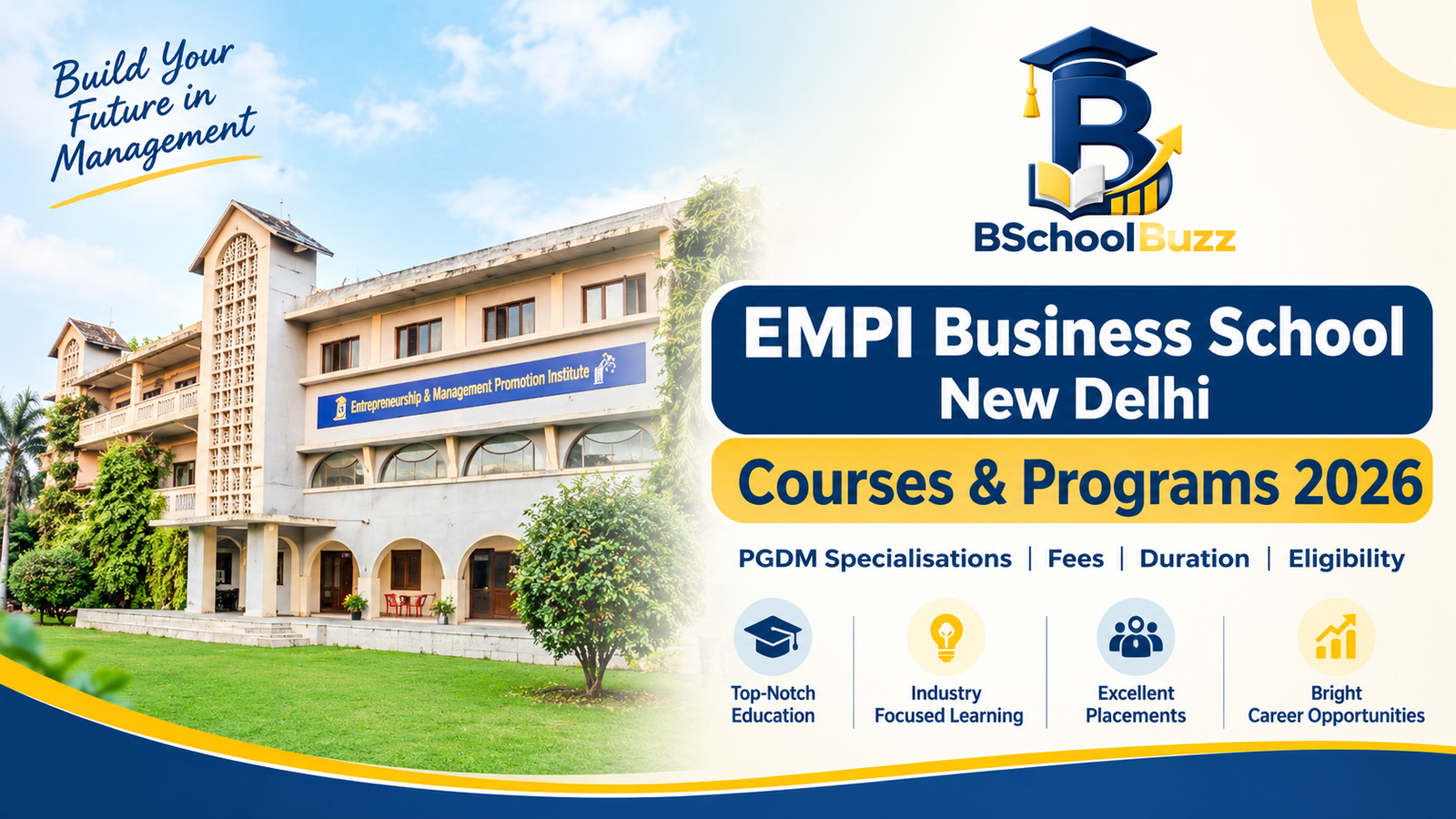
EMPI Business School is located at Ansal Villas, Satbari, Chattarpur, New Delhi. Its official contact page identifies the location as New Delhi – 110074. The campus offers residential facilities, and the institution describes its learning environment as a campus-based, community-oriented setting. (Official contact page)
Key details at a glance
| Detail | Information |
|---|---|
| Institution | EMPI Business School |
| Location | Satbari, Chattarpur, New Delhi |
| Main qualification | Post Graduate Diploma in Management (PGDM) |
| Programme duration | Two years for the full-time PGDM programmes, as described by EMPI |
| Programme areas | General Management, Advertising Communication, Human Resource Management, International Business, Research & Business Analytics |
| General Management areas | Marketing and Finance |
| Teaching approach | Industry-oriented learning, case-based activities, projects and professional development |
| Internship | EMPI's programme information describes a compulsory summer internship |
| Entrance exams considered | CAT, MAT, XAT, CMAT, GMAT and ATMA are listed in the admissions information |
| Selection stages | Academic record, entrance-exam performance, group discussion and personal interview, among other factors |
| Residential facility | In-campus hostel options are described on the official website |
| Official website | https://empi.ac.in/ |
The information above summarises EMPI's published pages. The current admission portal and programme-specific documents should be treated as the final reference for fees, eligibility, selection details and deadlines. (Admissions, programmes)
What is a PGDM?
PGDM stands for Post Graduate Diploma in Management. It is a postgraduate management qualification offered by an institute rather than an MBA degree awarded directly by a university. Students considering a PGDM should check the institution's approval status, the exact programme name and any applicable equivalence provisions instead of assuming that every diploma has identical recognition.
A PGDM curriculum commonly covers business fundamentals and specialist management areas. Depending on the programme, it may include marketing, finance, human resources, research, analytics, international business, strategy, operations and business communication. Students should compare the actual curriculum and learning outcomes rather than judging a course solely by its title.
EMPI presents its PGDM programmes as AI-infused and industry-oriented, with emphasis on practical learning and professional development. The extent of AI-related learning, the software used and the projects required can vary by programme and should be confirmed through the current course structure. (EMPI official programmes)
2. Courses Offered at EMPI Business School in 2026
EMPI's official programme page lists five principal PGDM options. These programmes target different professional interests, so applicants should compare the curriculum and intended career direction before choosing one. (Official programme list)
Programme list
| Programme | Main focus | Suitable interests |
|---|---|---|
| PGDM (General Management – Marketing & Finance) | Business management with Marketing and Finance specialisation areas | Branding, sales, financial analysis, corporate finance and general management |
| PGDM (Advertising Communication) | Advertising, brand communication and marketing communication | Creative strategy, advertising, media, content and campaigns |
| PGDM (Human Resource Management) | People management and organisational development | Recruitment, HR operations, learning and development, employee relations |
| PGDM (International Business) | International markets and cross-border business | Export-import, global marketing, international trade and business development |
| PGDM (Research & Business Analytics) | Research, data interpretation and analytics-based business decisions | Business analysis, market research, analytics and decision support |
These are the programme titles published by EMPI. Applicants should check the current application form to confirm that the intended programme and any specific specialisation are available for their admission cycle.
PGDM in General Management – Marketing and Finance
This programme brings general management learning together with Marketing and Finance areas. Marketing concerns how organisations understand customers, communicate value, position products and develop commercial relationships. Finance focuses on financial information, investment decisions, financial risk and the management of organisational resources.
Students considering this option should ask how the curriculum allocates time between common management subjects and the two specialisation areas. They should also check which electives are available, whether dual specialisation is supported in the current structure, and how students select their preferred subjects.
PGDM in Advertising Communication
Advertising Communication is aimed at students interested in how brands communicate with audiences. Relevant learning areas may include consumer behaviour, advertising strategy, campaign planning, brand communication, media and digital marketing. The exact course content should be checked against the current programme curriculum.
This option may suit students who enjoy creative problem-solving but also want to understand audience research, communication objectives and campaign performance. Careers in this area can combine creativity with planning, client communication and analysis.
PGDM in Human Resource Management
Human Resource Management focuses on the people-related processes that help organisations function effectively. These may include recruitment, employee engagement, performance management, training, organisational behaviour, HR operations and talent development.
Students considering HR should explore whether they are more interested in people-facing work, policy and process management, employee development or HR analytics. These activities can require different strengths, even though they all sit within the wider human resources function.
PGDM in International Business
International Business examines how organisations operate across national borders. Relevant themes include global markets, international trade, cross-cultural communication, global marketing, sourcing, export-import processes and international business strategy.
This option may be worth considering for students interested in businesses that sell, source, distribute or operate internationally. Applicants should review the curriculum to see how the programme covers global business conditions, trade processes and the practical challenges of cross-border operations.
PGDM in Research & Business Analytics
Research & Business Analytics focuses on using information to understand business problems and support decisions. It can be relevant to students who enjoy interpreting data, investigating customer or market behaviour, preparing reports and identifying patterns that organisations can act on.
EMPI's official programme page describes Research & Business Analytics as a two-year full-time PGDM and discusses the use of AI in research and business decision-making. Students should verify the specific analytical methods, software tools, projects and assessment methods taught to the incoming batch. (Official programme page)
3. How to Choose the Right EMPI PGDM Programme
The best programme depends on your interests, strengths and career plans. A specialisation should not be chosen only because it is popular or because someone else recommends it. The subject matter should match the kind of work you want to learn and eventually perform.
Choose Marketing and Finance if you want business-function flexibility
The General Management option may be worth examining if you are interested in commercial roles, marketing, financial decision-making or broader business management. Review the current subject list to understand how Marketing and Finance are taught and what elective choices are available.
Choose Advertising Communication if you enjoy brands and communication
Advertising Communication may fit students who are interested in campaign ideas, brand identity, digital content, audience behaviour and marketing communication. Strong writing, presentation, creativity and analytical thinking can all be useful in this area.
Choose Human Resource Management if you are interested in people and organisations
HR may suit students who want to work with recruitment, employee development, HR operations, organisational culture or workforce planning. Communication, discretion, fairness and the ability to manage competing needs are valuable qualities in people-related roles.
Choose International Business if you are curious about global markets
International Business may be relevant to students who want to understand trade, overseas markets, global customers, cross-border supply chains and international business development. Interest in different cultures and the ability to understand how markets vary can be useful.
Choose Research & Business Analytics if you enjoy working with data
Analytics may fit students who like identifying patterns, testing assumptions, preparing reports and using evidence to make recommendations. Applicants should review the quantitative requirements and practical tools included in the programme so they can judge whether the course matches their current skills and learning goals.
Questions to ask before selecting a programme
Which subjects are compulsory, and which are electives?
What practical projects are part of the curriculum?
Does the programme include AI or analytics tools, and which ones?
What internship opportunities are available?
What roles have recent graduates pursued from this programme?
Is programme-specific placement information available?
What is the full fee for the intended intake?
Does the programme fit your preferred career path?
These questions help students compare programmes on substance rather than on labels.
4. Course Duration and Academic Structure
EMPI describes its full-time PGDM as a two-year programme using a semester system. The official programme information states that the academic calendar begins in July and that students are required to undertake a summer internship of six to eight weeks after the second semester of the first year. It also describes specialisation courses in the second year. Applicants should confirm the calendar and internship requirements for their own batch. (Official programme details)
What to expect during the programme
| Stage | Main purpose |
|---|---|
| Early coursework | Build a foundation in management and business functions |
| Specialist learning | Develop knowledge in the selected programme area |
| Practical learning | Apply concepts through cases, assignments, group work and projects where included |
| Summer internship | Gain exposure to a workplace and apply classroom learning |
| Second-year specialisation | Study more focused subjects linked to the selected programme |
| Career preparation | Develop communication, interview, presentation and workplace skills |
This table explains the general structure described by EMPI; it is not a substitute for the official semester-wise curriculum.
Why the summer internship matters
An internship can help students understand how business concepts are applied in an organisation. It may involve research, analysis, sales, operations, HR, marketing or other assignments depending on the employer and role.
Students should treat an internship as a learning opportunity, not merely a line on a résumé. They can prepare by setting clear learning goals, documenting their work, asking for feedback and reflecting on what they learned about the organisation and the chosen function.
Before admission, confirm the internship's duration, timing, assessment requirements and the level of support provided by the institution. Do not assume that a specific company or role is guaranteed.
How does dual specialisation work?
EMPI's programme page mentions dual specialisation as a programme highlight. Students should verify the current rules for selecting specialisations, the combinations available in their programme, any academic conditions and whether the option applies to every PGDM course. (Official programmes)
A dual-specialisation option may allow students to study more than one functional area, but it does not automatically mean every combination is available. The current curriculum and written academic rules should guide the decision.
5. EMPI Business School Eligibility Criteria
EMPI's admissions page states that applicants should hold at least a three-year bachelor's degree, or an equivalent qualification in any discipline recognised as eligible for postgraduate study, and have a minimum of 50% marks in graduation. The page also says final-year undergraduate students can apply, subject to submitting proof of graduation by the stated deadline. The current page should be checked for the exact deadline and any updated conditions. (Official admission criteria)
Basic eligibility overview
| Requirement | Information published by EMPI |
|---|---|
| Qualification | At least a three-year bachelor's degree or equivalent |
| Discipline | Any discipline, subject to recognition and eligibility rules |
| Minimum graduation marks | 50% |
| Final-year students | Eligible to apply, subject to submitting graduation proof by the deadline stated by EMPI |
| Work experience | Preferred but not mandatory, according to the admissions page |
Can students from any academic background apply?
EMPI's admissions page states that the qualifying bachelor's degree may be in any discipline, provided it meets the recognition and postgraduate-study eligibility requirements. Students from commerce, arts, science, engineering, business or other backgrounds should check whether their specific qualification meets the official criteria.
Eligibility and programme suitability are not the same. A student may meet the minimum academic criteria but still need to assess whether the curriculum, quantitative work, communication requirements and career pathways align with their strengths.
Can final-year students apply?
The official admission page indicates that final-year bachelor's degree students may apply. It also sets a deadline for providing proof of graduation. Because deadlines and admission rules can change, applicants should confirm the current wording before submitting their application and ensure that final results and documents can be provided on time.
Is work experience compulsory?
EMPI describes work experience as preferred but not mandatory. Fresh graduates are welcome to apply, while relevant work experience may receive consideration in the selection process. Applicants should not assume that experience guarantees admission or that freshers are disadvantaged automatically; the institution's stated overall selection criteria apply. (Official admission page)
6. Entrance Exams Accepted by EMPI Business School
EMPI's official admission page lists CAT, MAT, XAT, CMAT, GMAT and ATMA among the entrance-exam scores considered for selection. It also refers to state common entrance examinations in its selection criteria. The institution's page describes these scores as pre-qualifiers and states that the selection process also considers academic performance, group discussion and personal interview. (Official admission criteria)
Entrance exams listed by EMPI
| Exam | What applicants should do |
|---|---|
| CAT | Check the current admission cycle's accepted score requirements |
| MAT | Confirm the applicable score validity and admission instructions |
| XAT | Check whether the score is accepted for the intended programme and intake |
| CMAT | Confirm the current selection requirements |
| GMAT | Check which score format and validity period are accepted |
| ATMA | Confirm its role in the current selection process |
| State common entrance examinations | Ask the admissions team which examinations are accepted for the specific intake |
The official page lists the exams above, but it does not mean applicants should submit every score. Students should confirm which tests are accepted for the selected programme, whether any minimum score applies and how the score is evaluated.
Does EMPI use only entrance-exam scores?
No. The published selection information describes an overall evaluation. It includes academic performance in school and graduation, entrance-exam scores, group discussion and personal interview, with consideration for achievements, work experience and other activities. EMPI also states that applicants may be assessed through psychometric profile testing. (Official admissions page)
This means candidates should prepare a complete application rather than focusing exclusively on one test score. Academic consistency, communication, motivation, teamwork and evidence of initiative may also be relevant to the overall selection process.
7. EMPI Business School Admission Process for 2026
Applicants should use the current EMPI admission portal to confirm the steps and deadlines for the 2026 intake. The official website provides an admission page and an application link, but students should check the live portal for current forms, payment instructions and programme availability. (EMPI admissions)
Step-by-step application guide
Step 1: Select your programme
Review the current PGDM programme list and identify the programme that best fits your interests. Confirm its full title and availability for the intended intake.
Step 2: Check eligibility
Verify your qualifying degree, graduation marks and any conditions applicable to final-year students. If your academic background or qualification is unusual, request written clarification before applying.
Step 3: Review entrance-exam requirements
Check which accepted examination score you intend to submit. Confirm any minimum score, validity period or additional requirements that apply to the current intake.
Step 4: Complete the application form
Enter your academic details, contact information and programme preference carefully. Make sure the information matches your supporting documents.
Step 5: Pay the application fee
EMPI's admission page lists a non-refundable application fee of ₹1,113, including GST. Since fees can change, confirm the amount shown on the live application portal before payment. (Official admissions page)
Step 6: Prepare for the selection process
EMPI describes group discussion and personal interview as integral components of its selection process. Prepare to explain your academic background, interest in management, programme choice, career goals and relevant experiences.
Step 7: Follow the application status and instructions
Check the official portal and communications from the admissions team for updates, interview details, document requirements and any additional instructions.
Step 8: Review the offer before paying programme fees
If selected, read the offer letter carefully. Confirm the course, academic year, fee schedule, payment deadlines, refund policy and any conditions attached to admission.
This is a practical overview, not a guarantee of admission or a replacement for the current official application instructions.
How to prepare for the group discussion and interview
Candidates should stay informed about business and economic developments, practise explaining their opinions clearly and listen respectfully to other participants. In a group discussion, the ability to contribute relevant points, build on others' ideas and remain composed can be as important as speaking frequently.
For the personal interview, candidates should be ready to discuss why they selected the programme, what they understand about the specialisation and how they intend to use the qualification. Freshers can draw on academic projects, internships, volunteering, student activities and other genuine experiences.
Applicants should avoid memorising claims they cannot explain. A clear account of their interests, strengths and learning goals is more useful than giving rehearsed answers that do not reflect their actual experience.
8. EMPI Business School Fees for 2026–28
EMPI's official admission page publishes a fee schedule for the 2026–28 batch. It lists the PGDM course fee as ₹5,00,000 for the first year and ₹4,75,000 for the second year, for a total course fee of ₹9,75,000. The page separately lists residential lodging and boarding charges for campus residents. Applicants should verify the current fee schedule and any additional charges before making a payment. (Official fee details)
Published PGDM course fee
| Fee component | Amount |
|---|---|
| First-year course fee | ₹5,00,000 |
| Second-year course fee | ₹4,75,000 |
| Total course fee | ₹9,75,000 |
Residential lodging and boarding charges
| Residential charge | Amount |
|---|---|
| First year | ₹1,15,750 |
| Second year | ₹1,14,250 |
| Total residential charges listed | ₹2,30,000 |
The residential figures above are listed separately from the course fee. Students who plan to live on campus should ask what the charges cover, whether they are compulsory for particular categories and whether any deposits, taxes or other expenses are additional. The total payable amount should be calculated from the official offer and fee schedule for the student's intake. (EMPI admission page)
What should students include in their budget?
The course fee is only one part of the cost of pursuing a management programme. Depending on individual circumstances, students may need to budget for:
Hostel or residential charges.
Food and personal expenses not covered by residential fees.
Travel to and from campus.
Books, stationery and study materials.
Laptop, internet access and other learning tools.
Interview or internship-related travel.
Clothing and professional presentation expenses.
Any additional academic or administrative charges specified by the institution.
This list is for planning purposes. It does not mean every item is charged by EMPI or that all items are excluded from its published fees. Ask the admissions office for an itemised explanation of what the official fee includes.
Is the application fee refundable?
The official admissions page describes the application fee as non-refundable. Students should read the current payment and refund conditions before submitting the form. Application-fee rules and programme-fee refund rules are separate matters, so applicants should not assume that the same conditions apply to both. (Official admissions page)
How can students assess the financial value of a PGDM?
Compare the total cost with the quality and relevance of the curriculum, practical learning opportunities, faculty support, internship experience, career preparation and programme-specific placement outcomes. Do not base the decision only on the highest salary displayed on a website.
A useful comparison should include the full course fee, residential costs if relevant, likely personal expenses, financing costs and the kind of roles you realistically intend to pursue. Salary outcomes vary by student, employer, role, sector and market conditions, so a published package is not a guaranteed return for every student.
9. Curriculum and Teaching Approach
EMPI describes its PGDM learning model as industry-oriented and practical. Its official programme information highlights case-based learning, simulations, group activities, role play, experiential learning, live projects, corporate interactions and skill development. The current programme structure should be checked to understand which activities are required for each course. (Official programmes)
Management fundamentals
Students need a foundation in how organisations work. Depending on the programme, core management study may cover business functions, organisational behaviour, communication, financial concepts, marketing and strategy. These areas help students understand how decisions in one department affect the rest of a business.
Specialisation learning
Specialisation subjects give students a deeper focus in their selected field. Marketing students may study customer behaviour and brand strategy; finance students may focus on financial analysis and risk; HR students may explore workforce and organisational issues; international business students may study global markets; and analytics students may focus on research and data-based decisions.
The exact subject list and credit allocation should be checked in the official curriculum rather than inferred from the programme title.
AI-infused learning
EMPI promotes AI integration across its management programmes and highlights an AI and IoT lab. AI can support tasks such as analysing information, identifying patterns, preparing forecasts and automating repetitive work. However, the value of AI in a management programme depends on how students are taught to use tools responsibly, interpret outputs, protect data and evaluate the quality of recommendations.
Students should ask what AI-related subjects are taught in their chosen programme, which tools are used, whether students complete applied projects and how AI learning is assessed. Marketing, HR, finance and analytics may use AI in different ways, so the programme-specific curriculum matters.
Industry interaction and live projects
Industry talks, case studies and live projects can help students connect theory with business problems. They may expose students to how organisations make decisions, communicate with stakeholders and respond to practical constraints.
The quality of this exposure depends on the design of the activity and the student's participation. Before enrolling, ask what opportunities are part of the curriculum, whether projects are compulsory and how students are assessed.
Communication and professional development
Management work often involves explaining ideas, presenting findings, collaborating with colleagues and responding to feedback. EMPI highlights skill and personality development in its programme information. Students should check the current academic calendar for the specific workshops, mentoring sessions and professional-development activities available to their batch.
10. Internship and Practical Learning Opportunities
EMPI's programme page states that students undertake a compulsory summer internship after the second semester of the first year, with a duration of six to eight weeks. The page also highlights projects, on-job training and sector-focused capstone projects. Applicants should confirm the exact internship rules, evaluation requirements and placement-support arrangements for their intake. (Official programmes page)
What can students learn during an internship?
An internship gives students a chance to observe how a business function works in practice. Depending on the role, a student may help with market research, sales reporting, customer communication, recruitment coordination, financial analysis, operational reporting or data preparation.
A useful internship should help the student connect work tasks with what they have learned in class. Students can benefit by setting learning goals, requesting feedback, maintaining records of their responsibilities and reflecting on the skills they need to strengthen.
Does an internship guarantee a job?
An internship does not automatically guarantee a permanent job or a pre-placement offer. EMPI publishes a placement page with information about its placement activity, but students should distinguish between internship opportunities, pre-placement offers and final employment outcomes. (Official placement page)
Before admission, ask how internship opportunities are sourced, what support is provided, whether students can pursue their preferred sectors and how internship performance is evaluated. Do not assume that a specific employer, job title or stipend is guaranteed.
11. EMPI Business School Placements
Placements are an important factor for students comparing PGDM institutions, but placement figures need context. EMPI's official placement page publishes highlights for the Class of 2025, including the reported placement rate, highest package, average package and recruiter participation. The page lists 99% placed, a ₹22 LPA highest package, an ₹8.5 LPA average package and an ₹10.8 LPA average package for the top 18%. It also reports 107 recruiters participating and a highest pre-placement offer figure of ₹12.1 LPA after the first-year internship. (Official placement page)
Placement highlights published by EMPI
| Placement metric | Figure published for Class of 2025 |
|---|---|
| Students placed | 99% |
| Highest package | ₹22 LPA |
| Average package | ₹8.5 LPA |
| Average package for top 18% | ₹10.8 LPA |
| Recruiters participating | 107 |
| Highest PPO after first-year internship | ₹12.1 LPA |
These figures are taken from EMPI's official placement page. Applicants should review the complete report and ask how the placement rate is calculated, which students are included in the denominator and whether the salary figures refer to domestic roles, fixed pay, total CTC or another measure. A top-group average is not the average for the entire batch.
How should students interpret placement statistics?
The highest package represents the largest reported offer, not the salary most students should expect. The average package is more representative of the overall reported distribution, but it can be influenced by a small number of high offers. The median, where available, can provide another useful view of the middle outcome.
Placement statistics are most useful when accompanied by information about the batch size, number of eligible students, number seeking placements, number placed, salary definitions and the roles or sectors represented. Ask for the latest programme-specific report and confirm the batch year before comparing EMPI with another institution.
Does a high placement percentage guarantee a job?
No. A published placement percentage is a report of past outcomes for a defined group, not a guarantee of an individual student's result. Outcomes can vary depending on academic performance, internships, communication, technical skills, preferred location, market conditions and the roles a student is willing to consider.
Students should also ask whether the reported placement figure covers all students or only those who participated in the placement process. This distinction can materially affect comparisons between institutions.
What types of roles can PGDM graduates pursue?
Career paths depend on the chosen programme and the student's skills. Potential roles may include marketing executive, brand associate, financial analyst, HR executive, recruiter, international business development executive, research analyst, business analyst or analytics associate. These are examples of possible career directions, not a promise of placement into any specific role.
Students should compare these pathways with their interests and review the employers and job profiles shown in the latest official placement information.
12. Career Opportunities After EMPI PGDM Programmes
A PGDM can provide a foundation for entry-level management roles, but the actual career path depends on the student's specialisation, skills, internship experience and employer requirements. The following examples show how different programme areas can connect with work functions.
Marketing and Finance
Marketing-related opportunities can include sales, brand support, market research, customer relationship management, digital marketing and business development. Finance-related roles can include financial analysis, corporate finance support, banking operations, risk support and financial planning, depending on the candidate's skills and the employer's requirements.
Students should look at the job descriptions for their preferred roles and identify the analytical, communication and technical skills that employers expect.
Advertising Communication
Potential career areas include advertising coordination, media planning, brand communication, content strategy, digital campaign support and client servicing. These roles may require a combination of creative thinking, writing, research, organisation and the ability to measure campaign performance.
A portfolio of genuine projects or campaign work can help demonstrate practical skills, although its importance varies by employer and role.
Human Resource Management
Potential roles include HR operations, recruitment coordination, talent acquisition, learning and development, employee engagement and HR analytics support. Students interested in HR should build communication skills and learn how to handle information professionally and confidentially.
International Business
Career areas can include export-import coordination, international sales, global business development, trade documentation, market research and international supply chain support. Job requirements vary considerably, and some positions may require specialised trade knowledge, language skills or prior experience.
Research and Business Analytics
Potential roles include business analyst, market research analyst, reporting analyst, research associate and analytics support positions. Depending on the role, employers may expect proficiency in spreadsheets, statistics, data visualisation, SQL or other analytical tools. Students should confirm which technical skills their target jobs require and build them through practical work.
How to improve employability during the PGDM
Build a strong understanding of your chosen specialisation.
Practise presenting ideas and explaining analysis clearly.
Use projects to demonstrate problem-solving and teamwork.
Develop technical skills relevant to your preferred roles.
Treat the summer internship as an opportunity to gain practical experience.
Maintain a clear, accurate résumé and prepare examples of your contributions.
Ask for feedback and work on specific areas for improvement.
Research employers and job descriptions before interviews.
These steps can strengthen preparation, but they cannot guarantee a particular job or salary.
13. Campus and Residential Facilities
EMPI's official website identifies its residential campus at Ansal Villas, Satbari, Chattarpur, New Delhi. Its admissions page describes an in-campus hostel with single-, twin- and triple-sharing options. Students should confirm current availability, the room types offered for their intake and what is included in the residential charges. (Official contact page, admissions page)
What should students check before choosing a hostel?
Applicants should ask about room occupancy, meals, utilities, internet access, security arrangements, campus rules, maintenance, visitor policies and any additional charges. The published lodging and boarding figure should be checked against the written accommodation terms to understand exactly what it covers.
Students should also consider their daily routine, personal preferences, transport needs and whether a residential environment suits their circumstances. Campus life can support collaboration and networking, but the right arrangement varies by student.
14. How to Compare EMPI with Other PGDM Colleges
Comparing institutions is easier when the same criteria are used for each option. Students should avoid comparing one college's highest package with another college's average package, or one institution's tuition-only fee with another's full residential cost.
A practical comparison framework
| Factor | What to compare |
|---|---|
| Programme | Exact title, specialisation and curriculum |
| Approval and recognition | Current official regulatory approval and any applicable equivalence status |
| Eligibility | Degree requirements, minimum marks and entrance-exam rules |
| Selection | Entrance score, group discussion, interview and other criteria |
| Fees | Full programme fee, hostel charges and other compulsory costs |
| Academic structure | Duration, semester system, internship and project requirements |
| Practical learning | Case studies, live projects, industry interactions and software exposure |
| Placements | Latest batch, placement rate, average, median and highest package |
| Career fit | Roles and industries relevant to the student's goals |
| Location and living | Campus location, residential facilities, commute and living expenses |
Compare programme-specific placement outcomes
If a college publishes institution-wide placement figures, do not assume they apply equally to every programme. Ask for the data related to the programme and graduating batch you are evaluating. Also check whether figures are based on all enrolled students, placement participants or only students who received offers.
Compare the full cost, not just tuition
The total cost of attendance can include tuition, accommodation, food, transport, learning materials and other expenses. Where students use an education loan, interest and repayment terms also affect the financial decision.
A lower fee does not necessarily mean better value, just as a higher fee does not guarantee better outcomes. The decision should consider programme quality, affordability, learning opportunities and realistic career goals together.
15. Frequently Considered Questions Before Applying
Is EMPI Business School a university?
EMPI Business School presents its management programmes as PGDM programmes. Applicants should check the institution's current approval and recognition documents and confirm the exact qualification awarded. Do not describe a PGDM as a university MBA unless the relevant official documentation supports that wording.
Is a PGDM the same as an MBA?
An MBA is a degree, while a PGDM is a postgraduate diploma. Their status and equivalence depend on the institution and applicable regulatory provisions. Students should verify the recognition and equivalence status of the specific programme rather than assuming that every PGDM is automatically identical to an MBA.
Is EMPI suitable for fresh graduates?
EMPI's admissions page says fresh graduates may apply if they meet the stated eligibility requirements. The institution lists work experience as preferred but not mandatory. Applicants should evaluate the course structure, practical learning opportunities and career pathways to determine whether the programme fits their goals. (Official admissions page)
Should applicants choose a specialisation based only on placement figures?
No. Placement outcomes are one consideration, but the choice should also reflect interests, aptitude, curriculum, learning opportunities and long-term goals. Students should examine the roles offered to graduates in each programme and verify whether the placement data is programme-specific.
16. Final Checklist Before Submitting an Application
Before applying to EMPI Business School New Delhi for the 2026 intake, complete the following checks:
Confirm the exact programme title and its availability.
Read the current eligibility requirements.
Check which entrance-exam scores are accepted.
Verify the selection process and interview requirements.
Confirm the current application fee and total programme fee.
Review hostel charges and what the residential fee covers.
Check the latest curriculum, semester structure and internship requirements.
Request the latest placement information and clarify how the figures are calculated.
Read the offer, payment, withdrawal and refund conditions carefully.
Save the application confirmation, offer letter, official fee schedule and payment receipts.
For clarification, use the contact details listed on EMPI's official website. The admissions page lists the email address admissions@empi.ac.in and phone numbers +91 8800010971 and +91 8800010972. Confirm these details on the official contact page before relying on them. (Official contact page)
Conclusion
EMPI Business School New Delhi offers PGDM options across General Management with Marketing and Finance, Advertising Communication, Human Resource Management, International Business, and Research & Business Analytics. Its official information highlights a two-year full-time structure, a summer internship, industry-oriented learning and an AI-infused approach. The admissions page also publishes eligibility requirements, entrance-exam options and a fee schedule for the 2026–28 batch. (Programmes, admissions)
Before making a decision, applicants should verify the current course availability, complete fee structure, hostel costs, eligibility, selection stages and curriculum directly with EMPI. Placement figures should be read in context and compared using the same definitions across institutions. The most suitable programme is the one that fits your career interests, academic strengths, budget and preferred learning environment—not simply the one with the most attractive headline.
Key Takeaways
Compare the programmes carefully: Choose a specialisation based on your career interests and the curriculum.
Verify eligibility: The published minimum is 50% graduation marks with a qualifying bachelor's degree; check current conditions before applying.
Prepare for selection: Review the entrance-exam requirements and prepare for the group discussion and personal interview.
Budget for the complete cost: The published PGDM fee is ₹9.75 lakh, with residential charges listed separately.
Review the curriculum: Check the current subjects, AI-related learning, practical projects and internship requirements.
Interpret placement data correctly: The highest package is not a typical salary guarantee; review average, median and programme-specific data where available.
Check hostel terms: Confirm availability, room type, facilities and what the residential charges include.
Use official sources: Confirm the current intake, fee schedule, deadlines and selection process with EMPI before paying any amount.
Frequently Asked Questions
What courses are offered by EMPI Business School New Delhi?
EMPI lists PGDM programmes in General Management (Marketing and Finance), Advertising Communication, Human Resource Management, International Business, and Research & Business Analytics.
What is the duration of EMPI Business School PGDM courses?
EMPI describes its full-time PGDM programmes as two-year programmes. Applicants should verify the current structure for their chosen course.
What is the eligibility for EMPI Business School admission?
EMPI's published criteria include a bachelor's degree of at least three years or an equivalent qualification and a minimum of 50% marks in graduation. Confirm the current requirements before applying.
Which entrance exams are accepted by EMPI Business School?
The admissions page lists CAT, MAT, XAT, CMAT, GMAT and ATMA. It also refers to state common entrance examinations in its selection criteria.
What is the EMPI Business School PGDM fee for 2026–28?
The official admissions page lists a total course fee of ₹9.75 lakh, divided into ₹5 lakh for the first year and ₹4.75 lakh for the second year. Verify the latest fee schedule before payment.
What are the hostel fees at EMPI Business School?
The published residential lodging and boarding charges total ₹2.30 lakh for two years. Confirm current availability and exactly what the charges cover.
Does EMPI Business School provide internship opportunities?
EMPI's programme information describes a compulsory summer internship of six to eight weeks after the second semester of the first year. Confirm the current batch requirements with the institution.
What is the highest placement package at EMPI Business School?
EMPI's official placement page reports a highest package of ₹22 LPA for the Class of 2025. This is a reported past outcome, not a guarantee for future students.
What is the average package at EMPI Business School?
EMPI reports an average package of ₹8.5 LPA for the Class of 2025 and ₹10.8 LPA for the top 18%. Applicants should review the official placement information to understand how these figures are calculated.
Where is EMPI Business School located?
EMPI Business School's official contact page lists its residential campus at Ansal Villas, Satbari, Chattarpur, New Delhi – 110074. Check the official website for current contact details and directions.
Ask a question
Still confused? Leave your question and our team will help you.