
Quick Summary
- Alliance University eligibility 2027 is based on the requirements for the specific MBA programme and intake.
- The Alliance School of Business MBA is a two-year, full-time programme.
- The published general eligibility requirement is a bachelor’s degree with at least 50% aggregate marks.The official MBA page lists 45% aggregate marks for SC/ST candidates under the stated relaxation.
- Accepted entrance-test options include AMAT, GMAT, NMAT, CAT, XAT, MAT and CMAT.
- The general eligibility summary does not state a compulsory minimum duration of work experience.
- The selection process may include an oral extempore presentation, essay writing and a personal interview, according to the publisheadmissions information.
- Merit-based MBA scholarships are listed separately and may depend on entrance-test scores and academic performance.
- Alliance University’s official website displays admissions open for 2027–2028 and lists an MBA – July 2027 programme entry.
- Applicants should verify current deadlines, test-score conditions and final-year eligibility through the official admissions portal.
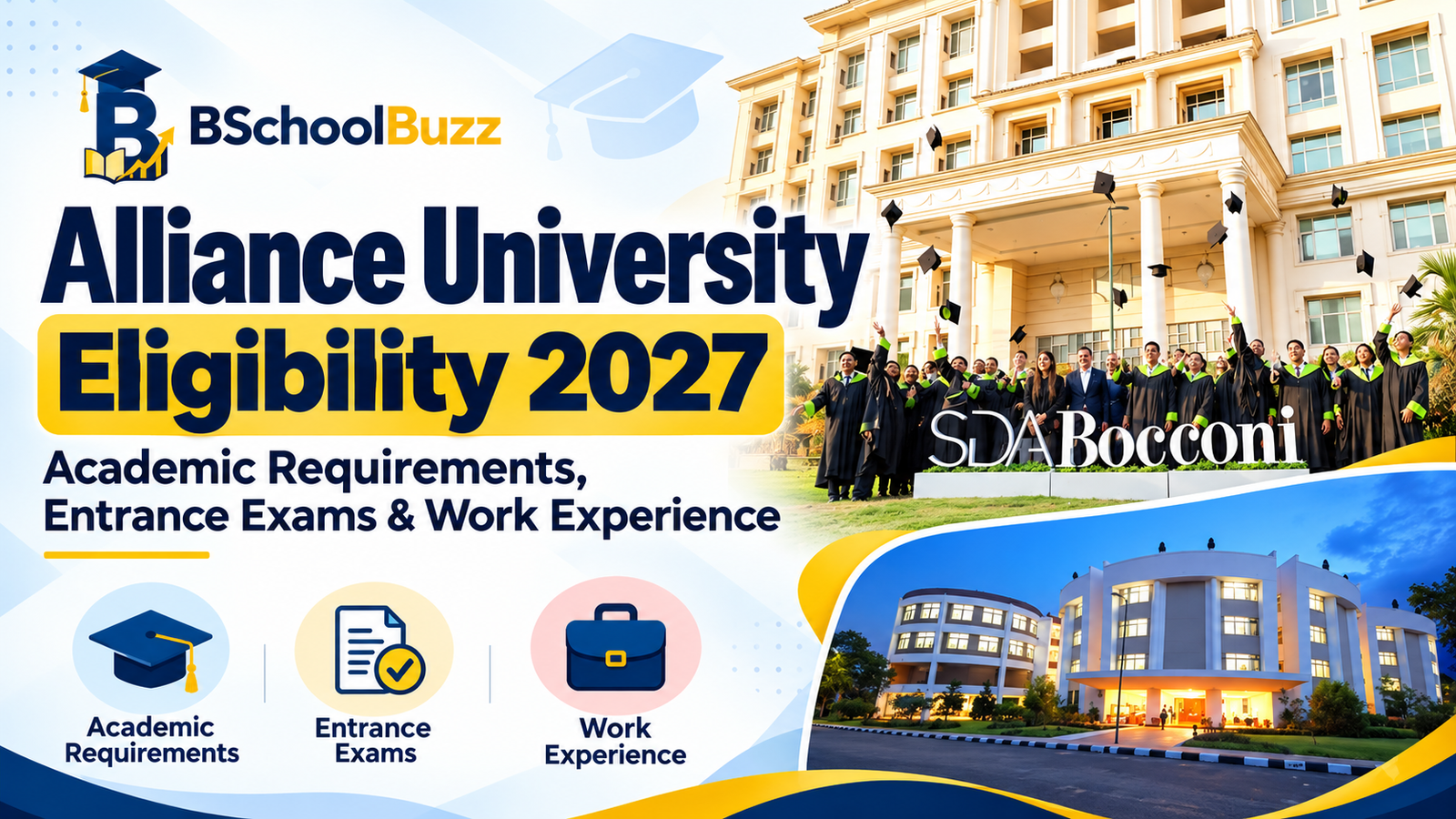
Alliance University Eligibility 2027: Academic Requirements, Entrance Exams & Work Experience
Introduction
Students planning to pursue an MBA at Alliance University in 2027 should understand the eligibility requirements before completing an application. Academic marks, entrance-test performance and the university’s selection process are important parts of admission planning. Applicants should also confirm which MBA programme they are applying to because Alliance University offers management education through different schools and programme formats.
This article focuses on the flagship Master of Business Administration (MBA) offered by Alliance School of Business. The university’s official MBA page lists a two-year, full-time programme and publishes eligibility criteria, accepted entrance tests, fee information, scholarships and selection details. Applicants should use the official page and the application portal to confirm the latest rules for their intended intake.
The most important starting point is the academic requirement: the published programme page specifies a bachelor’s degree with a minimum of 50% aggregate marks, with a 5-percentage-point relaxation for SC/ST candidates. It also lists management entrance tests, including CAT, GMAT, NMAT, XAT, MAT and CMAT, alongside the Alliance Management Aptitude Test (AMAT). Candidates must verify the exact requirements applicable to their application cycle before submitting documents or paying fees.
Table of Contents
Alliance University Eligibility 2027: Overview
Which MBA Programme Does This Guide Cover?
Academic Qualification Required for MBA Admission
Minimum Graduation Marks
Eligibility for Final-Year Students
Entrance Exams Accepted by Alliance School of Business
Is There a Fixed Entrance Exam Cutoff?
Work Experience Requirements
Documents to Prepare for MBA Admission
Alliance University MBA Selection Process
How to Strengthen Your Application
MBA Application Dates for 2027
Scholarships and Entrance-Test Scores
Common Eligibility Mistakes
Frequently Asked Questions
Conclusion
About MBA Compass
1. Alliance University Eligibility 2027: Overview
Alliance University eligibility 2027 refers to the conditions candidates must satisfy to apply for the MBA programme. These conditions include the minimum educational qualification, academic performance and entrance-test requirements. Applicants should check the current admission page for any updates concerning application rounds, deadlines and selection stages.
The university’s published MBA page identifies the following general conditions:
| Eligibility factor | Published information |
|---|---|
| Programme covered | Master of Business Administration (MBA), Alliance School of Business |
| Programme duration | Two years, full-time |
| Academic qualification | Bachelor’s degree |
| Minimum aggregate marks | 50% for the general category |
| SC/ST relaxation | The published page lists 45% for SC/ST candidates |
| Entrance-test options | AMAT, GMAT, NMAT, CAT, XAT, MAT and CMAT |
| Selection | Academic record, entrance-test performance and further selection stages as prescribed |
| Work experience | No compulsory minimum duration stated in the general eligibility summary on the MBA page |
| Official source | Alliance School of Business MBA |
The university’s page mentions the minimum academic qualification and accepted tests, but applicants should read the live application instructions for the complete requirements. In particular, the test-score rules and deadlines may be revised for different admission rounds.
2. Which MBA Programme Does This Guide Cover?
Alliance University offers management programmes through different academic units. This guide concerns the MBA offered by Alliance School of Business, rather than automatically applying the criteria of Alliance Ascent College, Alliance Global Business School or another specialised MBA programme.
This distinction matters because programme names can be similar while eligibility rules, fees, course structures, selection steps and application schedules differ.
The Alliance School of Business MBA is described on the official website as a two-year, full-time programme. Its curriculum includes core management subjects, electives, an industry internship programme and a dissertation. The university also describes opportunities to select elective areas based on students’ interests and skills, subject to programme requirements.
Before applying, verify these details:
The name of the academic school offering the programme.
Whether the application is for the general MBA or a specialised MBA.
The relevant intake, such as the July 2027 intake or another published batch.
The accepted entrance tests for that specific programme.
The programme-specific fee structure and selection process.
Official programme page: Alliance University MBA.
3. Academic Qualification Required for MBA Admission
The first major requirement for Alliance University MBA admission is a bachelor’s degree. The official programme page specifies a bachelor’s degree with the required aggregate marks.
Applicants from different undergraduate disciplines should check the published requirement rather than assume that only business-related graduates can apply. The general eligibility summary identifies a bachelor’s degree and does not restrict the degree to a single academic stream.
Students who have completed BBA, BCom, BA, BSc, BTech or another undergraduate programme should check their marks and degree status against the current rules. The precise acceptance of a qualification, including qualifications obtained outside India, should be confirmed with the university if the case is unusual.
Why the undergraduate qualification matters
An MBA builds on the knowledge and skills students develop during their earlier education. The university’s eligibility requirement establishes the minimum academic qualification needed to apply. It does not mean that a particular undergraduate subject automatically guarantees admission.
Candidates should provide accurate information about their degree, awarding institution, graduation year and marks. If the university requests transcripts, provisional certificates or other proof, those documents should be submitted in the format specified by the application portal.
What if the degree is not yet complete?
Candidates who are still pursuing graduation should not assume that the same document requirements apply to them as to graduates. The published MBA summary identifies a bachelor’s degree as the academic requirement, but the exact final-year application conditions should be checked in the current admission instructions.
Before submitting an application as a final-year student, confirm whether the relevant intake permits provisional applications and what deadline applies to final results and degree documents.
4. Minimum Graduation Marks
The official Alliance School of Business MBA page specifies the following minimum academic marks:
General category: 50% aggregate in a bachelor’s degree.
SC/ST candidates: 45% aggregate, reflecting the published 5-percentage-point relaxation.
Applicants should verify the category conditions and supporting documentation required for any relaxation. Do not assume that the same relaxation applies to every category unless the current programme instructions say so.
Eligibility by academic category
| Applicant category | Published minimum graduation marks |
|---|---|
| General | 50% aggregate |
| SC/ST | 45% aggregate |
| Other categories | Confirm the applicable current policy with the university |
The table reflects the general eligibility summary on the official MBA page. The university’s current admissions policy and application portal should be treated as the final authority for individual cases.
How should aggregate marks be checked?
Candidates should refer to their official undergraduate marksheets or consolidated transcript. If the university awards grades or CGPA rather than a percentage, use the conversion method issued by the awarding institution. Avoid applying a self-created formula.
For example, a candidate with a CGPA should check whether their university provides a formal conversion certificate or a stated formula. If the method is not clear, the applicant should ask Alliance University how to report the result in the application.
Does meeting the minimum marks guarantee admission?
No. The minimum percentage is an eligibility condition, not an admission guarantee. Candidates must also follow the applicable entrance-test and selection requirements. A complete application should accurately represent the applicant’s academic record and meet the deadlines set by the university.
5. Eligibility for Final-Year Students
Final-year applicants should review the current application instructions carefully. The general programme summary states that applicants need a bachelor’s degree, but the precise conditions for students awaiting final results should be confirmed for the intended admission round.
If the university permits final-year applications for the relevant intake, applicants should be prepared to submit the final marksheets and degree documents within the deadline specified by the admissions team.
Final-year applicant checklist
Before applying, prepare or verify:
Class 10 and Class 12 academic records, if requested.
Available undergraduate semester-wise or year-wise marksheets.
Current college or university details.
Expected graduation date.
Any provisional certificate or bonafide document required by the portal.
The deadline for submitting final graduation results.
The procedure to follow if a result or certificate is delayed.
These steps help applicants avoid a common problem: completing an application without understanding the conditions attached to pending graduation results.
What if a final-year result is delayed?
Do not rely on deadlines published for an earlier intake. Contact the admissions office and ask which document can be submitted temporarily, whether a provisional result is acceptable and when the final certificate must be provided. Keep the response or official instruction for reference.
6. Entrance Exams Accepted by Alliance School of Business
Entrance-test performance is an important part of the MBA application. The official Alliance School of Business MBA page lists the following accepted test options:
Alliance Management Aptitude Test (AMAT)
GMAT
NMAT
CAT
XAT
MAT
CMAT
Applicants should verify that their test and score are accepted for the specific 2027 intake. Test validity, score-reporting requirements and any programme-specific conditions should be confirmed on the official admissions page.
Entrance exams and what to verify
| Entrance test | What the applicant should check |
|---|---|
| CAT | Confirm the accepted examination year and score-reporting process |
| GMAT | Verify score validity and the accepted test format, if specified |
| NMAT | Check the accepted test window and score-submission requirements |
| XAT | Confirm the applicable test year and score conditions |
| MAT | Check whether the score is accepted for the intended admission round |
| CMAT | Confirm score validity and the university’s reporting instructions |
| AMAT | Check the university’s test schedule, registration and assessment instructions |
The official page lists these exams but does not, in the general eligibility summary, provide a single universal minimum score or percentile that applies to every applicant. Candidates should therefore avoid treating an unofficial cutoff estimate as a confirmed requirement.
Should applicants take AMAT if they already have another score?
The published MBA page lists AMAT alongside national-level management tests. Whether a candidate with an existing score needs to take an additional assessment depends on the current admission instructions. Applicants should check the live application portal or contact the admissions team before registering for another test.
How should applicants choose an entrance test?
Choose from the tests officially accepted for the intended programme and intake. Consider the exam’s format, preparation requirements, available test dates and the time needed to receive the result. The decision should be based on valid options and the applicant’s preparation, not on rumours about an unofficial cutoff.
7. Is There a Fixed Entrance Exam Cutoff?
The general Alliance School of Business MBA page lists accepted entrance tests but does not publish one universal minimum cutoff for every accepted test in its eligibility summary. This means applicants should not treat a score circulated by a third-party website as an official admission threshold unless the university confirms it.
A lack of a published general cutoff does not mean that entrance-test scores are irrelevant. Test performance is listed among the factors used in the admission process, and applicants should submit valid results according to the university’s instructions.
What applicants should do
Check the official page for the intended MBA intake.
Confirm which entrance tests are accepted.
Verify the test year and score-reporting requirements.
Follow the instructions for AMAT, if it applies to the applicant.
Prepare for all additional selection stages.
Avoid assuming that meeting the minimum graduation marks guarantees an offer.
Cutoff versus eligibility
Eligibility determines whether an applicant meets the minimum conditions to be considered. A cutoff, when officially published, is a score threshold associated with a particular test or selection stage. A final admission decision may involve other factors as well.
Candidates should distinguish these terms when reading MBA admission articles. If the university has not published a specific cutoff for the relevant intake, the article should not invent one.
8. Work Experience Requirements
Work experience can be useful when applying to management programmes, but applicants should distinguish between a programme’s minimum eligibility conditions and the wider profile assessment.
The general Alliance School of Business MBA eligibility summary lists a bachelor’s degree, minimum marks and accepted entrance tests. It does not state a compulsory minimum duration of work experience in that summary.
Applicants should therefore not assume that they must have one or two years of full-time experience merely because some other MBA programmes require it. At the same time, candidates should check the current application form and programme-specific instructions for any additional conditions.
Can fresh graduates apply?
The published general eligibility criteria do not state that prior work experience is mandatory. A fresh graduate who satisfies the academic and entrance-test requirements should review the current admission process and confirm whether any additional conditions apply to the chosen intake.
Fresh graduates can prepare a strong application by presenting their academic achievements, entrance-test results, projects, internships, extracurricular activities and career interests accurately wherever the application requests them. Such experiences should be described honestly and should not be presented as full-time employment unless that is what they were.
How should applicants report work experience?
Candidates who have professional experience should provide accurate information about their employers, roles and dates. If the application requests supporting proof, submit the documents specified by the university.
Applicants should not inflate employment duration or classify internships and academic projects as full-time jobs without a clear basis. Accurate information is essential during admissions verification.
Does work experience guarantee an advantage?
Work experience alone does not guarantee admission. The university’s published eligibility and selection requirements should be followed, and candidates should focus on submitting a complete application that reflects their actual qualifications.
9. Documents to Prepare for MBA Admission
The final document list can vary according to the application portal and the applicant’s circumstances. The university’s current instructions should be checked before submission. The following preparation checklist covers common academic and application records candidates may need.
| Document or information | Purpose |
|---|---|
| Undergraduate marksheets or transcript | Supports academic marks |
| Degree certificate or provisional certificate, if available | Confirms graduation status |
| Class 10 and Class 12 records, if requested | Provides earlier academic details |
| Entrance-test scorecard | Supports the submitted test result |
| Identity document | Verifies personal details |
| Recent photograph | Meets the portal’s image requirement |
| Updated résumé or CV, if requested | Summarises academic and professional background |
| Category certificate, where applicable | Supports a claim for a category-based relaxation |
| Other documents requested by the portal | Meets programme-specific requirements |
This is a preparation checklist, not a substitute for the university’s final document list.
Document preparation tips
Check readability. Upload clear scans with all names, dates, marks and official seals visible.
Keep details consistent. Names and education dates should match across the application and supporting records.
Use official grade conversions. If marks are reported as CGPA or grades, follow the issuing university’s official conversion method.
Keep originals available. The university may request verification during the admission process.
Review uploads before submitting. Check that each document is attached to the correct field and meets the portal’s file requirements.
10. Alliance University MBA Selection Process
The published MBA page identifies academic performance and entrance-test scores as relevant admission factors. It also describes selection activities such as an oral extempore presentation, essay writing and a personal interview in its admissions information.
Candidates should confirm the exact sequence and applicability of these stages for the intended 2027 intake. The current admissions page and application communication should take precedence over old instructions.
Step 1: Check eligibility
Review the bachelor’s degree requirement, aggregate marks and applicable category relaxation. Confirm whether the academic qualification meets the programme’s stated conditions.
Step 2: Select an accepted entrance-test route
Check the accepted tests and decide which valid score you will submit. If AMAT is required for your application, follow the university’s registration and test instructions.
Step 3: Complete the online application
Enter academic and personal information accurately. Submit the documents requested by the portal and pay the application fee shown in the official system.
Step 4: Participate in the required assessments
Depending on the current selection instructions, applicants may be asked to complete an oral extempore presentation, an essay-writing assessment or other evaluation stages. Follow the format and timing communicated by the university.
Step 5: Attend the personal interview
The interview gives the selection panel an opportunity to assess the applicant’s communication, motivation and overall profile. Prepare to explain academic decisions, career goals and reasons for choosing the programme.
Step 6: Follow official admission communication
Keep track of messages from the admissions team and check the application portal for updates. If selected, review the offer terms, fee payment schedule and document-verification requirements before accepting the offer.
11. How to Strengthen Your Application
Meeting the basic eligibility conditions is the first step. Candidates should then make sure their application is complete, accurate and easy to evaluate.
Maintain a clear academic record
Check the marks entered in the application against official records. If the university requires an aggregate calculation or grade conversion, use the prescribed method and keep supporting proof.
Prepare for the entrance test
Select an accepted test and allow sufficient preparation time. Focus on the sections relevant to that exam and plan the test date early enough to meet the application timeline.
Practise written and spoken communication
If the current selection process includes essay writing or an oral extempore presentation, practise presenting a clear argument. Choose a structure that introduces the topic, explains two or three relevant points and concludes logically.
Prepare for the personal interview
Be ready to discuss:
Why you want to pursue an MBA.
Why you have selected Alliance School of Business.
Your academic background and interests.
Your short-term and long-term career goals.
Projects, internships or professional experiences you have genuinely completed.
What you hope to learn during the programme.
Avoid memorising generic answers. Specific, truthful examples are more useful than exaggerated claims.
Report your background honestly
Do not invent leadership roles, employment details, grades or achievements. If asked about a weakness or an academic challenge, give a direct explanation and describe what you learned from the experience.
12. MBA Application Dates for 2027
Alliance University’s official website displays admissions open for 2027–2028, and its downloads section lists an MBA programme entry for Alliance School of Business for July 2027. The current application page should be checked for the exact deadline, round dates and any changes to the admission schedule. <Cite refs={["turn117390search0","turn761916search0","turn761916search1"]}/>
| Application detail | Current verification status |
|---|---|
| Admission year | 2027–2028 is displayed on the official website |
| Programme listing | MBA – July 2027 is listed in the downloads section |
| Exact final application deadline | Check the live official admissions portal |
| Entrance-test deadlines | Check the programme-specific instructions |
| Interview schedule | Follow official application communications |
| Final document-submission date | Confirm with the admissions team |
Applicants should not rely on dates from an earlier intake. Application deadlines, assessment schedules and seat availability may differ by round. Submit the application early enough to address any document or payment issue.
13. Scholarships and Entrance-Test Scores
Alliance University publishes scholarship information for eligible MBA applicants. The official scholarship page lists merit-based awards linked to entrance-test scores and academic performance. These scholarships are separate from the minimum admission eligibility requirements.
The official MBA page includes examples of score-based tuition-fee waivers, such as:
| Entrance test | Published score threshold | Published tuition-fee waiver |
|---|---|---|
| CAT/XAT | 90 percentile and above, with the stated academic conditions | 50% |
| CAT/XAT | 80 percentile and above, with the stated academic conditions | 25% |
| GMAT | 650 and above, with the stated academic conditions | 50% |
| GMAT | 600 and above, with the stated academic conditions | 25% |
| NMAT | 240 and above, with the stated academic conditions | 50% |
| NMAT | 220 and above, with the stated academic conditions | 35% |
| NMAT | 200 and above, with the stated academic conditions | 25% |
| NMAT | 180 and above, with the stated academic conditions | 10% |
The published scholarship conditions also refer to minimum academic marks across Class 10, Class 12 and graduation. Applicants should read the current scholarship policy carefully, as awards may have additional terms and may be subject to approval or availability.
These scholarship thresholds should not be mistaken for admission cutoffs. A scholarship threshold indicates the published criteria for a financial award; it does not automatically define the minimum score required to apply for or receive admission.
Official references: Alliance University Scholarships and Alliance School of Business MBA.
14. Common Eligibility Mistakes
Mistake 1: Confusing different Alliance MBA programmes
Alliance University has multiple management offerings. Confirm that the application is for Alliance School of Business before using its eligibility requirements.
Mistake 2: Checking only the degree title
A bachelor’s degree is required, but applicants must also meet the minimum aggregate marks and the applicable entrance-test requirements.
Mistake 3: Assuming that all entrance tests have identical rules
CAT, GMAT, NMAT, XAT, MAT, CMAT and AMAT have different formats and score-reporting processes. Check the current university instructions for the selected test.
Mistake 4: Treating scholarship scores as admission cutoffs
Scholarship thresholds are designed for financial awards. They should not be presented as universal admission cutoffs unless the university explicitly states that they are.
Mistake 5: Assuming work experience is compulsory
The general eligibility summary does not specify a mandatory minimum work-experience duration. Review the current programme requirements rather than applying criteria from another business school.
Mistake 6: Reusing outdated application dates
Use the live admissions portal for the current cycle. Do not assume a previous year's deadline remains valid.
Mistake 7: Using an unofficial CGPA conversion
Use the conversion method provided by the awarding institution and confirm any uncertainty with the admissions team.
Mistake 8: Assuming eligibility guarantees admission
Minimum eligibility allows an application to be considered; the selection process still applies.
15. Frequently Asked Questions
1. What is the eligibility for Alliance University MBA admission 2027?
The official Alliance School of Business MBA page lists a bachelor’s degree with a minimum of 50% aggregate marks. It lists 45% for SC/ST candidates under the stated relaxation and identifies accepted entrance tests. Confirm the current application instructions before applying.
2. What is the minimum percentage required for Alliance University MBA?
The published MBA page specifies 50% aggregate marks for general-category applicants and 45% for SC/ST candidates. Applicants should verify the applicable category conditions in the current admission policy.
3. Which entrance exams are accepted by Alliance School of Business?
The official programme page lists AMAT, GMAT, NMAT, CAT, XAT, MAT and CMAT. Applicants should confirm which scores and test years are accepted for the relevant 2027 intake.
4. Is CAT compulsory for Alliance University MBA?
CAT is one of the entrance-test options listed by the university. The page also lists other tests, including GMAT, NMAT, XAT, MAT, CMAT and AMAT. Check the current instructions to determine the appropriate route for your application.
5. Can final-year students apply to Alliance University MBA?
The general eligibility summary identifies a bachelor’s degree as the academic qualification. Final-year candidates should confirm the current policy for provisional applications and the deadline for submitting final graduation documents.
6. Is work experience compulsory for Alliance University MBA?
The general MBA eligibility summary does not state a compulsory minimum work-experience duration. Candidates should review any additional programme-specific conditions in the current application instructions.
7. Is AMAT required for Alliance University MBA?
AMAT is listed among the accepted entrance-test options on the official MBA page. Whether it is required in addition to another score depends on the current instructions for the applicant’s programme and admission cycle.
8. Does Alliance University offer MBA scholarships?
Yes. The university publishes merit-based and other scholarship categories for MBA applicants. Eligibility may depend on entrance-test scores, academic marks and the applicable scholarship terms.
9. What is the duration of the Alliance School of Business MBA?
The official programme page lists the MBA as a two-year, full-time programme. Applicants should consult the programme page for the current curriculum and intake details.
10. Where can I verify Alliance University MBA eligibility for 2027?
Use the official Alliance School of Business MBA page, the university’s admissions portal and the official scholarship page. These sources should be checked for the latest criteria, deadlines and application instructions.
16. Conclusion
Alliance University eligibility 2027 should be checked against the requirements for the exact MBA programme and intake. For the Alliance School of Business MBA, the published criteria specify a bachelor’s degree, minimum aggregate marks and an accepted management entrance-test route. The university also describes additional selection stages, which applicants should confirm in the current application instructions.
Candidates should prepare their academic records, check the entrance-test requirements, verify whether any category relaxation applies and review the selection process before applying. Those considering scholarships should separately review the scholarship conditions rather than treating award thresholds as admission cutoffs.
The most reliable next step is to check the official Alliance School of Business MBA page and the current admissions portal. Confirm the applicable rules and deadlines before submitting an application.
17. About MBA Compass
MBA Compass helps prospective management students understand programme eligibility, admission requirements and application procedures. Its guides are intended to support research and planning. Applicants should always confirm final eligibility, accepted tests, deadlines and document requirements with the institution before applying.
Key Takeaways
Confirm that you are applying to Alliance School of Business, not another Alliance University management programme.
Check the minimum graduation marks and any applicable category relaxation.
Review the current list of accepted entrance tests before selecting your exam.
Do not confuse scholarship score thresholds with admission cutoffs.
Verify final-year application conditions and document-submission deadlines.
Prepare academic records, entrance-test scorecards and other documents requested by the application portal.
Check whether the current selection process includes an extempore presentation, essay writing and personal interview.
The general eligibility summary does not specify a compulsory minimum work-experience duration.
Review scholarship conditions separately from the basic eligibility criteria.
Use the official university website for the latest 2027 intake details.
Frequently Asked Questions
What is the eligibility for Alliance University MBA admission 2027?
The official Alliance School of Business MBA page lists a bachelor’s degree with a minimum of 50% aggregate marks. It lists 45% for SC/ST candidates under the stated relaxation. Applicants should confirm the current requirements before applying.
What is the minimum percentage required for Alliance University MBA?
The published criteria specify 50% aggregate marks for general-category applicants and 45% for SC/ST candidates. Check the current admission policy for applicable conditions.
Which entrance exams are accepted by Alliance School of Business?
The official MBA page lists AMAT, GMAT, NMAT, CAT, XAT, MAT and CMAT. Confirm the accepted scores and test-year conditions for the intended intake.
Is CAT compulsory for Alliance University MBA?
CAT is one of the listed entrance-test options. Other options include GMAT, NMAT, XAT, MAT, CMAT and AMAT. Check the current admission instructions to determine which route applies to your application.
Can final-year students apply to Alliance University MBA?
Final-year applicants should check the current admission policy for provisional applications and the deadline for submitting final graduation documents.
Is work experience compulsory for Alliance University MBA?
The general eligibility summary does not specify a compulsory minimum duration of work experience. Applicants should review the current programme-specific instructions.
Is AMAT required for Alliance University MBA?
AMAT is listed among the accepted entrance-test options. Whether it is required in addition to another score depends on the current instructions for the programme and admission cycle.
Does Alliance University offer MBA scholarships?
Yes. The university publishes merit-based and other scholarship categories. Eligibility may depend on entrance-test scores, academic marks and the applicable scholarship terms.
What is the duration of the Alliance School of Business MBA?
The official programme page lists a two-year, full-time MBA. Refer to the programme page for the current curriculum and intake details.
Where can I verify Alliance University MBA eligibility for 2027?
Visit the official Alliance School of Business MBA page at https://www.alliance.edu.in/program/master-of-business-administration-mba/ and check the university’s current admissions portal for eligibility, deadlines and application instructions.
Ask a question
Still confused? Leave your question and our team will help you.